
When Samsung launched its mirrorless NX series, photographers were drawn to the compact size, APS-C sensors, and interchangeable lens flexibility. Two models that often come up in conversation are the Samsung NX300 and the NX3000. Both share core DNA, but key differences in design, performance, and features raise a practical question: Is the NX300 worth the premium over the NX3000, or does the more affordable NX3000 deliver enough for most users?
This comparison dives deep into build quality, image performance, autofocus, video capabilities, and real-world usability to help you determine which camera aligns with your needs—whether you're a hobbyist stepping up from a smartphone or a semi-serious shooter looking for a portable kit.
Design and Build: Where the Price Difference Shows
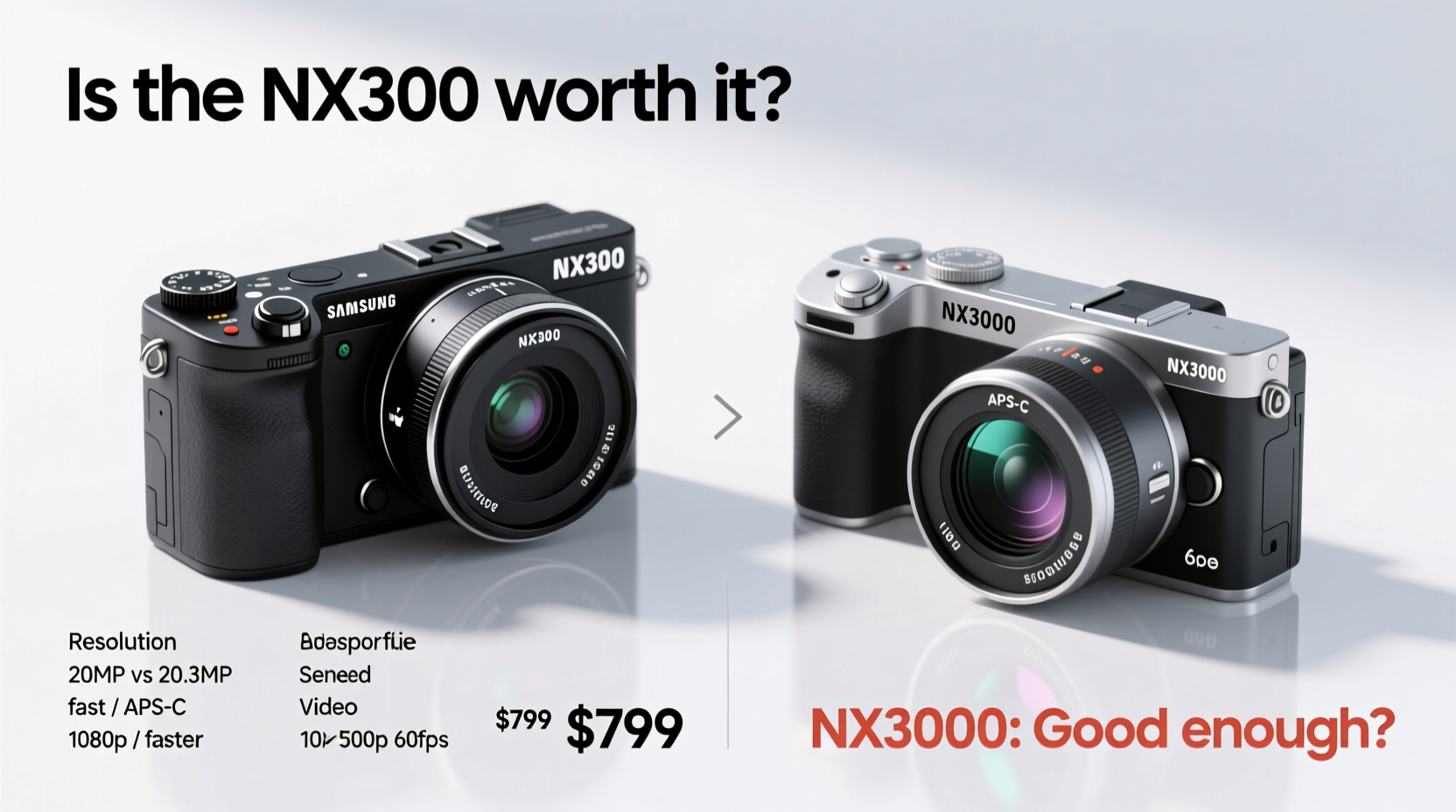
The physical distinction between the NX300 and NX3000 is immediately noticeable. The NX300 features a more refined body with a built-in electronic viewfinder (EVF), a tilting touchscreen LCD, and a mode dial on top. In contrast, the NX3000 eliminates the EVF entirely, uses a fixed rear screen, and replaces the mode dial with menu-based shooting modes accessed through the touchscreen.
These changes significantly reduce manufacturing costs, which translates into the NX3000’s lower price point. However, they also impact usability. The absence of an EVF means you must rely solely on the rear screen, which can be challenging in bright sunlight. The lack of a mode dial slows down manual adjustments, especially when switching between shooting scenarios quickly.
Image Quality: Nearly Identical Sensor, Slight Processing Differences
Both cameras use a 20.3-megapixel APS-C CMOS sensor without an optical low-pass filter, designed to maximize sharpness and detail. In real-world testing, the image quality between the two models is nearly indistinguishable under similar conditions. Dynamic range, color accuracy, and high ISO performance (up to ISO 25600) are virtually the same.
Where they differ slightly is in processing speed and buffer depth. The NX300 uses a newer DRIMe IV image processor compared to the NX3000’s DRIMe III. This allows faster continuous shooting—up to 8.6 fps on the NX300 versus 3.5 fps on the NX3000—and a deeper buffer when shooting in RAW format. For action or event photography, this can be a meaningful advantage.
“Even with the same sensor, processor architecture and buffer management can dramatically affect how usable a camera feels during rapid-fire shooting.” — David Lin, Imaging Technologist at PhotoGear Review
Autofocus and Performance: Speed vs Simplicity
The NX300 introduces phase-detection AF points across the sensor, enabling faster subject acquisition and improved tracking—especially useful for moving subjects. It also supports face detection and object tracking, making it more reliable in dynamic scenes.
The NX3000 relies solely on contrast-detection autofocus, which tends to hunt more in low light and slower to lock focus during video recording. While adequate for static portraits or landscapes, it struggles with fast-moving subjects or dim environments.
In everyday use, the NX300’s hybrid AF system provides a noticeably smoother experience. Whether capturing children playing or street scenes, the ability to track focus quickly adds confidence. The NX300 also includes customizable function buttons and a dedicated movie record button, enhancing operational efficiency.
Detailed Comparison Table
| Feature | Samsung NX300 | Samsung NX3000 |
|---|---|---|
| Release Year | 2012 | 2013 |
| Resolution | 20.3 MP | 20.3 MP |
| Image Processor | DRIMe IV | DRIMe III |
| Continuous Shooting | 8.6 fps | 3.5 fps |
| Autofocus System | Hybrid (Phase + Contrast) | Contrast Detection Only |
| Electronic Viewfinder | Yes (236k dots) | No |
| LCD Screen | 3.0\", Tilting, Touchscreen | 3.0\", Fixed, Touchscreen |
| Video Recording | 1080p at 30fps | 1080p at 30fps |
| Wi-Fi & NFC | Yes | Yes |
| Mode Dial | Yes | No (Menu-based modes) |
| Weight | 267g (body only) | 236g (body only) |
Real-World Use Case: Travel Photography
Consider Sarah, a travel blogger who shoots her own content. She started with the NX3000 for its lightweight design and Wi-Fi sharing capability. While she appreciated the image quality, she found herself missing shots due to slow autofocus and struggled to compose in direct sunlight without an EVF.
After upgrading to the NX300, her workflow improved significantly. The tilting screen helped capture unique angles—like overhead food shots or low-angle architecture—while the EVF made shooting in bright Mediterranean sun manageable. Faster burst shooting allowed her to capture fleeting moments at local festivals, and the mode dial let her switch from landscape to portrait mode mid-walk without fumbling through menus.
For someone like Sarah, whose content depends on spontaneity and visual quality, the NX300 justified its higher price through tangible improvements in responsiveness and usability.
Is the NX300 Worth the Extra Money?
The answer depends on your expectations and usage patterns. If you prioritize convenience, speed, and professional handling, the NX300 delivers significant advantages. Its EVF, faster processor, hybrid autofocus, and physical controls make it feel like a true step-up camera.
However, if you’re a casual shooter who primarily takes still photos in good light, shares images directly via Wi-Fi, and values portability over performance, the NX3000 remains a capable option. It produces excellent image quality, fits easily in a bag, and costs notably less—making it a strong choice for beginners or those on a tight budget.
Checklist: Choosing Between NX300 and NX3000
- ✅ Do you need an electronic viewfinder for outdoor shooting? → Choose NX300
- ✅ Will you shoot action, pets, or events requiring fast bursts? → Choose NX300
- ✅ Do you prefer physical dials and buttons over touch menus? → Choose NX300
- ✅ Are you mainly taking selfies, landscapes, or still life in daylight? → NX3000 may suffice
- ✅ Is budget a primary concern and portability critical? → NX3000 is lighter and cheaper
- ✅ Do you plan to use the camera long-term or grow into advanced photography? → NX300 offers room to grow
Frequently Asked Questions
Can I attach an external viewfinder to the NX3000?
Yes, Samsung offered the OVF-101 external optical viewfinder that attaches via the hot shoe. However, it's purely optical and doesn’t display exposure data or focus confirmation like the NX300’s built-in EVF.
Are lenses interchangeable between the NX300 and NX3000?
Absolutely. Both cameras use the Samsung NX mount, so all NX lenses are fully compatible with either body. This means you can pair either camera with primes like the 30mm F2 pancake or zooms like the 16–50mm power zoom lens.
Does the NX300 have better battery life?
Battery life is nearly identical—both use the BP1030 battery rated for about 400 shots per charge. However, using the EVF on the NX300 consumes slightly more power than using the LCD alone on the NX3000.
Final Verdict: Value Meets Capability
The Samsung NX300 is objectively the better camera. It offers superior handling, faster performance, and features that matter to serious enthusiasts. The NX3000, while impressive for its price, makes too many compromises in usability to serve as a long-term tool for growing photographers.
That said, “good enough” depends on your goals. If you want a simple, lightweight camera for social media and family memories, the NX3000 performs admirably. But if you aim to learn photography, shoot in varied conditions, or simply want a more responsive tool, the NX300 is worth the investment—even today, years after discontinuation.
Ultimately, the NX300 isn't just about specs—it's about experience. The difference in control, feedback, and reliability transforms how you interact with your camera. When choosing between them, ask not just what you’ll shoot, but how you want to shoot it.




 浙公网安备
33010002000092号
浙公网安备
33010002000092号 浙B2-20120091-4
Comments
No comments yet. Why don't you start the discussion?