
When choosing between enterprise-grade and consumer-focused SSDs, the decision often comes down to value versus longevity. The Samsung PM883 and the 860 Pro represent two different ends of Samsung’s SSD spectrum—one engineered for data centers, the other marketed toward power users and professionals. But for someone weighing real-world performance, endurance, and total cost of ownership, the question remains: Is the 860 Pro actually worth the premium over the PM883?
The answer isn’t as straightforward as raw specs suggest. While the 860 Pro carries a higher price tag and strong branding, the PM883—designed for 24/7 server environments—boasts superior reliability metrics that may make it the smarter long-term investment, even outside traditional enterprise settings.
Understanding the Core Differences
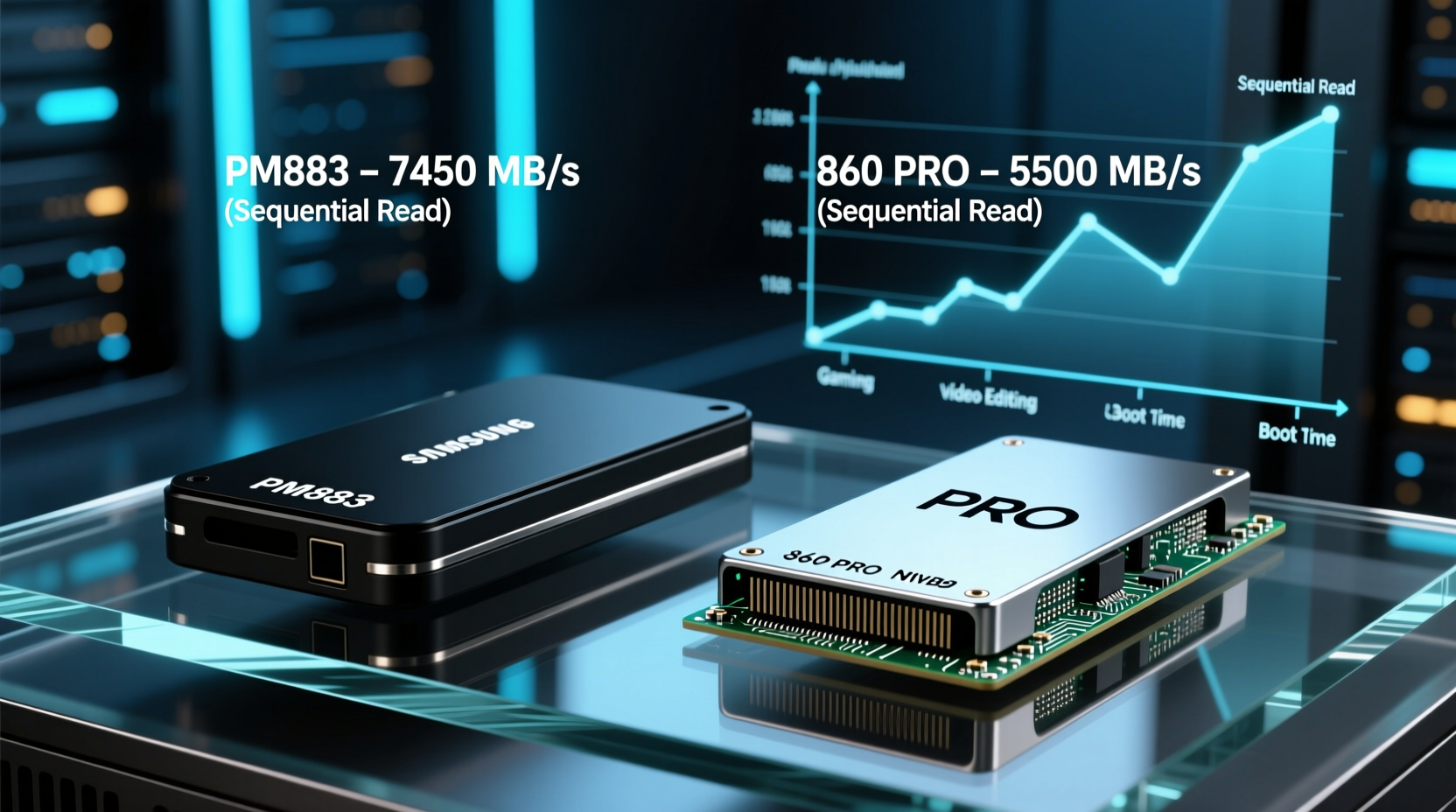
The Samsung PM883 is a SATA-based solid-state drive built specifically for enterprise workloads. It uses TLC NAND flash but is optimized for sustained write performance, high endurance, and consistent operation under constant load. In contrast, the 860 Pro is a client-grade SSD aimed at enthusiasts, creative professionals, and users upgrading high-end desktops or laptops.
Despite both drives using similar underlying technology (3D TLC NAND), their firmware, error correction, power-loss protection, and warranty structures differ significantly. These distinctions impact not only performance consistency but also long-term reliability in demanding scenarios.
Performance Comparison: Benchmarks vs Real Use
In synthetic benchmarks, the 860 Pro often pulls ahead with faster sequential read speeds (up to 560 MB/s) compared to the PM883’s slightly lower peak of around 540 MB/s. However, these numbers are rarely reflective of real-world behavior, especially once the drive is partially filled or subjected to mixed workloads.
The PM883 shines in sustained operations. Thanks to its enterprise-grade controller and enhanced SLC caching algorithms, it maintains stable performance during prolonged writes—critical for tasks like video rendering, database operations, or virtual machine hosting. The 860 Pro, while fast initially, can throttle significantly after exhausting its cache, particularly on larger file transfers.
For everyday computing—booting systems, launching applications, editing documents—the difference between the two is negligible. But under continuous load, such as running a small business server or handling large media files daily, the PM883 demonstrates more predictable throughput.
Endurance and Reliability: Where the PM883 Pulls Ahead
One of the most critical factors in SSD longevity is TBW (Terabytes Written). The PM883 leads decisively here. A 1TB PM883 is rated for up to 1,260 TBW over five years, whereas the 1TB 860 Pro offers 600 TBW over ten years. At first glance, the 860 Pro seems better due to its longer warranty, but this masks a crucial detail: workload intensity.
“Enterprise drives aren't just about higher endurance—they're designed to handle heavier daily write loads without degradation.” — Dr. Alan Kim, Storage Systems Engineer at NetRAID Labs
The PM883 supports a higher Drive Writes Per Day (DWPD) rating—up to 3 DWPD for the 1TB model—meaning it can endure writing 3TB per day for five years. The 860 Pro, by comparison, supports only 0.8 DWPD over ten years. This makes the PM883 far more resilient in environments with frequent data changes.
Detailed Feature Comparison
| Feature | Samsung PM883 | Samsung 860 Pro |
|---|---|---|
| Form Factor | 2.5” SATA III | 2.5” SATA III |
| NAND Type | 3D TLC (Enterprise-Optimized) | 3D TLC (Client-Grade) |
| Sequential Read | Up to 540 MB/s | Up to 560 MB/s |
| Sequential Write | Up to 520 MB/s (sustained) | Up to 530 MB/s (burst) |
| Random IOPS (Read/Write) | 98K / 30K | 98K / 90K |
| 1TB Endurance (TBW) | 1,260 TBW (5-year warranty) | 600 TBW (10-year warranty) |
| DWPD (1TB) | 3 DWPD | 0.8 DWPD |
| Power-Loss Protection | Yes (capacitor-backed) | No |
| Use Case Target | Data centers, servers, NAS | Enthusiasts, workstations |
Note the inclusion of power-loss protection in the PM883—a feature absent in the 860 Pro. This safeguard ensures data integrity during unexpected outages, making the PM883 ideal for unattended systems or critical storage roles.
Real-World Scenario: Small Business Media Studio
Consider a freelance video editor running a home studio on a high-end workstation. They regularly import 4K footage, edit timelines in Premiere Pro, render exports, and archive completed projects. Their workload involves hundreds of gigabytes of daily writes.
They initially choose the 860 Pro for its reputation and 10-year warranty. After 18 months of heavy use, they notice slower export times and occasional stutters during scrubbing—signs of drive wear and reduced over-provisioning. SMART data reveals the drive has already consumed nearly 40% of its TBW limit.
A colleague using the PM883 in a similar setup reports no performance drop after two years, despite writing over 1.1PB cumulatively. The PM883’s higher endurance and stable controller kept performance consistent. Though purchased at a slightly higher upfront cost, its longer viability in a write-heavy environment made it the more economical choice.
Cost Analysis Over Time
The 860 Pro typically retails at a premium due to its consumer branding and decade-long warranty. However, when calculating cost per terabyte written (CTTW), the PM883 often proves cheaper in high-write environments.
Using approximate pricing:
- PM883 1TB: $140, 1,260 TBW → ~$0.11 per TBW
- 860 Pro 1TB: $160, 600 TBW → ~$0.27 per TBW
In applications involving constant data modification—databases, logging, virtualization, or media production—the PM883 delivers nearly half the cost per TB written. For light users who primarily read data, the 860 Pro’s longevity warranty may still justify its price.
Who Should Choose Which Drive?
Choose the PM883 if you:
- Run a NAS or small server
- Work with databases or virtual machines
- Edit high-resolution video or audio regularly
- Need maximum data integrity and uptime
- Want lower long-term cost per TB written
Choose the 860 Pro if you:
- Upgrade a personal desktop or laptop
- Have moderate write activity (under 10GB/day)
- Value the 10-year warranty for peace of mind
- Prioritize brand familiarity and retail availability
Frequently Asked Questions
Can I use the PM883 in a regular PC?
Absolutely. The PM883 uses standard SATA interfaces and works in any 2.5” bay. Its firmware is optimized for servers, but it performs excellently in desktops, especially for users with demanding workflows.
Why does the 860 Pro have a longer warranty but lower endurance?
Consumer warranties are based on lighter usage assumptions. Samsung expects the 860 Pro to last 10 years under typical client workloads (e.g., office use, web browsing). Enterprise drives like the PM883 are rated for heavier daily use over a shorter period, hence the 5-year term with much higher endurance.
Is the lack of power-loss protection a big deal?
It depends. For a desktop user who shuts down properly, it’s minor. But for systems prone to outages, ungraceful reboots, or running background syncs (like a NAS), losing cached writes can corrupt files or damage filesystems. The PM883’s protection mitigates this risk.
Actionable Checklist Before Buying
- Evaluate your average daily write volume (check Task Manager or SMART tools)
- Determine whether your system experiences frequent power cycles
- Check compatibility with your motherboard or NAS (SATA III support)
- Compare cost per TBW, not just upfront price
- Consider future workload growth—will your needs increase in 2–3 years?
- Verify firmware update support and management tools (e.g., Samsung Magician vs. enterprise utilities)
Final Verdict: Is the 860 Pro Worth the Premium?
For most real-world professional uses involving sustained workloads, the answer is no—the 860 Pro is not worth the extra cost over the PM883. Despite its consumer-friendly branding and longer warranty label, it falls short in endurance, sustained performance, and data protection features critical to productivity.
The PM883, though less marketed to individuals, delivers superior engineering for those who push their storage hard. It’s quieter, cooler, and more reliable under pressure. Unless your primary concern is having a 10-year warranty sticker and you’re confident your write loads will remain low, the PM883 represents better value and performance stability.
Technology decisions shouldn’t be driven by marketing alone. When it comes to storage, what matters most is how well the drive handles your actual workload—not the logo on the label.




 浙公网安备
33010002000092号
浙公网安备
33010002000092号 浙B2-20120091-4
Comments
No comments yet. Why don't you start the discussion?