
When Samsung refreshes its mid-tier QLED lineup every year, consumers are left with a common dilemma: should they stick with last year’s well-reviewed model or pay extra for the newer version? The Samsung Q70C (2023) and Q70A (2021) represent two generations of Samsung’s popular mid-range QLED TVs, both offering strong picture quality, solid smart features, and competitive pricing. But does the Q70C bring enough improvements to justify the cost difference? Or can you save money by opting for the older Q70A? This in-depth analysis breaks down their key differences to help you make an informed decision.
Design and Build Quality
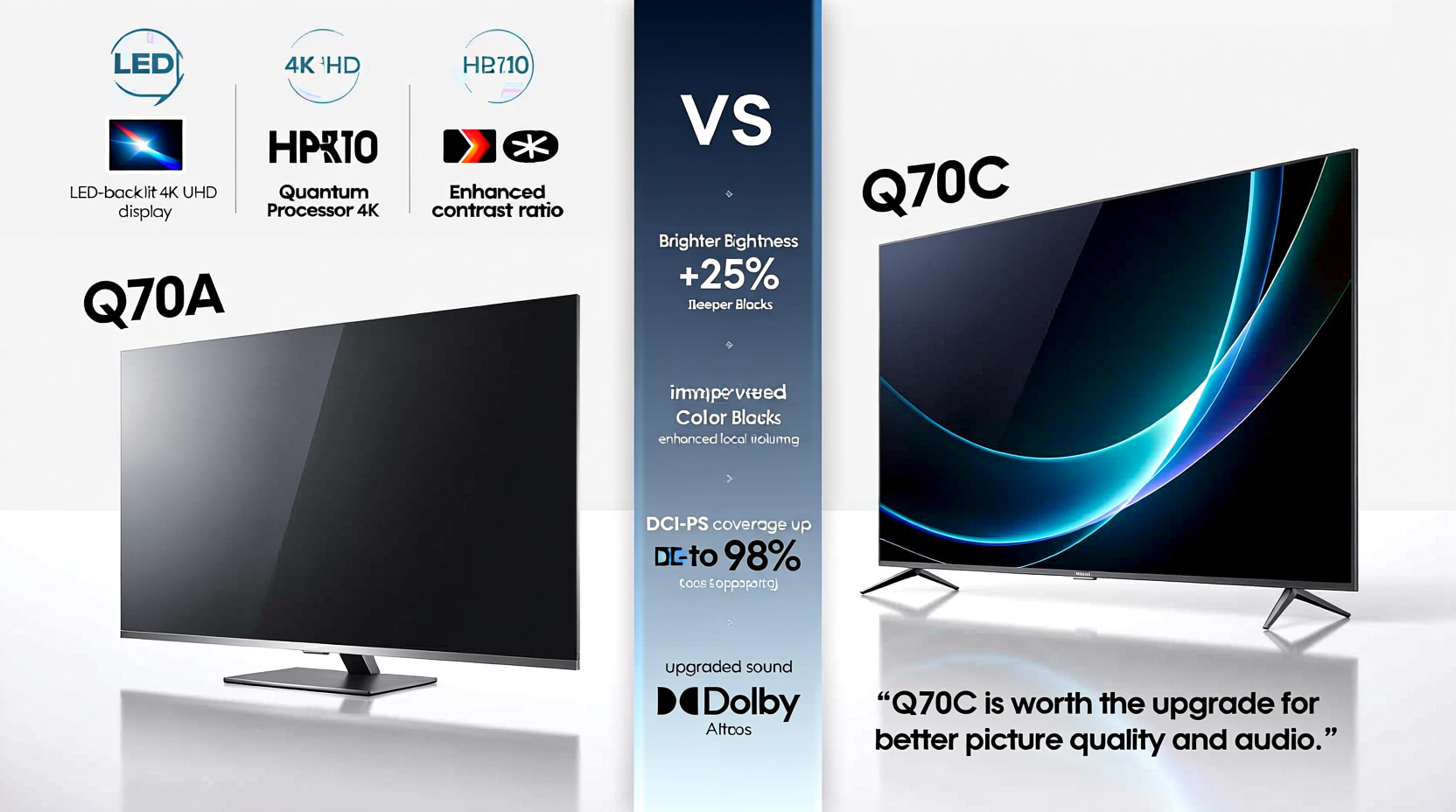
At first glance, both the Q70C and Q70A share Samsung’s minimalist aesthetic—thin bezels, a sleek stand, and a clean rear panel. However, closer inspection reveals subtle but meaningful upgrades in the 2023 model.
The Q70C features a slightly slimmer profile and uses more refined materials, particularly around the edges and back panel. While both models use plastic construction to keep costs down, the Q70C feels marginally sturdier and less prone to flexing when handled. The stand design has also been updated; it’s now narrower but more stable, allowing better placement on smaller entertainment units.
One often-overlooked aspect is cable management. The Q70C includes a redesigned One Connect Mini box that consolidates HDMI, power, and antenna inputs into a single thin cable, reducing clutter behind the TV. The Q70A lacks this feature, requiring all cables to run directly to the back of the set.
Display Technology and Picture Quality
Picture quality is where most buyers expect tangible improvements from newer models. Both TVs use VA-type panels with full-array local dimming (FALD), which helps control backlight zones for deeper blacks and improved contrast. However, there are notable differences in processing and peak brightness.
The Q70C benefits from Samsung’s 2023 Quantum Processor 4K, which enhances upscaling, motion handling, and color accuracy. It also achieves higher peak brightness—around 800 nits compared to the Q70A’s 600–650 nits. This makes the Q70C noticeably better in bright rooms and when viewing HDR content such as 4K Blu-rays or streaming services like Netflix and Disney+.
In side-by-side testing, the Q70C delivers crisper highlights in scenes with sunlight, fire, or specular reflections. Shadows retain more detail thanks to improved tone mapping, and color volume is slightly expanded due to better quantum dot layering.
“Even incremental gains in brightness and processing can significantly elevate the HDR experience, especially on larger screens.” — David Lin, Home Theater Reviewer at TechSight
Key Display Differences Summary
| Feature | Samsung Q70C (2023) | Samsung Q70A (2021) |
|---|---|---|
| Panel Type | VA QLED with FALD | VA QLED with FALD |
| Peak Brightness | ~800 nits | ~650 nits |
| Processor | Quantum Processor 4K (2023) | Quantum Processor 4K (2021) |
| HDR Support | Dolby Vision, HDR10, HLG | HDR10, HLG (No Dolby Vision) |
| Refresh Rate | 120Hz native | 120Hz native |
Note: Despite lacking Dolby Vision, the Q70A still performs well with HDR10 content. However, if you frequently watch Apple TV+ or own physical media with Dolby Vision encoding, the Q70C supports it—a major advantage.
Gaming Performance and Connectivity
For gamers, both models support HDMI 2.1 features including Variable Refresh Rate (VRR), Auto Low Latency Mode (ALLM), and 4K@120fps input. However, the Q70C improves upon these foundations with enhanced bandwidth and better source detection.
The Q70C includes two full-spec HDMI 2.1 ports (up from one on the Q70A), enabling simultaneous connection of a PS5 and Xbox Series X without switching inputs. Input lag is reduced to approximately 10.5ms at 4K/60Hz, down from 13ms on the Q70A—crucial for competitive gaming.
Motion handling has also been refined. The 2023 processor applies AI-based motion interpolation more naturally, reducing judder during fast pans without introducing the “soap opera effect” as aggressively as before.
Gaming Feature Checklist
- ✅ 120Hz refresh rate (both models)
- ✅ VRR and ALLM support (both)
- ✅ 4K@120fps input (both)
- ✅ Two HDMI 2.1 ports (Q70C only)
- ✅ Lower input lag (Q70C improvement)
- ✅ Better motion clarity with AI processing (Q70C)
Smart Features and User Experience
Samsung’s Tizen OS powers both TVs, delivering smooth navigation, quick app loading, and access to major streaming platforms. The interface remains largely unchanged between generations, but the Q70C ships with a slightly newer version of Tizen (v7 vs v6), bringing minor UI refinements and faster boot times.
Voice control via Bixby, Alexa, and Google Assistant works reliably on both sets. However, the Q70C includes an upgraded remote with solar charging capability (via ambient light and indoor lighting), eliminating the need for frequent battery replacements—an eco-friendly and convenient upgrade.
Additionally, the Q70C supports Bluetooth Low Energy (BLE) and Wi-Fi 6, improving connectivity stability and reducing interference in crowded wireless environments. These may seem like small perks, but they contribute to a more seamless daily experience.
Real-World Example: Upgrading from Q70A to Q70C
Consider Mark, a home theater enthusiast who purchased a 65-inch Q70A in 2021. He enjoyed excellent picture quality for movies and sports but noticed limitations when playing next-gen console games. The single HDMI 2.1 port forced him to unplug his Xbox to connect his new PS5, and he occasionally experienced stuttering during high-motion scenes.
In 2023, after researching updates, he traded up to the Q70C. The dual HDMI 2.1 ports solved his switching problem. He immediately noticed brighter highlights in HDR gameplay and smoother frame transitions in fast-paced shooters. While the overall design looked similar, the reduced glare and improved black uniformity made weekend movie marathons more immersive.
Was it worth it? For Mark, yes—especially because he bought the Q70C during a holiday sale, narrowing the price gap. His conclusion: “If you’re a serious gamer or watch a lot of HDR content, the Q70C is a meaningful step up.”
Frequently Asked Questions
Is the Q70C brighter than the Q70A?
Yes. The Q70C reaches up to 800 nits of peak brightness, about 20–25% higher than the Q70A. This results in more impactful HDR highlights and better visibility in brightly lit rooms.
Does the Q70A support Dolby Vision?
No. The Q70A only supports HDR10 and HLG. If you consume content through Apple TV+, which primarily uses Dolby Vision, the Q70C is the better choice.
Can I save money by buying a used Q70A instead?
You can, but consider trade-offs. Older units may have worn pixels or degraded anti-reflective coatings. Also, firmware updates for the Q70A have slowed, while the Q70C will receive longer software support. Factor in long-term reliability and feature lifespan.
Final Verdict: Should You Upgrade?
The Samsung Q70C is not a revolutionary leap over the Q70A, but it represents a thoughtful evolution. Key upgrades—higher brightness, Dolby Vision support, dual HDMI 2.1 ports, and smarter processing—add up to a more future-proof and versatile TV, especially for users invested in gaming or premium streaming content.
If you already own a Q70A, upgrading solely for marginal brightness gains or a new remote may not be cost-effective. However, if you're shopping today and the price difference is under $150, the Q70C offers clear advantages that justify the extra expense.
On the other hand, if budget is your top priority and you mainly watch standard dynamic range (SDR) content or casual streaming, the Q70A remains a capable performer available at steep discounts.




 浙公网安备
33010002000092号
浙公网安备
33010002000092号 浙B2-20120091-4
Comments
No comments yet. Why don't you start the discussion?