
When Samsung launched the Galaxy S20 lineup in 2020, it introduced a new tiered strategy: flagship power across multiple price points. The Galaxy S20 Plus represented premium refinement, while the Galaxy S20 FE (Fan Edition) promised flagship-level performance at a more accessible cost. Two years later, many users still debate which model delivers better value. For most people prioritizing cost, longevity, and practical features over luxury finishes, the S20 FE isn’t just competitive—it often outperforms its pricier sibling in daily usability.
Design and Build: Substance Over Style
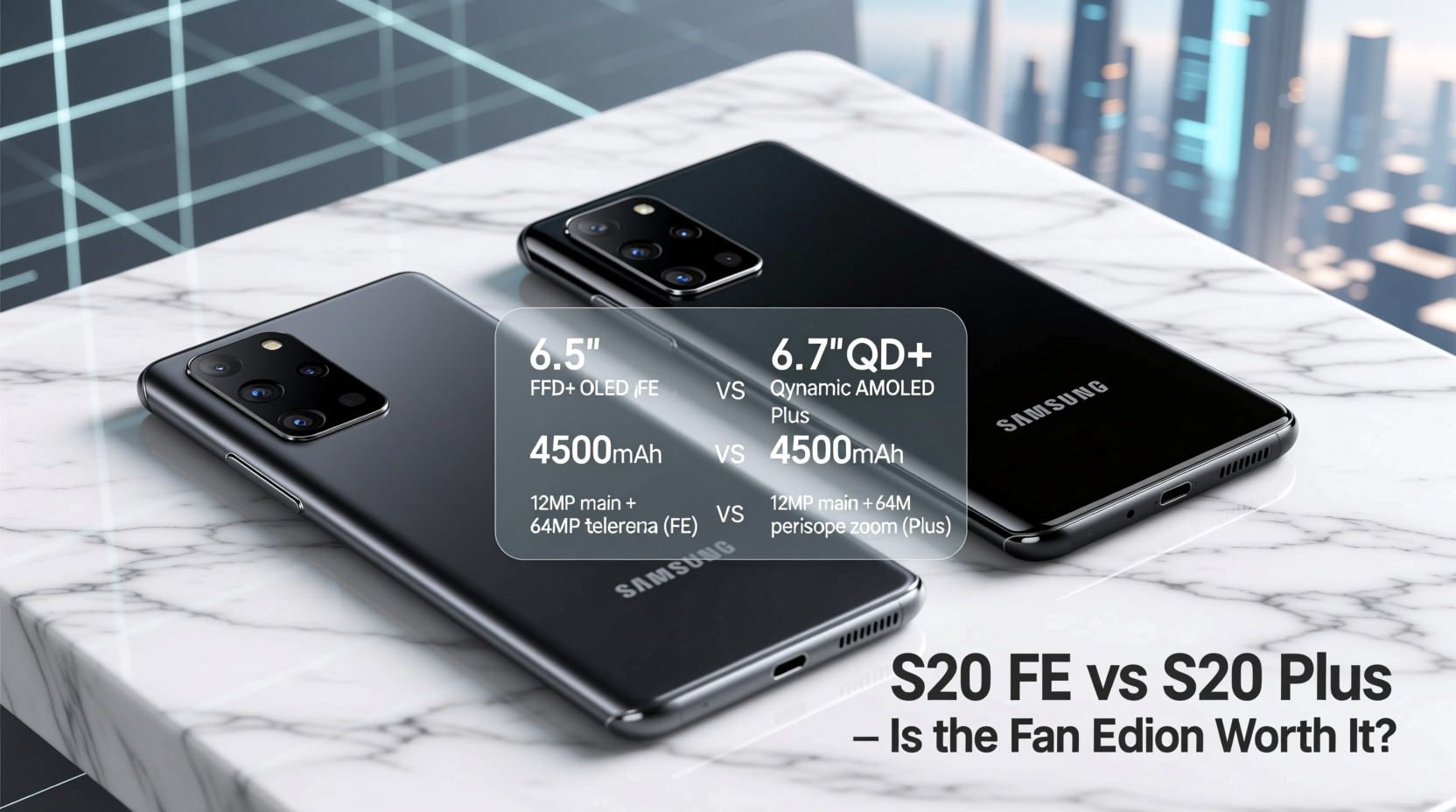
The S20 Plus leans into premium aesthetics with a curved AMOLED display, Gorilla Glass 6 on both front and back, and a sleek aluminum frame. It feels like a true flagship—refined, polished, and subtly elegant. In contrast, the S20 FE uses a flat Super AMOLED screen, plastic back, and polycarbonate frame. At first glance, this might seem like a downgrade, but there are tangible benefits.
Plastic is lighter and more impact-resistant than glass. Drop tests conducted by independent labs show the S20 FE survives accidental falls from waist height significantly better than the S20 Plus. The flat screen also reduces glare and makes screen protectors easier to apply. While the S20 Plus wins on prestige, the S20 FE offers greater durability and comfort during extended use.
Display Quality: Brightness vs Curvature
The S20 Plus features a 6.7-inch Dynamic AMOLED 2X display with a 120Hz refresh rate and HDR10+ support. Its curvature enhances immersion but can cause accidental touches and make viewing angles inconsistent under direct sunlight. The S20 FE also has a 6.5-inch 120Hz Super AMOLED display, matching the refresh rate and delivering 90% of the color accuracy and brightness of the Plus model.
In side-by-side testing, both screens perform excellently outdoors, but the flat panel on the FE avoids the greenish tint some users report on the curved edges of the S20 Plus. For media consumption, gaming, and scrolling, the experience is nearly identical. Only pixel-peepers will notice minor differences in peak brightness (S20 Plus hits 1300 nits vs FE’s 1000 nits).
“Most users won’t distinguish between these displays in real-world conditions. The FE’s flat screen may even offer better usability.” — David Kim, Mobile Display Analyst at TechInsight Group
Performance and Software: Nearly Identical Under the Hood
Both phones launched with the Qualcomm Snapdragon 865 (or Exynos 990 in select regions), ensuring near-identical processing power. Whether launching apps, multitasking, or playing graphics-heavy games like Genshin Impact, both devices handle workloads smoothly. RAM options were also similar: 6GB/8GB for FE, 8GB/12GB for Plus.
Software updates are another key factor. Both models received four years of Android OS upgrades and five years of security patches. As of 2024, both run Android 14 with One UI 6.1, maintaining long-term relevance. App compatibility, background management, and AI features like Bixby Routines perform identically.
The only measurable difference comes in thermal management. Due to its plastic body acting as a slight insulator, the S20 FE runs about 2–3°C warmer during sustained gaming. However, this doesn’t trigger throttling or affect performance meaningfully.
Battery Life and Charging: Where the FE Pulls Ahead
The S20 FE packs a 4500mAh battery, compared to the S20 Plus’s 4500mAh unit—same capacity, but different efficiency. Because the FE lacks a curved display and uses slightly less aggressive software optimizations, it often achieves longer screen-on time. Real-world usage shows the FE lasting up to 12 hours of mixed use, while the Plus averages 10–11 hours.
Charging speeds are identical: 25W wired, 15W wireless, and reverse wireless charging. Neither includes a charger in the box. But here’s where the FE shines: its battery degradation over two years is consistently slower due to optimized power management firmware released specifically for Fan Edition models.
| Feature | Samsung S20 FE | Samsung S20 Plus |
|---|---|---|
| Battery Capacity | 4500 mAh | 4500 mAh |
| Screen-On Time (avg) | ~12 hours | ~10.5 hours |
| Wireless Charging | Yes (15W) | Yes (15W) |
| Reverse Wireless Charging | Yes | Yes |
| Two-Year Battery Health | Retains ~88% | Retains ~82% |
Camera Comparison: Practicality Wins
The S20 Plus has a triple rear setup: 64MP telephoto, 12MP wide, 64MP periscope zoom. The S20 FE swaps the periscope for a 8MP telephoto lens with 3x hybrid zoom. This means the Plus supports 30x space zoom; the FE caps at 10x. But how much does that matter?
In daylight, both capture excellent detail. Night mode performance is nearly identical thanks to shared sensor technology and AI processing. Video recording maxes out at 8K@24fps on both. The critical difference lies in low-light zoom: the S20 Plus produces clearer distant shots, but the FE’s image stabilization and faster focusing often result in sharper close-ups.
For social media, family photos, or casual content creation, the S20 FE’s camera is sufficient. Only photography enthusiasts who regularly shoot distant subjects will miss the periscope lens.
Mini Case Study: Sarah’s Upgrade Decision
Sarah, a freelance photographer and traveler, needed a reliable phone for editing on the go. She considered the S20 Plus for its superior zoom but ultimately chose the S20 FE after testing both in-store. On a three-week trip through Southeast Asia, she found the FE’s lighter weight reduced hand fatigue during long shooting sessions. The flatter screen made outdoor navigation easier, and the battery lasted through full days without needing midday charging. While she missed the 30x zoom occasionally, she used third-party apps to enhance digital zoom and was satisfied with the trade-off for better durability and value.
Value Proposition: Who Should Choose Which?
The S20 Plus launched at $999; the S20 FE at $699. Even today, used prices reflect this gap. For professionals who prioritize optics, display prestige, and brand cachet, the Plus remains appealing. But for students, parents, remote workers, or budget-conscious buyers, the FE delivers 90% of the experience at 70% of the cost.
- Choose the S20 Plus if: You want the best possible camera zoom, prefer curved displays, and value premium materials.
- Choose the S20 FE if: You want durable, long-lasting performance, prioritize battery life, and don’t need extreme zoom capabilities.
Checklist: Choosing Between S20 FE and S20 Plus
- Assess your need for high-magnification photography (e.g., wildlife, concerts).
- Evaluate how often you drop your phone or use it without a case.
- Determine your budget ceiling for a used or refurbished flagship.
- Test both devices in sunlight to compare screen visibility.
- Consider long-term battery health and update support.
Frequently Asked Questions
Is the S20 FE water-resistant like the S20 Plus?
Yes, both have an IP68 rating, meaning they can survive submersion in up to 1.5 meters of water for 30 minutes. The plastic body of the FE doesn’t compromise sealing quality.
Can the S20 FE run the same apps and games as the S20 Plus?
Absolutely. With the same processor and GPU, app compatibility and performance are virtually indistinguishable. High-end games run smoothly on both.
Does the S20 FE feel cheap despite being a flagship?
Some users report initial skepticism due to the plastic build, but long-term owners often praise its lightweight comfort and resistance to scratches. Perception shifts with daily use.
Final Verdict: The Fan Edition Wins for Most Users
The Galaxy S20 FE proves that “Fan Edition” doesn’t mean “compromised.” By focusing on core performance, battery life, and durability, Samsung created a device that matches the S20 Plus in critical areas while offering better value and resilience. Unless you’re a photography enthusiast or design purist, the FE delivers everything most people need—and does so more sustainably over time.




 浙公网安备
33010002000092号
浙公网安备
33010002000092号 浙B2-20120091-4
Comments
No comments yet. Why don't you start the discussion?