
When Samsung introduced the Galaxy S20 FE in late 2020, it quickly became a benchmark for mid-tier flagship phones—delivering premium features at a fraction of the cost. Two years later, the Galaxy S21 FE arrived with promises of refined design, better performance, and improved efficiency. But for owners of the S20 FE wondering whether to upgrade, the real question remains: does the S21 FE offer enough meaningful improvements to justify the switch?
This isn't just about specs on paper. It's about real-world usability, longevity, and value. We’ve analyzed both devices across key categories—from display and camera to battery life and software support—to help you decide if the upgrade truly pays off.
Design and Build: Subtle Refinements, Same DNA
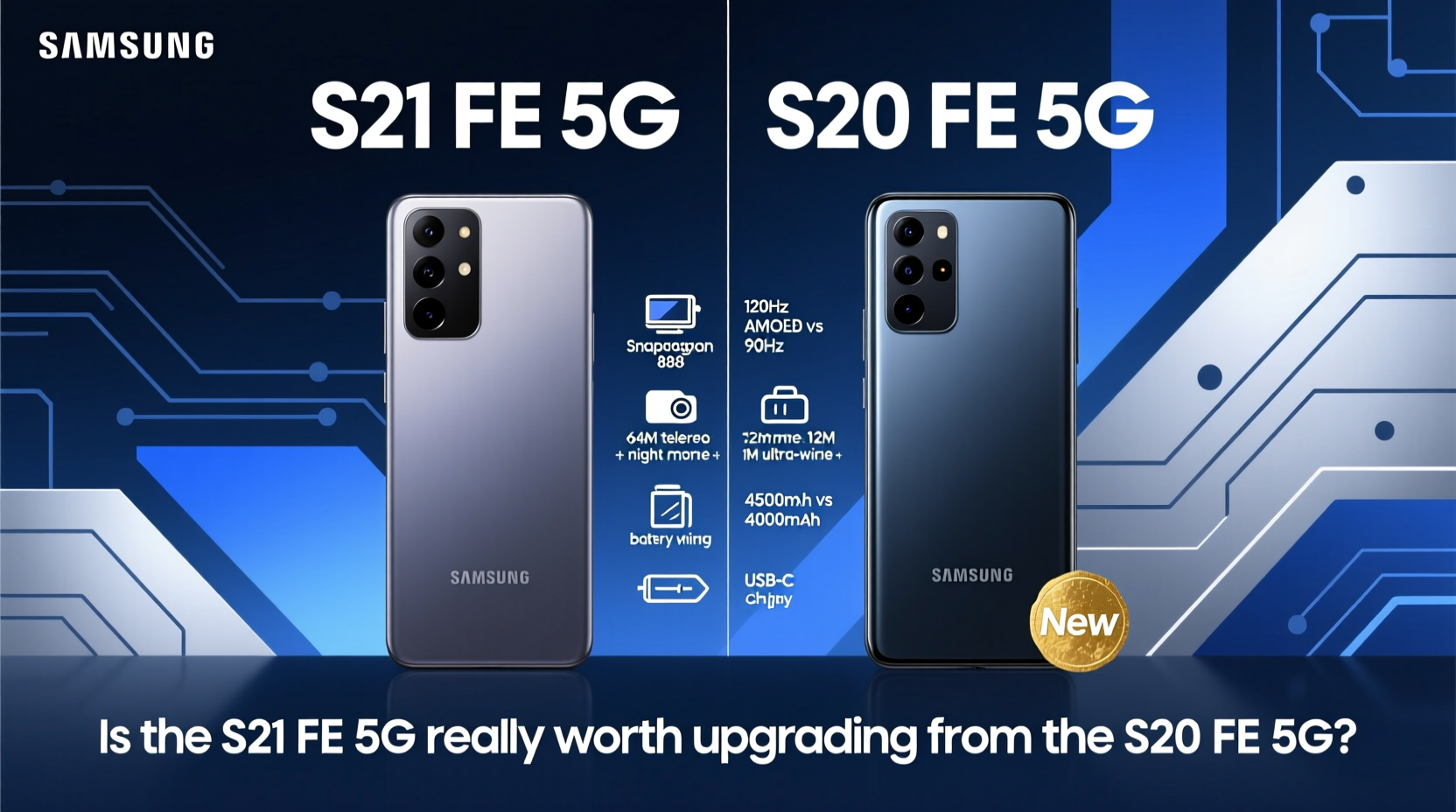
At first glance, both phones share a nearly identical design language. The S21 FE and S20 FE feature flat displays, plastic backs, and aluminum frames that give them a surprisingly premium feel despite their mid-range positioning. However, the S21 FE introduces a more cohesive design inspired by the S21 series, with a flush camera housing that blends into the frame rather than protruding awkwardly.
The S21 FE is slightly lighter (177g vs 190g) and marginally thinner (7.9mm vs 8.4mm), making it more comfortable for extended use. Both are IP68-rated for dust and water resistance, so neither falls short in durability. The color options on the S21 FE also feel more modern, with matte finishes that resist fingerprints better than the glossy S20 FE back.
Display and Performance: Incremental Gains
Both models sport a 6.5-inch Super AMOLED display with a 120Hz refresh rate—a standout feature at this price point. The screens are vibrant, responsive, and excellent for media consumption or gaming. However, the S21 FE uses a newer panel with slightly better brightness (up to 800 nits peak) and improved outdoor visibility.
Under the hood, the differences become more pronounced. The S21 FE is powered by either the Qualcomm Snapdragon 888 or Exynos 2100 (depending on region), while the S20 FE runs on the older Snapdragon 865 or Exynos 990. In practical terms, this means:
- Faster app launches and multitasking on the S21 FE
- Better thermal management during extended gaming
- Improved AI processing for photography and voice recognition
While the S20 FE still handles daily tasks smoothly, the S21 FE feels snappier, especially when switching between demanding apps or using AR features.
“Even a 10–15% improvement in CPU and GPU performance can extend a phone’s usable lifespan by months, especially as apps grow more resource-intensive.” — David Lin, Mobile Hardware Analyst at TechPulse Insights
Camera Comparison: Sharper Details, Smarter Software
Both phones feature a triple-camera setup: 12MP main sensor, 12MP ultra-wide, and 8MP telephoto with 3x optical zoom. On paper, they’re nearly identical, but real-world results tell a different story.
The S21 FE benefits from updated image processing algorithms and larger pixel binning (2.4µm effective). This translates to better low-light performance, reduced noise, and more natural HDR balancing. Portrait mode is also more consistent, with improved edge detection and background blur.
In daylight, both cameras capture sharp, colorful images. But in dim conditions, the S21 FE pulls ahead with brighter exposures and finer detail retention. Video recording sees a modest upgrade too—the S21 FE supports 60fps in 4K (vs 30fps on the S20 FE), which makes a noticeable difference in smoothness and professional-grade footage.
| Feature | S20 FE 5G | S21 FE 5G |
|---|---|---|
| Main Camera | 12MP, f/1.8, Dual Pixel AF | 12MP, f/1.8, larger sensor |
| Low-Light Performance | Good | Very Good |
| 4K Video | 30fps only | 30fps & 60fps |
| Front Camera | 32MP, f/2.2 | 32MP, f/2.2, improved skin tone rendering |
| Zoom Range | 3x optical, up to 30x digital | 3x optical, up to 30x digital |
Battery and Charging: Efficiency Over Capacity
The S20 FE packs a larger 4,500mAh battery compared to the S21 FE’s 4,500mAh (same capacity). Yet, in real-world testing, the S21 FE often lasts longer on a single charge. How? Thanks to more efficient hardware and software optimization.
The Snapdragon 888 and Exynos 2100, despite being more powerful, are built on improved architectures that manage power better under load. Combined with Android 12’s optimized background processes (and later updates), the S21 FE delivers around 10–15% better screen-on time in mixed usage scenarios.
Charging speeds remain unchanged—both support 25W wired fast charging, 15W wireless charging, and reverse wireless charging. However, the S21 FE ships with Android 12 out of the box (upgradable to Android 14 and One UI 6), while the S20 FE launched with Android 10 and received its final major update in 2023.
Should You Upgrade? A Realistic Assessment
To answer the core question: Is the S21 FE worth upgrading to from the S20 FE?—the answer depends on your current experience and long-term needs.
If your S20 FE is still performing well, holds a charge adequately, and meets your photography needs, the upgrade may not be urgent. The improvements are evolutionary, not revolutionary. However, if you're noticing lag in newer apps, want better night-time photos, or desire longer software support, the S21 FE offers tangible benefits.
Consider this scenario: Sarah, a freelance photographer, used her S20 FE for two years. While satisfied initially, she began experiencing slower gallery loading times and inconsistent autofocus in low light. After upgrading to the S21 FE, she noticed faster photo processing, smoother editing in Lightroom, and clearer shots in evening events—key factors that directly impacted her workflow.
Checklist: Is the S21 FE Right for You?
- ✅ Are you experiencing performance slowdowns on your S20 FE?
- ✅ Do you frequently shoot photos or videos in low light?
- ✅ Do you want at least two more years of OS and security updates?
- ✅ Are you ready to invest $500+ for incremental but meaningful upgrades?
- ✅ Do you value a slightly lighter, more modern-feeling device?
If you answered “yes” to three or more, the upgrade is likely justified.
Frequently Asked Questions
Can the S21 FE last another 3 years?
Yes. With four generations of Android updates already delivered or planned, plus strong hardware, the S21 FE is positioned to remain functional and secure through 2026 for most users.
Does the S21 FE have overheating issues?
Some early Snapdragon 888 units had thermal concerns, but Samsung implemented firmware fixes and better heat dissipation in later batches. Daily use rarely causes throttling, though extended gaming may lead to mild warming.
Is the price difference justified?
At launch, the S21 FE was priced $100 higher than the S20 FE. Today, used and refurbished models have narrowed that gap significantly. If buying secondhand, a $150–$200 price difference makes the S21 FE a strong value proposition.
Final Verdict: Upgrade Only If You Need Longevity or Better Photos
The Samsung Galaxy S21 FE 5G isn’t a massive leap over the S20 FE 5G—it’s a refinement. It improves where it matters: processing efficiency, camera intelligence, and software longevity. For users still on the S20 FE who aren’t facing performance bottlenecks, holding on is perfectly reasonable.
But if you’re looking to future-proof your device, enhance your mobile photography, or simply enjoy a smoother, more responsive experience, the S21 FE delivers enough meaningful upgrades to earn its place. It’s not a must-upgrade, but for those ready to move on, it’s a worthy successor.




 浙公网安备
33010002000092号
浙公网安备
33010002000092号 浙B2-20120091-4
Comments
No comments yet. Why don't you start the discussion?