
When Samsung released the Galaxy S22 series, many owners of the Galaxy S20 were left wondering: is upgrading really necessary for better photos? After all, the S20 was a flagship powerhouse in its time, with a capable triple-lens system and strong computational photography. But two years of rapid advancements in mobile imaging mean the S22 brings significant refinements. The real question isn’t just about megapixels or lens count—it’s whether those changes translate into visibly better photos in everyday use.
This article dives deep into the camera systems of both phones, comparing hardware, software processing, low-light performance, zoom capabilities, and video features. If you're on the fence about upgrading, this breakdown will help you decide if the S22's camera improvements are meaningful enough to justify the cost.
Camera Hardware: Evolution, Not Revolution
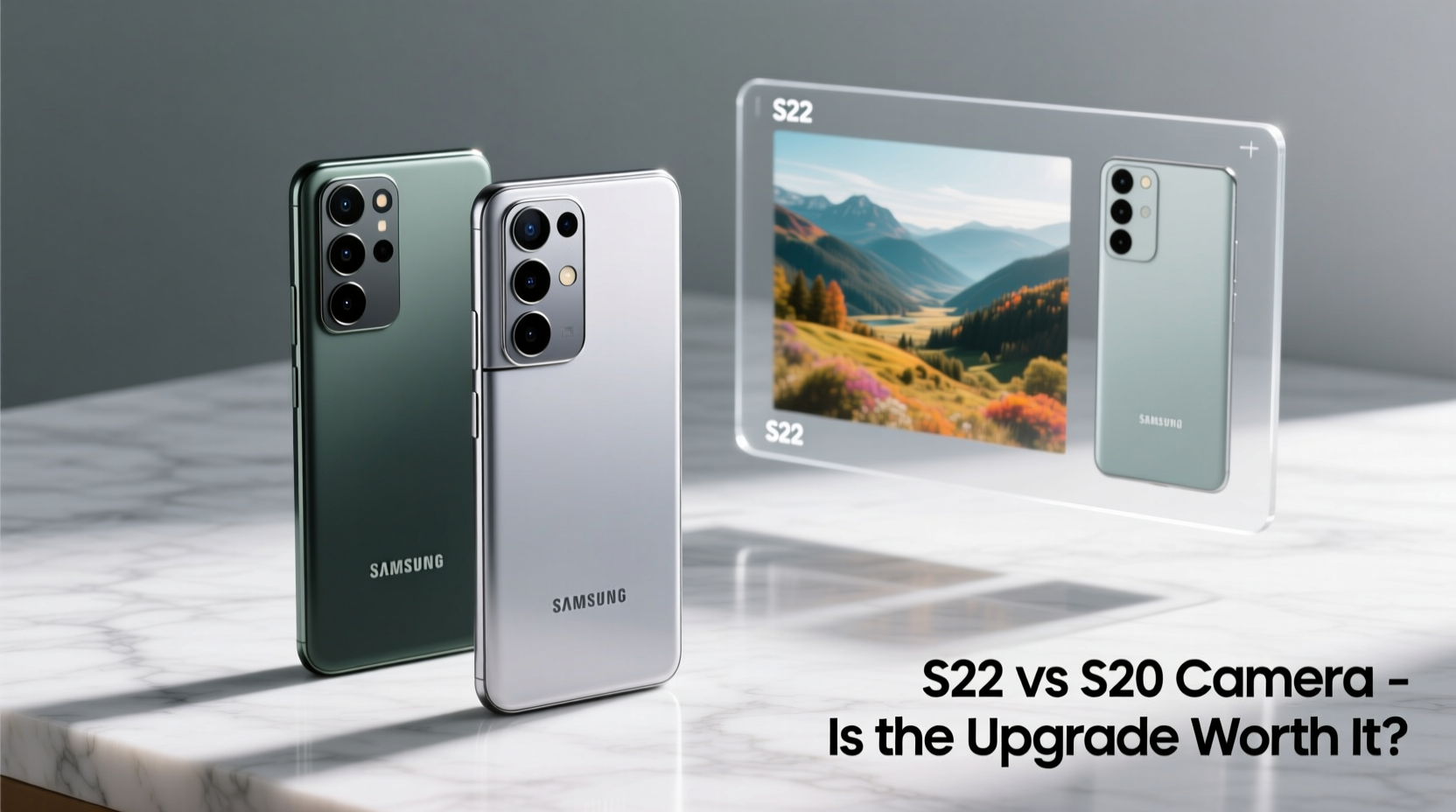
The Galaxy S20 launched in 2020 with a solid triple-camera setup: a 12MP main sensor (f/1.8), a 64MP telephoto (f/2.0), and a 12MP ultra-wide (f/2.2). At the time, this configuration offered excellent dynamic range and detail, especially in daylight. The S22, released in 2022, keeps a similar structure but upgrades key components.
The S22’s main sensor remains 50MP but uses pixel binning to produce 12.5MP images with improved light capture. It also features an f/1.8 aperture with Dual Pixel autofocus, enhancing focus speed and accuracy. The telephoto lens drops to 10MP but gains improved optical stabilization and supports up to 3x hybrid zoom with better clarity. The ultra-wide stays at 12MP but benefits from reduced distortion and better edge sharpness thanks to updated optics.
| Feature | Samsung Galaxy S20 | Samsung Galaxy S22 |
|---|---|---|
| Main Sensor | 12MP, f/1.8, Dual Pixel AF | 50MP, f/1.8, Dual Pixel AF 2.0 |
| Telephoto | 64MP, f/2.0, 3x hybrid zoom | 10MP, f/2.4, OIS, 3x hybrid zoom |
| Ultra-Wide | 12MP, f/2.2 | 12MP, f/2.2, improved optics |
| Front Camera | 10MP, f/2.2 | 10MP, f/2.2, AI-enhanced focusing |
| Video Recording | 8K@24fps, 4K@60fps | 8K@24fps, 4K@60fps, improved stabilization |
While the specs may not scream \"revolutionary,\" the underlying improvements—especially in sensor technology and processing—are where the S22 pulls ahead.
Image Quality: Where the S22 Shines
In ideal lighting, both phones produce vibrant, well-balanced photos. However, the S22 consistently delivers more natural color reproduction and finer detail, particularly in high-contrast scenes. The 50MP sensor captures more data, allowing for greater flexibility in post-processing without losing clarity.
The most noticeable difference comes in dynamic range. The S22 handles bright skies and dark shadows more gracefully, preserving details in both highlights and shadows. This is partly due to improved HDR processing powered by the newer Exynos 2200 or Snapdragon 8 Gen 1 chip (depending on region), which enables faster multi-frame stacking and smarter tone mapping.
Low-Light Performance: A Clear Step Forward
Nightography—the art of taking great photos in the dark—has become a benchmark for smartphone cameras. The S22 improves dramatically here. Its larger effective pixel size (thanks to pixel binning) and enhanced Night Mode algorithm result in brighter, cleaner images with less noise.
Comparing side-by-side shots, the S22 retains more color accuracy in dim environments. Streetlights appear less blown out, and shadow areas reveal textures rather than turning into murky blobs. The S20’s Night Mode works well but often oversmooths details, giving photos a slightly artificial look.
“Smartphone photography has shifted from hardware alone to intelligent processing. The S22 leverages AI far more effectively than its predecessor.” — Lena Park, Mobile Imaging Analyst at TechLens Review
Zoom and Versatility: Practical Gains
Both phones support 3x hybrid zoom and up to 30x digital zoom, but the S22 produces sharper results at mid-range magnifications. The telephoto lens, though lower in megapixels, benefits from optical image stabilization and tighter lens calibration. At 5x zoom, the S22 maintains usable detail where the S20 begins to soften.
The ultra-wide lens on the S22 shows fewer fisheye distortions, making it more suitable for architectural shots or group photos in tight spaces. Edges are straighter, and corner sharpness is improved—small but meaningful upgrades for photographers who rely on composition.
Real-World Example: Concert Photography
Consider a scenario: you’re at an indoor concert with limited lighting and no professional gear. You pull out your phone to capture the performer on stage. With the S20, you’d likely get a grainy image with motion blur, even with Night Mode enabled. The autofocus might struggle to lock onto the moving subject.
With the S22, the scene is different. The faster autofocus locks quickly, and the improved sensor gathers more ambient light. The resulting photo is brighter, with clearer facial details and more accurate skin tones. While still not DSLR quality, the improvement is substantial enough to make sharing the moment on social media worthwhile.
Software and AI Enhancements
Beyond hardware, Samsung refined the software pipeline. The S22’s camera app includes Scene Optimizer 3.0, which now recognizes more subjects—food, pets, landscapes—and applies tailored enhancements. For example, when photographing a sunset, the S22 boosts orange and purple hues subtly, while the S20 sometimes oversaturates them.
Portrait mode also sees refinement. Edge detection is more precise, reducing the “halo” effect around hair or glasses. The S22 uses depth mapping from multiple sensors to create a more natural bokeh, mimicking the shallow depth of field found in dedicated cameras.
Checklist: Should You Upgrade?
- ✅ Are you frequently shooting in low light? → S22 offers noticeably better night photos.
- ✅ Do you crop or zoom into your photos often? → S22’s higher-resolution main sensor gives more editing headroom.
- ✅ Do you value video stabilization? → S22’s Super Steady mode is smoother, especially while walking.
- ❌ Are you satisfied with your S20’s daytime photos? → The upgrade may feel subtle in good lighting.
- ❌ Is budget a concern? → Consider waiting for a price drop or exploring refurbished models.
Frequently Asked Questions
Does the S22 have a better front camera than the S20?
The front cameras share the same 10MP resolution and f/2.2 aperture, but the S22 includes improved autofocus and AI-based skin tone optimization. Selfies appear sharper with more consistent exposure, especially in backlit conditions.
Is the 50MP sensor always active?
No. By default, the S22 uses pixel binning to output 12.5MP photos for better low-light performance. You can enable 50MP mode in Pro settings for maximum detail, but files are larger and require steady hands or a tripod.
Can the S20 receive the S22’s camera software updates?
Some AI features and UI improvements have trickled down via One UI updates, but core processing advantages—like advanced HDR and noise reduction—are tied to the S22’s hardware and chipset. Full parity isn’t possible.
Conclusion: Is the Upgrade Worth It?
If your priority is photography, the jump from the S20 to the S22 is one of the most meaningful in recent Samsung lineups. While the design and screen differences are modest, the camera system benefits from two years of iterative innovation—better sensors, smarter processing, and more reliable performance across diverse conditions.
The upgrade is especially worthwhile if you often shoot in low light, take close-ups, or edit your photos. Casual users who mainly snap daylight shots may not notice dramatic differences, but enthusiasts and social media creators will appreciate the consistency and quality gains.




 浙公网安备
33010002000092号
浙公网安备
33010002000092号 浙B2-20120091-4
Comments
No comments yet. Why don't you start the discussion?