
Choosing between the Samsung Galaxy S23 Ultra and the iPhone 14 Pro Max isn't just about brand loyalty—it's a decision rooted in daily usability, long-term value, and personal priorities. Both devices represent the pinnacle of their respective ecosystems in 2023, offering top-tier hardware, advanced cameras, and seamless software experiences. But for users considering an upgrade, especially from older models or switching platforms, the real question remains: is the jump truly worth it?
This comparison dives deep into design, display, performance, camera capabilities, battery life, and ecosystem integration—helping you determine which flagship aligns best with your lifestyle and whether spending over $1,000 on either device delivers tangible returns.
Design and Build: Premium Feel, Different Philosophies
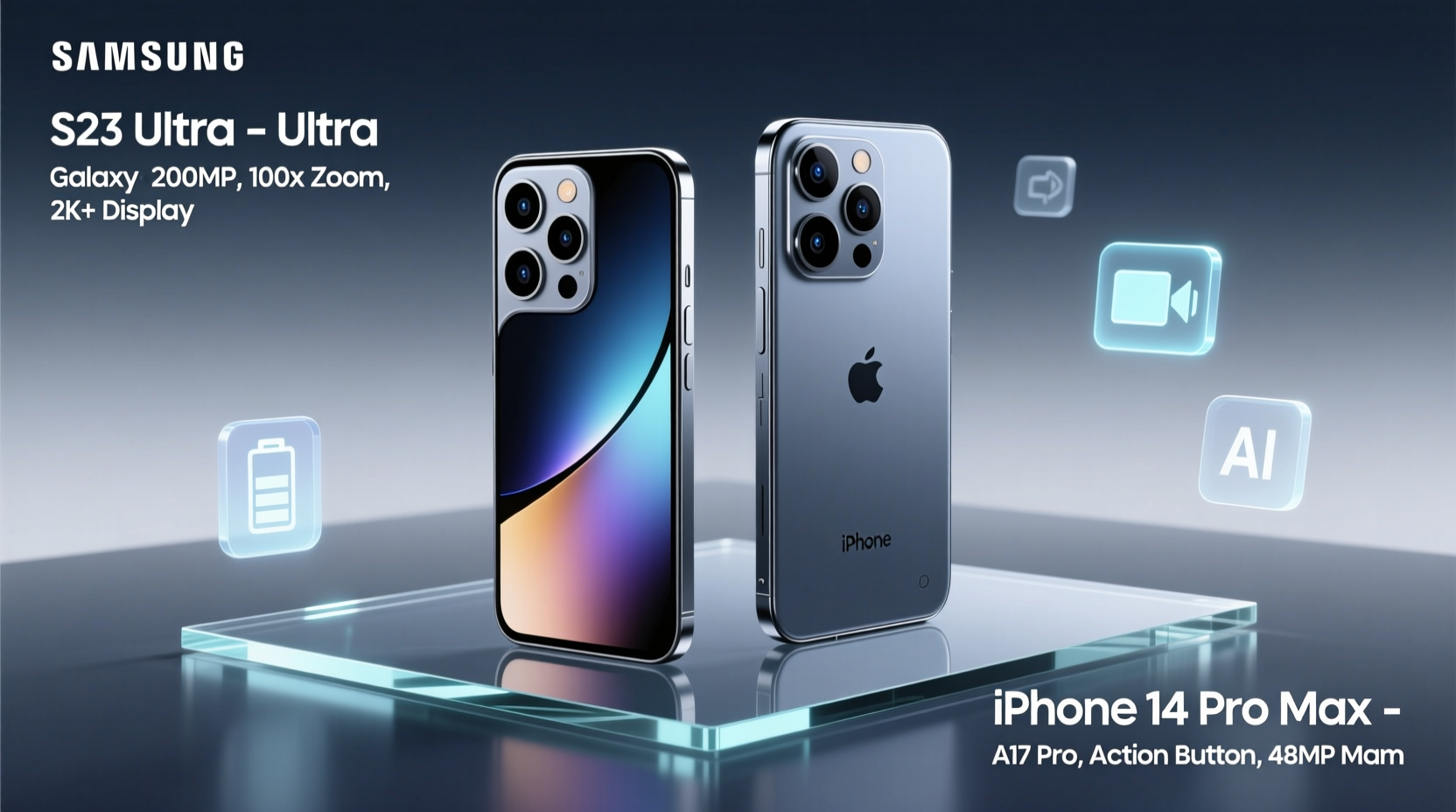
The S23 Ultra and iPhone 14 Pro Max both use premium materials—Gorilla Glass Victus 2 on the front and back, with aluminum frames (S23 Ultra) and surgical-grade stainless steel (iPhone). The difference lies in aesthetic language and ergonomics.
Samsung opts for a boxier, more functional look, integrating the S Pen—a feature absent on iPhones. This adds utility for note-takers, artists, and multitaskers but increases thickness slightly. At 234 grams, the S23 Ultra feels substantial, bordering on heavy for prolonged one-handed use.
In contrast, the iPhone 14 Pro Max maintains Apple’s minimalist elegance with rounded edges and a slightly better weight distribution at 240 grams. Despite being marginally heavier, its curved sides make it feel more compact in hand. The Dynamic Island—a replacement for the notch—adds interactive functionality, allowing live activity tracking without sacrificing screen space.
Display Quality: Brightness, Refresh Rate, and Usability
Both phones feature 6.7–6.8-inch OLED displays with adaptive refresh rates up to 120Hz, ensuring smooth scrolling and responsive touch input. However, key differences affect real-world viewing.
The S23 Ultra boasts a 3088 x 1440 resolution, offering sharper text and finer detail, especially noticeable when viewing high-resolution photos or editing documents. Its peak brightness reaches an industry-leading 1750 nits, making outdoor visibility exceptional even under direct sunlight.
The iPhone 14 Pro Max, while slightly lower in resolution (2796 x 1290), uses Apple’s ProMotion technology and introduces Always-On Display—a first for iPhones. It hits 2000 nits peak brightness in HDR mode, giving it a slight advantage in extreme lighting conditions. Colors are calibrated for accuracy, favored by creatives relying on color consistency.
“Display quality isn’t just about specs—it’s about how consistently the screen performs across environments. Both excel, but Samsung leans toward customization, while Apple focuses on out-of-the-box reliability.” — David Lin, Mobile Display Analyst at TechInsight Group
Performance and Software: Android Flexibility vs iOS Optimization
Under the hood, both devices are powerhouses. The S23 Ultra uses Qualcomm’s Snapdragon 8 Gen 2 (exclusive to Samsung in this generation), delivering unmatched processing speed and efficiency for Android flagships. The iPhone 14 Pro Max runs on Apple’s A16 Bionic chip—built on a 4nm process, optimized specifically for iOS workloads.
Benchmarks show the A16 excels in single-core tasks, crucial for app launch speed and UI responsiveness. Meanwhile, the Snapdragon 8 Gen 2 pulls ahead in multi-core performance and GPU-intensive applications like gaming and 4K video editing.
Software experience diverges significantly. One UI 5.1 (on S23 Ultra) offers deep customization: split-screen multitasking, DeX desktop mode, private share folders, and extensive automation via Bixby Routines. However, this flexibility can overwhelm some users.
iOS 16, running on the iPhone, prioritizes simplicity, security, and ecosystem cohesion. Updates arrive faster and are supported longer—Apple guarantees five years of OS updates compared to Samsung’s four. This longevity makes the iPhone a smarter long-term investment for users who keep phones beyond two years.
Real-World Example: Switching Platforms
Take Mark, a longtime iPhone user upgrading from an iPhone XS. He switched to the S23 Ultra for its camera zoom and S Pen. Initially excited, he struggled with inconsistent app behavior, delayed updates, and file management quirks. After three months, he returned to the iPhone 14 Pro Max, citing “fewer headaches” and smoother iMessage integration with his family.
Conversely, Lena, a Samsung Note series loyalist, briefly tested the iPhone 14 Pro Max. While impressed by camera quality and battery optimization, she missed the S Pen and multitasking features essential for her freelance design work. She reverted to the S23 Ultra, calling it “the only phone that fits my workflow.”
Camera Comparison: Zoom, Video, and Computational Photography
Both phones deliver outstanding photography, but their strengths cater to different needs.
| Feature | Samsung S23 Ultra | iPhone 14 Pro Max |
|---|---|---|
| Main Sensor | 200MP (f/1.7) | 48MP (f/1.78) |
| Telephoto Lenses | 3x & 10x optical zoom, 100x digital | 3x optical zoom, 15x digital |
| Ultra-Wide | 12MP (f/2.2) | 12MP (f/2.2) |
| Video Recording | 8K@30fps, HDR10+ | 4K@60fps Dolby Vision, Cinematic Mode |
| Low-Light Performance | Excellent (large sensor) | Outstanding (computational tuning) |
The S23 Ultra dominates in zoom photography. Its periscope lens enables true 10x optical magnification—ideal for concerts, wildlife, or distant subjects. The 200MP mode captures immense detail, though most shots default to 12MP via pixel binning for balanced results.
The iPhone 14 Pro Max doesn’t match the zoom range but produces more natural color grading and superior dynamic range. Its computational photography enhances skin tones and background separation in portraits. For videographers, Dolby Vision HDR recording across all cameras provides unmatched post-production flexibility—an edge no Android phone currently matches.
Battery Life and Charging: Endurance vs Ecosystem Efficiency
The S23 Ultra packs a 5000mAh battery, consistently lasting 1.5 to 2 days with moderate use. Fast charging reaches 50% in 30 minutes (with a 45W charger sold separately), and it supports wireless and reverse wireless charging.
The iPhone 14 Pro Max, despite a smaller 4323mAh battery, achieves nearly identical endurance due to aggressive power management and the efficiency of the A16 chip. It supports 20W fast charging and MagSafe, enabling convenient magnetic accessories—but still lacks USB-C, remaining on Lightning.
Is the Upgrade Worth It? A Practical Checklist
Before investing in either device, consider the following checklist to assess if the upgrade benefits you meaningfully:
- Are you on a phone older than 3 years? If yes, any flagship will feel dramatically faster.
- Do you need telephoto zoom beyond 5x? Choose S23 Ultra.
- Do you record or edit video regularly? iPhone’s Dolby Vision gives professional-grade output.
- Do you use non-Apple devices (Windows, Android tablets)? Samsung integrates better across mixed ecosystems.
- Do you value long-term software support? iPhone wins with 5+ years of guaranteed updates.
- Do you want a stylus for notes or drawing? Only S23 Ultra includes one natively.
Frequently Asked Questions
Can I expect better battery life on either phone compared to older models?
Yes. Both offer significant improvements over predecessors. The S23 Ultra improves upon the S22 Ultra with better thermal management, while the iPhone 14 Pro Max gains 2–3 hours over the iPhone 13 Pro Max thanks to the A16’s efficiency.
Is switching from iPhone to Android (or vice versa) difficult?
Data transfer tools like Google’s “Switch to Android” and Apple’s “Move to iOS” simplify the process. However, ecosystem lock-in—iMessage, FaceTime, iCloud, Samsung DeX, Knox—can create friction. Evaluate your app dependencies before switching.
Which phone holds resale value better?
Historically, iPhones retain value longer. After 12 months, iPhone 14 Pro Max holds ~65% of its value versus ~55% for the S23 Ultra, according to market data from Gazelle and Swappa.
Final Verdict: Who Should Upgrade?
The upgrade is worth it—if your current device limits your needs. For photographers needing extreme zoom, creators valuing multitasking, or Android enthusiasts wanting the full S Pen experience, the S23 Ultra justifies its price. For those embedded in Apple’s ecosystem, prioritizing video quality, software longevity, and seamless device integration, the iPhone 14 Pro Max remains unmatched.
Neither phone is objectively “better.” The decision hinges on workflow, preferences, and future plans. If you're satisfied with your current device, waiting for the S24 Ultra or iPhone 15 Pro Max could yield more meaningful innovations—especially with rumored titanium builds, next-gen chips, and improved AI features on the horizon.




 浙公网安备
33010002000092号
浙公网安备
33010002000092号 浙B2-20120091-4
Comments
No comments yet. Why don't you start the discussion?