
Choosing between the Samsung Galaxy S23 and the Galaxy Z Flip 5 isn’t just about specs—it’s about lifestyle, priorities, and how you use your phone every day. The S23 represents the peak of traditional flagship design: powerful, reliable, and polished. The Z Flip 5, on the other hand, is a bold statement in compact innovation, folding into a pocket-sized device with a dynamic cover screen. But does the Flip’s form factor justify stepping away from the raw performance and camera excellence of the S23? Let’s break it down.
Design and Portability: Foldable Flexibility vs Flagship Solidity
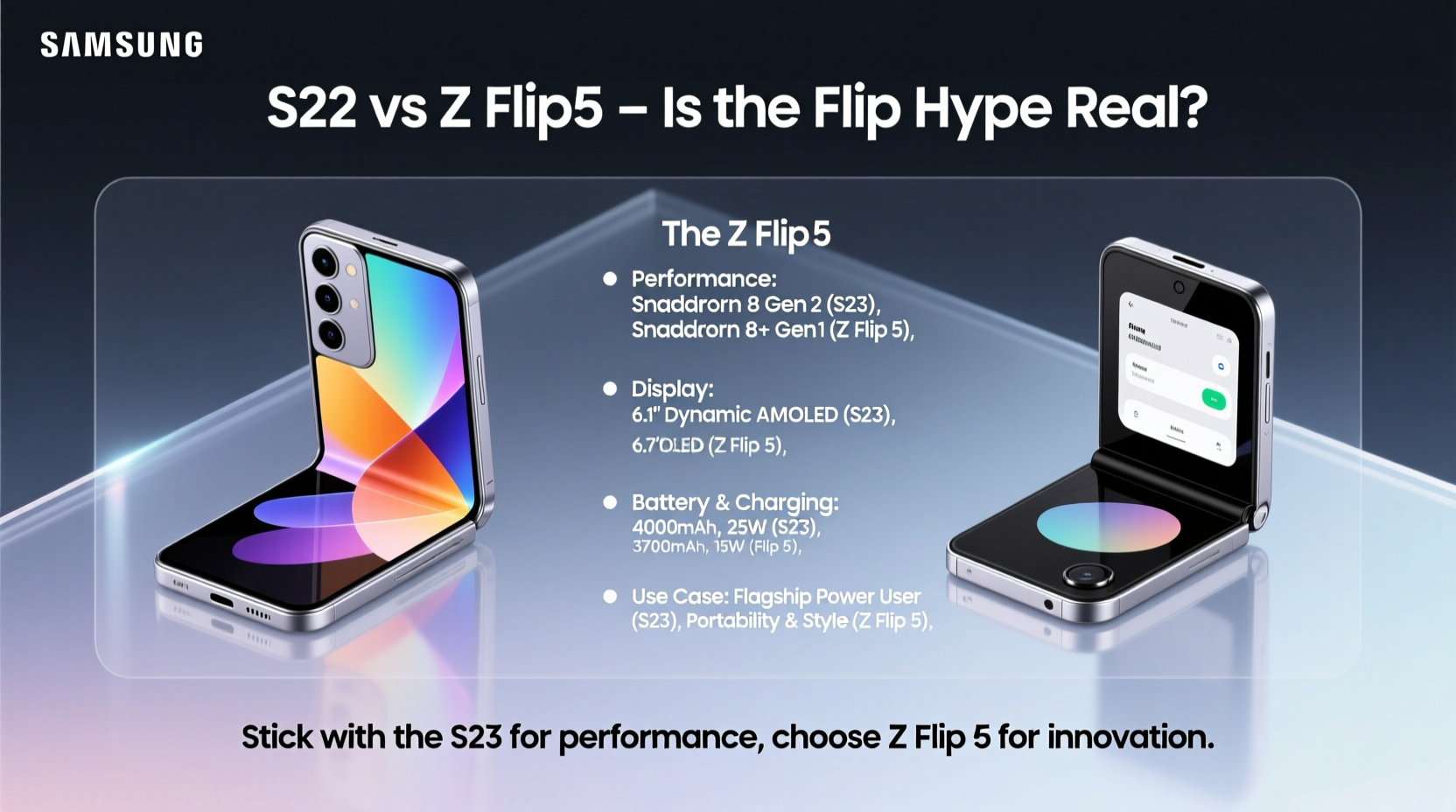
The most immediate difference lies in design philosophy. The S23 follows a familiar high-end smartphone blueprint: a sleek glass-and-metal slab with a 6.1-inch flat display. It fits comfortably in one hand, though not quite pocket-friendly for tighter jeans. At 168g, it’s light for a flagship but still demands attention when carried.
The Z Flip 5 reimagines portability. When folded, it’s barely larger than a credit card, measuring just over 3 inches tall. This makes it ideal for purses, small pockets, or minimalist carry. Unfolded, it reveals a 6.7-inch main display with a noticeable crease down the middle—a trade-off for its flexibility. The hinge mechanism has improved dramatically since earlier foldables, now rated for up to 200,000 folds (about five years of daily use).
Performance and Daily Use: Power vs Practicality
Under the hood, both devices use the Qualcomm Snapdragon 8 Gen 2 for Galaxy, ensuring top-tier performance. Apps launch instantly, multitasking is smooth, and gaming is flawless on both. However, thermal management differs due to form factor. The S23’s larger chassis allows better heat dissipation during extended use—ideal for marathon gaming or video editing.
The Z Flip 5, while equally fast, can warm up quicker under heavy load. Its smaller battery (3,700mAh) also means shorter endurance compared to the S23’s 3,900mAh unit. In real-world testing, the S23 consistently delivers a full day plus some; the Flip 5 often requires a midday charge with moderate to heavy usage.
But where the Flip 5 shines is in usability innovations. The cover screen now spans the entire outer lid, allowing full app interactions—replying to messages, checking weather, or controlling music without opening the phone. This “Flex Mode” feature turns the phone into a mini stand for hands-free video calls or selfies using the rear cameras.
“The Z Flip 5 proves that foldables aren’t just novelties—they’re evolving into practical tools with unique workflows.” — David Kim, Mobile Tech Analyst at TechInsight Asia
Camera Comparison: Consistency vs Creativity
The S23 continues Samsung’s tradition of excellent camera tuning. Its triple-lens system (50MP main, 12MP ultrawide, 10MP telephoto) captures vibrant, detailed photos with natural color science. Low-light performance is outstanding, and the 3x optical zoom adds versatility. Video recording supports 8K at 30fps with excellent stabilization.
The Z Flip 5 uses a dual-camera setup (12MP main, 10MP ultrawide), omitting the telephoto lens. While image quality is strong in daylight, low-light shots lack the depth and clarity of the S23. However, the Flip offers creative advantages: hands-free shooting via Flex Mode, automatic framing during video calls, and seamless switching between front and rear cameras during selfie videos.
If photography is a priority—especially travel, portrait, or zoom-heavy use—the S23 remains the superior choice. But if you value fun, social-first features and spontaneous content creation, the Flip 5’s flexibility enhances the experience.
Durability and Longevity: Can Foldables Keep Up?
Foldable phones still face skepticism around long-term reliability. The S23, with its Gorilla Glass Victus 2 and IP68 rating, is built to withstand drops, scratches, and submersion in water. Most users can expect 3–4 years of daily use without major issues.
The Z Flip 5 improves on past weaknesses with an enhanced hinge seal and slightly better dust resistance, but it lacks an official IP rating. The inner display remains vulnerable to punctures—using a case is non-negotiable. While Samsung offers a 1-year limited warranty covering hinge and display defects, long-term repair costs are significantly higher than for conventional phones.
Battery longevity is another concern. Smaller batteries degrade faster, and foldable replacements cost upwards of $200. In contrast, the S23’s modular design makes battery swaps more accessible and affordable.
Feature Comparison Table
| Samsung Galaxy S23 | Samsung Z Flip 5 | |
|---|---|---|
| Display | 6.1” FHD+ Dynamic AMOLED 2X | 6.7” Foldable AMOLED + 3.4” Cover Screen |
| Chipset | Snapdragon 8 Gen 2 (for Galaxy) | Snapdragon 8 Gen 2 (for Galaxy) |
| Battery | 3,900mAh | 3,700mAh |
| Cameras | 50MP (main), 12MP (ultrawide), 10MP (telephoto) | 12MP (main), 10MP (ultrawide) |
| Water Resistance | IP68 | None (dust-resistant hinge) |
| Fold Endurance | N/A | 200,000 folds (~5 years) |
| Starting Price | $799 | $999 |
Who Should Choose Which Phone?
Deciding between these two comes down to personal needs. Consider the following checklist to guide your decision:
Choose the Samsung S23 if you:
- Prioritize camera quality and zoom capabilities
- Want longer battery life and consistent all-day performance
- Prefer a durable, water-resistant build
- Value proven reliability over experimental design
- Are budget-conscious (starts $200 cheaper)
Choose the Z Flip 5 if you:
- Love compact, stylish designs that stand out
- Want innovative features like Flex Mode and large cover screen
- Use your phone for social media, selfies, and quick content sharing
- Carry small bags or prefer minimal pocket bulk
- Are early adopters excited by new tech trends
Real-World Scenario: Maya’s Decision
Maya, a 29-year-old marketing consultant, was torn between the S23 and Z Flip 5. She travels weekly, values photo quality for client content, and hates charging her phone twice a day. Initially drawn to the Flip 5’s aesthetics, she tested both in-store. After trying to type emails on the folded half-screen and noticing the battery drained faster during her commute, she chose the S23. “The Flip was fun,” she said, “but I need something that works harder, not just looks cooler.”
Conversely, her colleague Jen, a lifestyle influencer, bought the Flip 5. She uses Flex Mode for TikTok videos, loves the instant selfie setup, and appreciates how easily it slips into her clutch. “It’s not the most powerful phone,” she admits, “but it helps me create content faster—and that’s worth the trade-offs.”
FAQ
Can the Z Flip 5 replace a traditional flagship?
For many users, yes—but with caveats. If your usage leans toward social media, messaging, and casual photography, the Flip 5 is capable. However, power users needing all-day battery, advanced cameras, or ruggedness may find it limiting.
Is the S23 too small in 2024?
Not necessarily. While many flagships now exceed 6.7 inches, the S23’s 6.1-inch display offers one-handed comfort and precision. It’s a deliberate choice for those overwhelmed by oversized phones.
Do foldable screens last?
Modern foldables like the Z Flip 5 are far more durable than early models. With proper care—using a case, avoiding debris, and not forcing the hinge—they can last 3+ years. But they’re still more fragile than traditional phones.
Final Verdict: Hype or Worth It?
The Z Flip 5 isn’t just hype—it’s a glimpse into the future of mobile design. It introduces meaningful innovations that change how we interact with our phones. But it’s not for everyone. The S23 remains a near-perfect flagship: balanced, powerful, and dependable.
If you value function over form, the S23 is the smarter buy. If you want a fashion-forward device that enables new ways to capture and share moments, the Z Flip 5 delivers a unique experience worth the premium.




 浙公网安备
33010002000092号
浙公网安备
33010002000092号 浙B2-20120091-4
Comments
No comments yet. Why don't you start the discussion?