
When it comes to budget-friendly Android tablets, Samsung’s Tab A series has long been a go-to for casual users, students, and families. With the release of the Samsung Galaxy Tab S3 (a rebranded version of the Tab S9 FE in some regions), many owners of older Tab A models are asking: is the upgrade truly worthwhile? On paper, the newer device promises better performance, improved display, and modern features. But real-world value depends on how you use your tablet. This in-depth analysis compares the two devices across key categories to help you decide if the jump makes sense.
Design and Build Quality
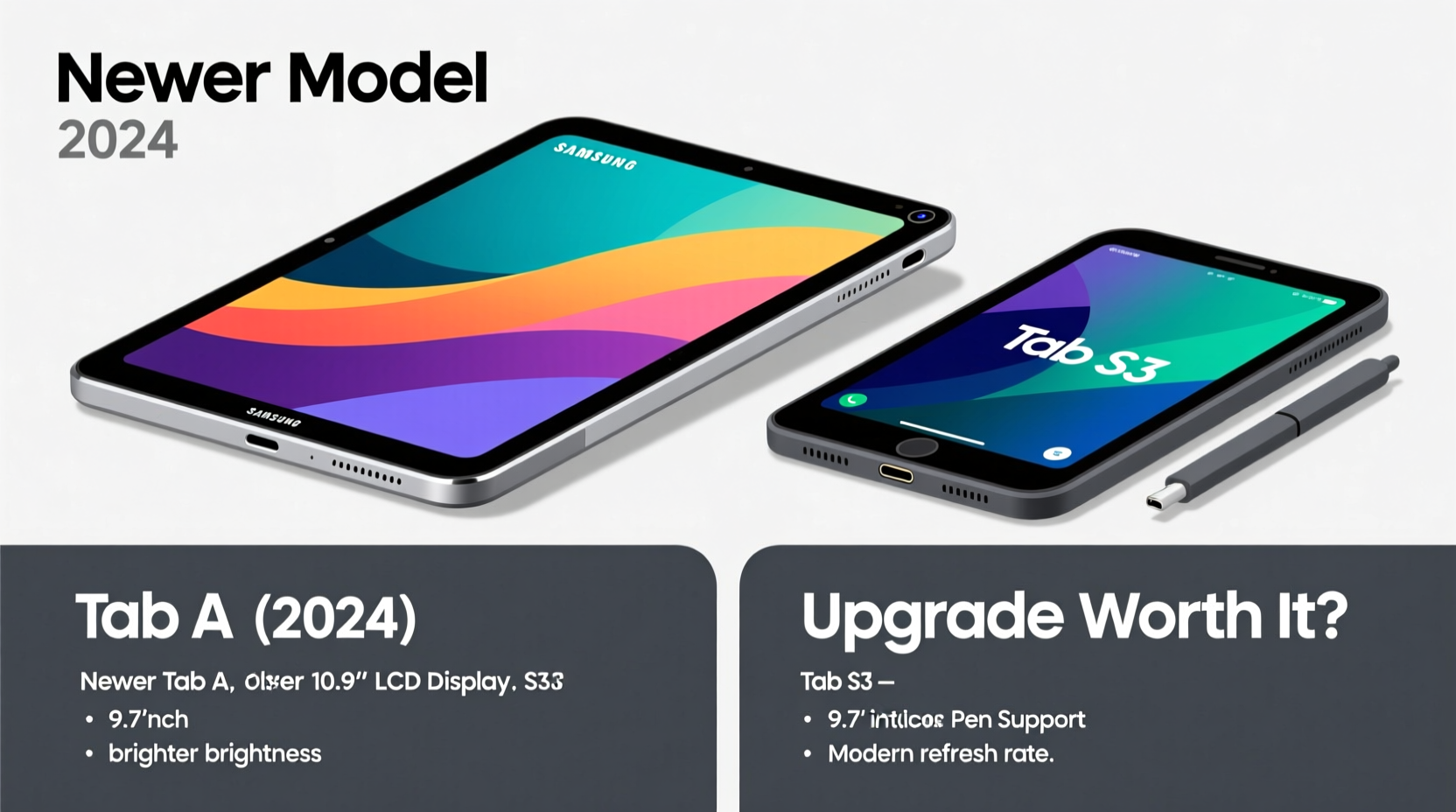
The physical experience of using a tablet starts with its design. The Samsung Tab A — particularly the 10.4-inch 2020 and 2022 models — delivers a solid, functional build with a plastic chassis and symmetrical bezels. It's lightweight at around 470g and comfortable for extended reading or media sessions. However, the design feels utilitarian, lacking premium touches.
In contrast, the Galaxy Tab S3 (SM-X200) steps up with a sleeker aluminum unibody that not only looks more refined but also improves heat dissipation and durability. At 496g, it’s slightly heavier, but the trade-off is a more balanced feel in hand. The bezels are slimmer, especially on the long edges, giving it a more modern aesthetic. While both tablets support the S Pen, only the S3 includes it in the box — a significant advantage for note-takers and artists.
Display and Visual Experience
One of the most noticeable differences lies in the display. The Tab A 10.4 uses a 2000x1200 resolution TFT LCD panel with a 60Hz refresh rate. Colors are decent, brightness is adequate indoors, but viewing angles and contrast fall short when compared to higher-end screens.
The Tab S3, however, features a 10.4-inch 2000x1200 LCD with enhanced brightness, better color accuracy, and support for HDR10 playback. More importantly, it offers smoother scrolling and responsiveness due to software optimizations and superior panel quality. For streaming video, digital art, or multitasking with split-screen apps, the visual upgrade is immediately apparent.
| Feature | Samsung Tab A (10.4) | Samsung Tab S3 |
|---|---|---|
| Display Type | TFT LCD | IPS LCD (enhanced) |
| Resolution | 2000 x 1200 | 2000 x 1200 |
| Brightness (typical) | ~400 nits | ~500 nits |
| HDR Support | No | Yes (HDR10) |
| Refresh Rate | 60Hz | 60Hz |
While resolution is identical, the S3’s screen benefits from better calibration, higher peak brightness, and improved outdoor visibility. For anyone consuming media daily, this is a meaningful step up.
Performance and Software Experience
Under the hood, the difference becomes even starker. The Tab A typically runs on entry-level processors like the Unisoc T618 or older MediaTek chips, paired with 3GB or 4GB of RAM. This setup handles basic tasks — web browsing, YouTube, light gaming — without major hiccups, but multitasking can lead to app reloads and sluggish transitions.
The Tab S3, powered by the Exynos 1380 (or Snapdragon 7 Gen 1 in some variants), brings mid-tier performance with 6GB or 8GB RAM options. Apps launch faster, background processes stay active longer, and demanding applications like Adobe Illustrator Draw or Microsoft Office run more fluidly. It also supports smoother DeX mode functionality, allowing desktop-like productivity when connected to a monitor.
“Upgrading from a Tab A to a Tab S3 feels like moving from dial-up to broadband — not just faster, but fundamentally more capable.” — Raj Mehta, Mobile Tech Analyst at GadgetInsight
Software updates are another critical factor. The Tab A line usually receives two generations of Android upgrades. The Tab S3, positioned as part of Samsung’s “FE” (Fan Edition) premium-access line, qualifies for four years of OS updates and five years of security patches. That means longer-term reliability and access to new features like AI-powered tools, enhanced multitasking, and improved privacy controls.
Real-World Usage: Who Benefits Most?
To illustrate the practical impact, consider Maria, a college student using her Tab A 10.4 for lecture notes, PDF readings, and online research. She often experiences delays when switching between apps, struggles with dim screen visibility in sunny classrooms, and finds her stylus laggy and sold separately. After upgrading to the Tab S3, she notices immediate improvements: notes sync instantly via Samsung Notes, videos stream clearly even in bright conditions, and DeX mode lets her organize research papers side-by-side like a laptop.
For users like Maria — those relying on their tablet for education, creativity, or hybrid work — the upgrade pays off quickly. But for someone who only watches Netflix on the couch or checks email occasionally, the Tab A remains perfectly sufficient.
Camera and Connectivity
Both tablets feature similar camera setups: an 8MP rear and 5MP front-facing camera. In practice, neither excels in low light, but the Tab S3 processes images faster and supports better stabilization during video calls. With remote learning and hybrid meetings still common, this small edge enhances Zoom or Google Meet experiences.
Connectivity is where the S3 pulls ahead. It supports Wi-Fi 6 (vs. Wi-Fi 5 on Tab A), offering faster downloads and better performance in crowded networks. Bluetooth 5.2 ensures more stable connections to headphones and accessories. Additionally, the S3 includes quad speakers tuned by AKG, delivering richer audio — a subtle but appreciated upgrade for audiobooks or music lovers.
Step-by-Step: Should You Upgrade?
Follow this decision framework to determine if the Tab S3 is right for you:
- Evaluate your current usage: Are you frequently frustrated by slow app launches or screen glare?
- Assess your needs: Do you take notes, edit documents, or attend video calls regularly?
- Check compatibility: Will your existing keyboard case or S Pen work with the new model?
- Compare pricing: Is the S3 priced within $100–$150 of your used Tab A’s resale value?
- Project longevity: Plan to keep the device for 3+ years? The S3’s update policy makes it a safer long-term investment.
Frequently Asked Questions
Can the Tab S3 replace a laptop?
For light productivity — writing, spreadsheets, presentations, and web research — yes, especially with a keyboard cover and DeX mode. It won’t handle heavy software like video editing suites, but it bridges the gap between tablet and PC better than the Tab A ever could.
Is the battery life significantly better?
Both tablets have 7,040mAh batteries and last about 10–12 hours under normal use. However, the S3’s more efficient processor and adaptive brightness mean slightly better endurance in mixed scenarios, especially when streaming HD content.
Do I need to buy additional accessories?
The Tab S3 includes the S Pen. A keyboard is sold separately but opens up full DeX functionality. If you already own Samsung ecosystem accessories, check compatibility — many magnetic keyboards work across models.
Final Verdict: Is the Upgrade Worth It?
The answer depends on your expectations. If you're satisfied with basic functions and don't mind occasional lag, the Tab A continues to offer solid value. But if you want a tablet that feels responsive, lasts longer with updates, and supports creative or professional workflows, the Galaxy Tab S3 is absolutely worth the upgrade.
It’s not just about newer specs — it’s about a more cohesive, future-ready experience. From the included S Pen to enhanced software support and superior display, the S3 transforms the tablet from a passive consumption device into an active tool for creation and productivity.




 浙公网安备
33010002000092号
浙公网安备
33010002000092号 浙B2-20120091-4
Comments
No comments yet. Why don't you start the discussion?