
When Samsung released the Galaxy Tab A8 as the successor to the widely used Tab A7, many users were left wondering: is this a meaningful upgrade or just a minor refresh? Both tablets sit in the budget-friendly segment, targeting casual users, students, and families. But subtle differences in design, performance, and software support can have a big impact on daily use. Understanding these distinctions helps determine whether investing in the newer model pays off—or if holding onto your A7 (or opting for it secondhand) makes more financial and functional sense.
Design and Build: Subtle Refinements
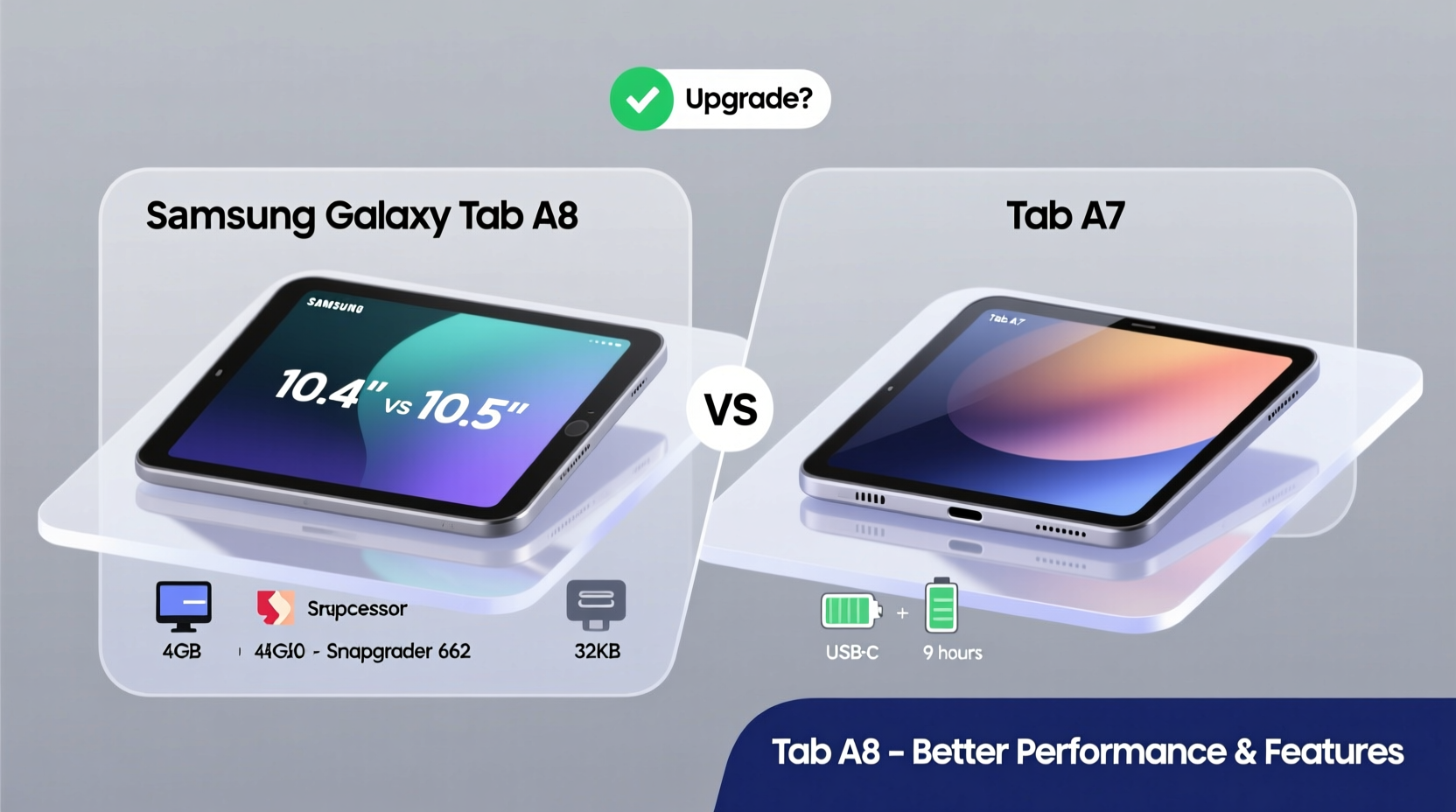
The physical differences between the Tab A8 and A7 are minimal but noticeable upon close inspection. Both tablets feature an 8.7-inch display (10.5” on the A8), aluminum unibody construction, and slim bezels. However, the A8 introduces a slightly more refined aesthetic with symmetrical bezels and a centered front camera—making video calls more natural and improving the overall symmetry of the device.
The Tab A7 has an off-center front-facing camera located on the long edge when held in landscape, which can be awkward during Zoom or Google Meet sessions. The A8 corrects this by centering the camera on the short edge, aligning better with how most people hold tablets during video chats.
Both devices are lightweight—around 500–510 grams—and comfortable for extended reading or media consumption. Neither includes IP ratings for water resistance, so care around moisture remains essential.
Display and Audio Comparison
The Tab A8 features a 10.5-inch WUXGA (1920 x 1200) TFT display with a 60Hz refresh rate, compared to the A7’s 8.7-inch (1200 x 2000) screen. While resolution is similar, the larger size on the A8 provides more screen real estate, making multitasking, movie watching, and web browsing significantly more enjoyable.
Audio quality remains a strong point on both models, featuring quad speakers tuned by AKG and supporting Dolby Atmos. In side-by-side listening tests, volume output and clarity are nearly identical. However, because the A8 has larger speaker chambers due to its bigger frame, sound feels slightly fuller and more immersive, especially when watching content in landscape mode.
“Even in budget tablets, audio matters. Samsung maintains high standards for speaker tuning across its lineup.” — David Lin, Mobile Audio Analyst at TechSound Review
Performance and Hardware Specs
Under the hood, the upgrade from the A7 to A8 is modest. The Tab A7 runs on the Qualcomm Snapdragon 662, while the A8 uses the slightly newer Unisoc T618. On paper, the T618 offers improved CPU efficiency and marginally better GPU performance, translating into smoother animations and better handling of graphics-intensive apps like drawing tools or casual games.
In real-world usage, however, the difference is subtle. Both chips handle everyday tasks—web browsing, YouTube, light document editing—without issue. Neither is designed for heavy gaming or professional-grade creative work. Apps launch quickly on both, and app switching remains fluid thanks to 3GB or 4GB of RAM depending on configuration.
One critical consideration is software longevity. The Tab A8 launched with Android 12 and supports updates up to Android 14, whereas the A7 shipped with Android 11 and maxes out at Android 13. For users who plan to keep their tablet for three years or more, that extra OS update could mean continued access to security patches and new features.
Key Hardware Differences at a Glance
| Feature | Samsung Tab A7 | Samsung Tab A8 |
|---|---|---|
| Display Size | 8.7 inches | 10.5 inches |
| Resolution | 1200 x 2000 | 1920 x 1200 |
| Processor | Qualcomm Snapdragon 662 | Unisoc T618 |
| RAM Options | 3GB / 4GB | 3GB / 4GB / 6GB (LTE) |
| Storage | 64GB (expandable) | 64GB / 128GB (expandable) |
| Front Camera | 5MP (landscape edge) | 5MP (portrait top) |
| OS Launch Version | Android 11 | Android 12 |
| Max OS Support | Android 13 | Android 14 |
| Battery | 7040 mAh | 7040 mAh |
| Weight | ~508g | ~507g |
Real-World Usage: Who Benefits Most from Upgrading?
To assess whether the upgrade is worthwhile, consider how you actually use your tablet. Here's a realistic scenario:
Mini Case Study: Maria, a High School Student
Maria has used her Tab A7 for two years primarily for online classes, note-taking with a stylus, and streaming shows during breaks. She finds the screen small when splitting apps side-by-side and often struggles with glare under classroom lighting. When she upgraded to the Tab A8, the larger display made Google Classroom and PDF annotations much easier to manage. The centered front camera also improved her participation in virtual study groups, where others previously commented she looked “crooked” on screen.
While the processor didn’t drastically speed up her experience, the extra screen space and updated interface gave her a fresher, more capable tool without needing to switch ecosystems.
For users like Maria—those using tablets for education, entertainment, or hybrid productivity—the A8’s larger screen and modernized design offer tangible benefits. But if your A7 still performs well and meets your needs, the upgrade may not justify the cost unless you specifically want a bigger display or longer software support.
Should You Upgrade? A Practical Checklist
Before deciding, evaluate your current situation using this checklist:
- ✅ Is your Tab A7 slow, glitchy, or no longer receiving updates?
- ✅ Do you find the 8.7-inch screen too small for reading, videos, or multitasking?
- ✅ Are you frequently on video calls where camera placement affects appearance?
- ✅ Do you plan to keep your tablet for more than two more years?
- ✅ Can you get the A8 at a discounted price or through a trade-in program?
If you answered “yes” to three or more, upgrading to the A8 becomes a reasonable choice. Otherwise, sticking with the A7—especially if it’s functioning well—is financially smart and environmentally responsible.
Frequently Asked Questions
Can the Tab A8 run Microsoft Office smoothly?
Yes. Both the A8 and A7 handle Word, Excel, and PowerPoint via the mobile apps or browser versions without lag. The larger screen on the A8 makes editing documents easier, particularly when viewing tables or formatting text.
Is the battery life different between the two models?
No. Both tablets have a 7040 mAh battery and deliver around 12–14 hours of mixed usage. Charging speed is identical (15W via USB-C), so there’s no advantage in endurance or recharge time.
Does the Tab A8 support the S Pen?
Not natively. Unlike higher-end Galaxy Tabs, neither the A7 nor A8 comes with S Pen support out of the box. Some third-party styluses work for basic note-taking, but precision and pressure sensitivity are limited.
Final Verdict: Upgrade Only If It Solves a Real Problem
The Samsung Galaxy Tab A8 isn't a revolutionary leap over the A7—it's an evolution. The larger screen, centered front camera, slightly better processor, and additional year of software support make it the superior option for new buyers. However, if you already own a Tab A7 and are happy with it, there’s little urgency to upgrade.
For those purchasing a budget tablet today, the A8 is the better pick. But for existing A7 owners, the decision should hinge on specific pain points: screen size limitations, outdated software, or usability issues in video communication. If none of these apply, extending the life of your current device saves money and reduces electronic waste.




 浙公网安备
33010002000092号
浙公网安备
33010002000092号 浙B2-20120091-4
Comments
No comments yet. Why don't you start the discussion?