
When Samsung launched the Galaxy Tab S8 series, it presented a clear choice: go compact with the Tab S8 or embrace the massive canvas of the Tab S8 Ultra. At first glance, the Ultra’s 14.6-inch display looks like the ultimate upgrade. But for most users, bigger doesn’t always mean better. The real question isn’t just about screen size—it’s about how that size impacts usability, portability, battery life, and value. This deep dive compares both tablets across key categories to help you decide if the Ultra’s expansive screen justifies its premium price and bulk.
Design and Portability: Size Matters More Than You Think
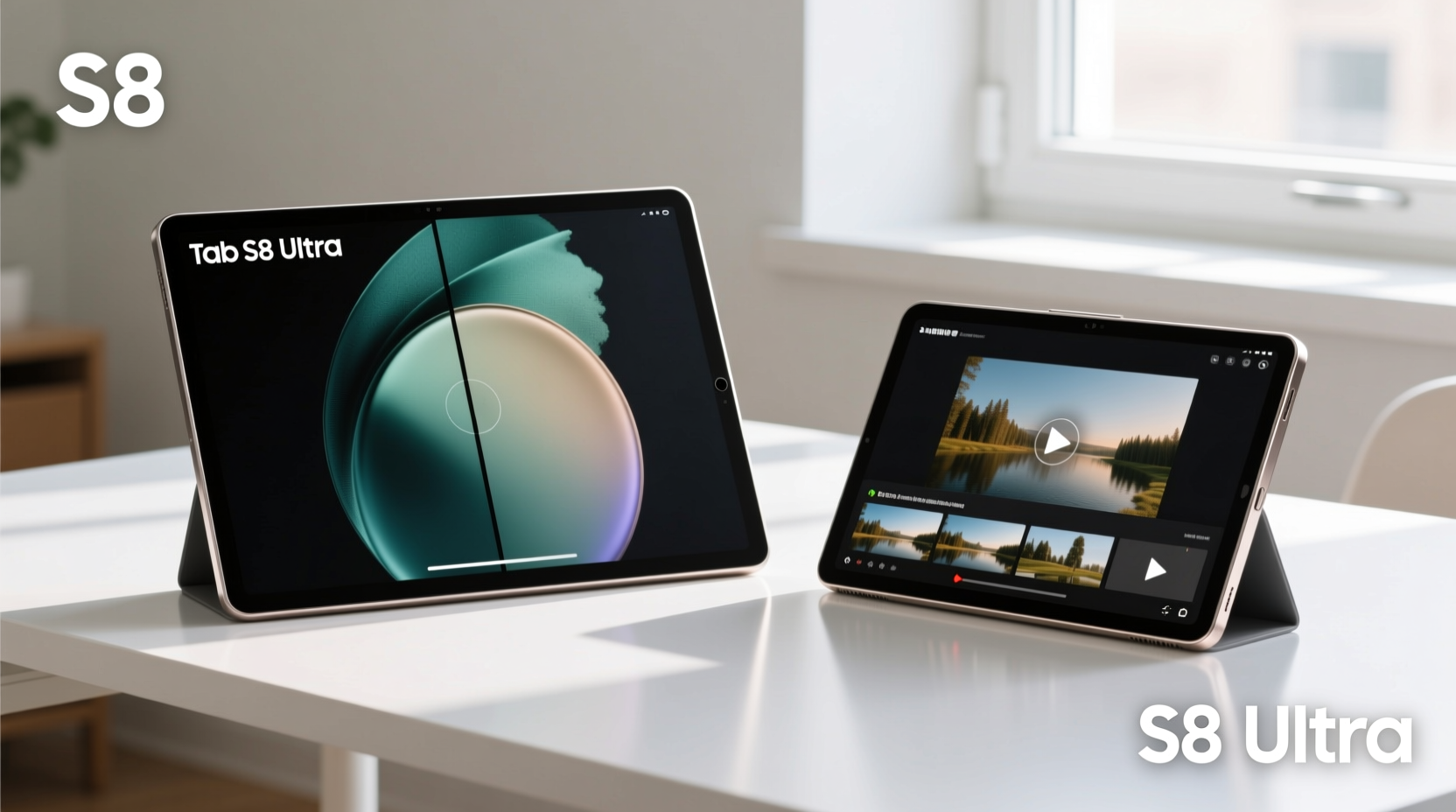
The most immediate difference between the Tab S8 and Tab S8 Ultra is their physical footprint. The standard Tab S8 features an 11-inch display and weighs 503 grams (Wi-Fi model), making it comfortable to hold one-handed for extended reading or media sessions. In contrast, the Tab S8 Ultra stretches to 14.6 inches and tips the scales at 726 grams—nearly half a pound heavier. That extra weight becomes noticeable after 20 minutes of handheld use, especially when lying in bed or commuting.
The Ultra’s ultrawide 16:10 aspect ratio is optimized for multitasking and video consumption, but it sacrifices pocketability. It doesn’t fit into most laptop sleeves or standard backpack side pockets. If you frequently travel, carry multiple devices, or work from cafes, the Tab S8’s compactness offers tangible advantages.
Display Quality and Real-World Use
Both tablets feature Super AMOLED panels with 120Hz refresh rates, HDR10+ support, and excellent color accuracy. However, the experience diverges significantly due to size and resolution.
| Feature | Tab S8 | Tab S8 Ultra |
|---|---|---|
| Screen Size | 11 inches | 14.6 inches |
| Resolution | 2560 x 1600 | 2960 x 1848 |
| Aspect Ratio | 16:10 | 16:10 (but much wider) |
| PPI (Pixels Per Inch) | ~275 PPI | ~243 PPI |
| Weight (Wi-Fi) | 503g | 726g |
While the Ultra’s screen delivers a near-laptop-like workspace, especially with the optional Book Cover Keyboard, its lower pixel density means text and images aren’t quite as sharp up close. For digital artists using the S Pen, the larger canvas allows more room for gesture controls and toolbars—but only if they have a stable surface. On-the-go sketching favors the S8’s balance of space and control.
“Screen size should serve your workflow, not dictate it. Many users overestimate how much real estate they actually need.” — David Kim, UX Designer & Tablet Workflow Consultant
Performance and Multitasking: Do You Need All That Space?
Under the hood, both models are nearly identical: powered by the Snapdragon 8 Gen 1 (or 8+ Gen 1 in some regions), 8GB/12GB RAM options, and support for the S Pen with 2.8ms latency. This means app launches, video editing, and gaming performance are virtually indistinguishable.
Where the Ultra shines is multitasking. With DeX mode and Samsung’s split-screen ecosystem, you can run four apps simultaneously—two side-by-side and two floating windows. The sheer width of the Ultra makes this practical. On the S8, quad app view feels cramped, often reducing usable space per window.
For professionals managing spreadsheets, coding, or content creation with reference materials open alongside primary tools, the Ultra’s screen is transformative. But for casual users checking email, browsing, or watching Netflix, the extra space goes underutilized.
Mini Case Study: Freelance Graphic Designer
Sophia, a freelance illustrator based in Barcelona, upgraded from the Tab S6 to the Tab S8 Ultra. She initially loved the expanded drawing area and dual-app layout for client feedback and design work. However, she found herself leaving the tablet at home during client meetings due to its size. After three months, she purchased a used Tab S8 as a secondary device for on-location work. “The Ultra is my studio tablet,” she says. “But the S8 comes with me everywhere.”
Battery Life and Charging: Bigger Screen, Bigger Drain
The Tab S8 packs a 8,000mAh battery, while the Ultra steps up to 11,200mAh. Despite the 40% larger battery, the Ultra’s screen consumes significantly more power. In real-world testing, both tablets deliver around 10–12 hours of mixed usage—web browsing, video streaming, note-taking—suggesting diminishing returns on battery scaling.
Charging speed is identical: 45W fast charging supported, though Samsung includes only a 25W charger in the box. Fully charging the Ultra takes about 1 hour 45 minutes, compared to 1 hour 20 minutes for the S8. Over time, that extra half-hour adds up, especially for users on tight schedules.
Checklist: Choosing Between S8 and S8 Ultra
- ✅ Consider the Tab S8 if: You prioritize portability, use the tablet on the move, or want a balanced blend of screen and weight.
- ✅ Choose the Tab S8 Ultra if: You replace your laptop with a tablet, do heavy multitasking, or create content professionally.
- ✅ Opt for the Ultra only if: You have a dedicated case, desk setup, or don’t mind carrying extra weight.
- ✅ Reconsider the Ultra if: You’ve never used a tablet larger than 12 inches—try one in-store first.
- ✅ Both support S Pen and Dex Mode—so functionality isn’t the deciding factor.
Value and Long-Term Use
The price gap is significant. At launch, the Tab S8 started at $729, while the Ultra began at $1,099—a $370 difference. Accessories like the Book Cover Keyboard add another $249, and the S Pen is included with both but requires protection.
For students or general users, the S8 offers better value. It runs all the same apps, supports 5G, has excellent speakers, and lasts just as long on a charge. The Ultra’s advantages are situational. Unless you’re using it as a desktop replacement or doing professional-grade creative work, you’re paying a premium for screen real estate you may not fully utilize.
Frequently Asked Questions
Can the Tab S8 Ultra replace a laptop?
Yes—for specific workflows. With Samsung DeX, a keyboard, and cloud-based software, it handles email, documents, light photo editing, and video calls efficiently. However, complex software like full Adobe Suite or CAD tools still require a traditional OS. It’s a capable secondary device, but not a universal replacement.
Is the S Pen experience better on the Ultra?
Marginally. The larger writing surface helps artists and note-takers who use gestures or toolbars. But precision and latency are identical across both models. The S Pen feels just as responsive on the S8.
Does the Ultra’s screen cause eye strain?
Some users report mild eye fatigue when viewing the Ultra at close range (under 12 inches) due to its size and curvature. Adjusting viewing distance or using screen zoom settings can mitigate this. The S8’s smaller screen naturally fits within typical reading distances.
Final Verdict: Is the Bigger Screen Worth It?
The Samsung Tab S8 Ultra is an engineering marvel—a tablet that blurs the line between mobile device and workstation. Its screen is undeniably impressive, offering unparalleled multitasking and media immersion. But greatness comes with trade-offs: weight, cost, and reduced mobility.
The Tab S8, by comparison, strikes a near-perfect balance. It’s powerful, portable, and versatile enough for 90% of users’ needs. Whether you're taking notes, watching shows, or working remotely, it delivers flagship performance without the burden.
If your workflow demands constant side-by-side app use, extensive digital drawing, or you’re committed to a laptop-free lifestyle, the Ultra earns its place. For everyone else, the standard Tab S8 provides smarter value and everyday comfort.




 浙公网安备
33010002000092号
浙公网安备
33010002000092号 浙B2-20120091-4
Comments
No comments yet. Why don't you start the discussion?