
The debate between hand-wound and automatic movements has simmered beneath the surface of horology for decades. With the rise of affordable, reliable automatics—especially in entry-level mechanical watches—the question arises: does a hand-wound movement like the Sanda 6015 still hold value? More importantly, does manually winding your watch offer any tangible benefits over letting a rotor do the work? The answer isn’t as simple as “one is better.” It depends on usage, appreciation, and what you value in a timepiece.
While automatic watches dominate the market, hand-wound calibers like the Sanda 6015 persist in niche roles—from budget military-style field watches to minimalist dress pieces. Understanding their differences goes beyond ticking mechanisms; it’s about ritual, engineering philosophy, and personal connection to craftsmanship.
Understanding the Mechanics: Hand-Wound vs Automatic
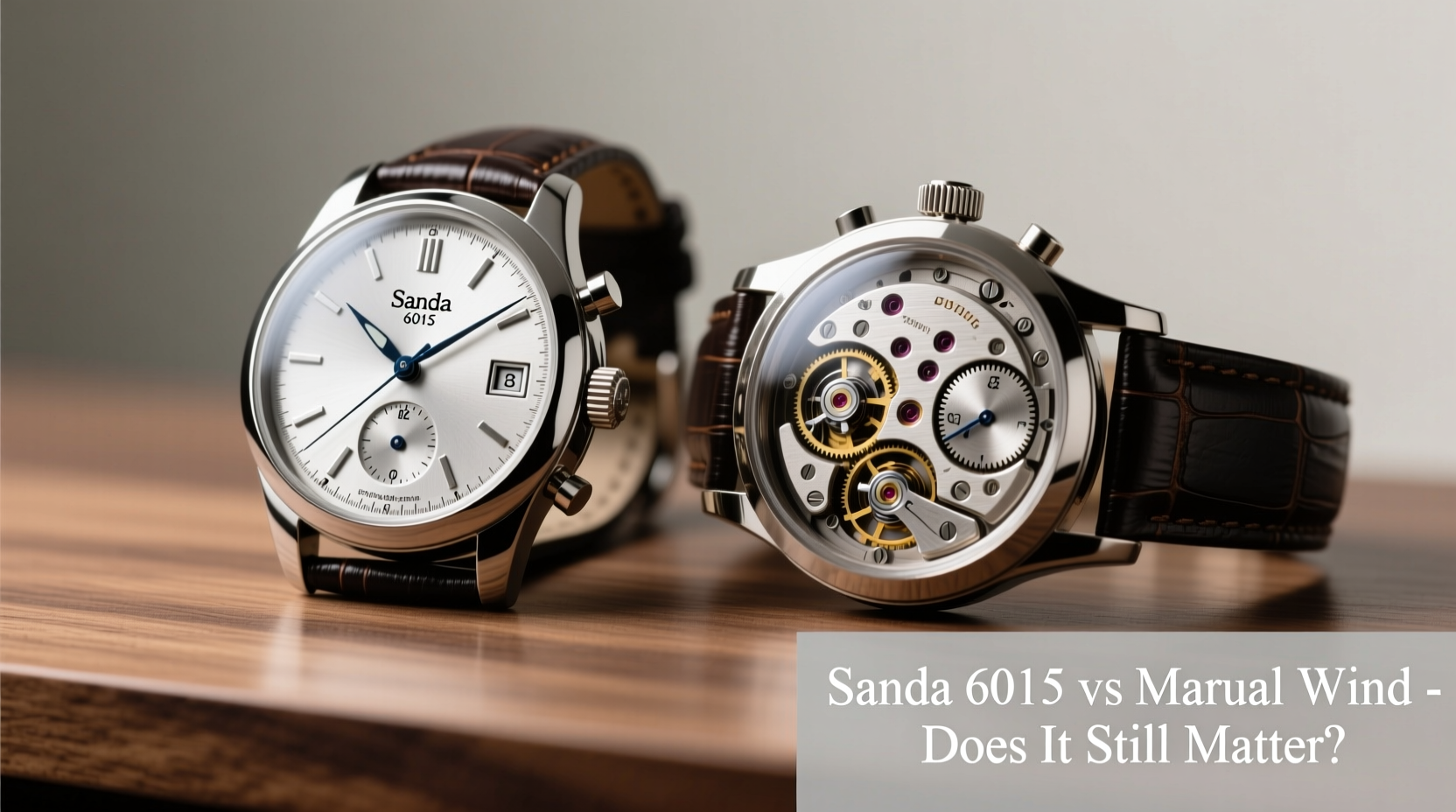
At their core, both hand-wound and automatic mechanical watches operate on the same principle: energy stored in a mainspring powers the gear train, escapement, and balance wheel to keep time. The key difference lies in how that spring is wound.
A hand-wound movement, such as the Sanda 6015, requires the wearer to manually turn the crown, tightening the mainspring through direct input. This action must be repeated every 24 to 48 hours, depending on power reserve. In contrast, an automatic (or self-winding) movement uses a weighted rotor that swings with arm motion, converting kinetic energy into winding force.
While automatics offer convenience, they come with trade-offs: added complexity, thickness, and potential inefficiency for inactive wearers. Hand-wound movements eliminate the rotor, resulting in thinner profiles and fewer moving parts—often making them more durable and easier to service.
“Hand-winding creates a daily ritual that connects the wearer to the machine on their wrist. It’s not just about telling time—it’s about appreciating the mechanism.” — Daniel Park, Independent Watchmaker & Horology Educator
Comparing the Sanda 6015 and Typical Automatic Movements
The Sanda 6015 is a Chinese-made manual-wind movement often found in rugged, low-cost field watches. Priced under $30 wholesale, it powers numerous microbrands and surplus-style timepieces. Meanwhile, common automatic alternatives include the Seiko NH35, Miyota 8215, and Sellita SW200—all widely used in watches from $200 to $1,000.
To understand where each excels, consider this comparison:
| Movement | Type | Power Reserve | Accuracy | Thickness | Common Use Case |
|---|---|---|---|---|---|
| Sanda 6015 | Manual Wind | ~40 hours | +30/-50 sec/day | 3.6mm | Budget field/dress watches |
| Miyota 8215 | Automatic | ~40 hours | +20/-40 sec/day | 4.7mm | Mid-tier divers, everyday wear |
| Seiko NH35 | Automatic | ~40 hours | +20/-40 sec/day | 5.3mm | Divers, pilot watches |
| Sellita SW200 | Automatic | ~38 hours | +10/-20 sec/day | 4.9mm | Luxury microbrands, Swiss alternatives |
Notably, the Sanda 6015 matches its competitors in power reserve while being significantly thinner. However, its accuracy is looser, and it lacks hacking (the second hand stops when setting time), a feature standard in higher-end movements. Still, for under $100 total watch cost, it delivers genuine mechanical function without reliance on batteries.
The Relevance of Hand Winding in a Modern Context
In an age of smartwatches and perpetual motion, why would anyone choose a watch requiring daily winding? The reasons are both practical and philosophical.
First, hand-wound watches eliminate rotor-related issues. Autocorrects can fail, unidirectional winding systems may be inefficient, and rotors add stress during impacts. Without these components, hand-wound movements like the 6015 are less prone to shock damage—ideal for tool watches.
Second, there’s intimacy. Manually winding a watch fosters engagement. You feel the resistance of the spring, hear the subtle clicks, and participate in keeping time alive. For enthusiasts, this ritual enhances emotional ownership. It transforms the watch from a passive accessory into an active companion.
Third, space efficiency. Removing the rotor allows for slimmer cases. Many ultra-thin dress watches—like vintage Jaeger LeCoultre models or modern Nomos pieces—use hand-wound movements precisely for this reason. The Sanda 6015, though not luxury-grade, enables similar design possibilities in affordable builds.
A Real Example: The Field Watch Enthusiast
Take Mark, a weekend hiker and owner of a Sanda 6015-powered field watch. He wears it only on outdoor trips, never daily. An automatic would lose power between outings, requiring resetting and re-winding anyway. But because his 6015 is manual, he winds it before each hike—a small act that prepares him mentally for adventure. The lack of rotor also means less internal movement during rough terrain, reducing wear. For Mark, the “inconvenience” is actually a benefit.
When Automatic Wins—and When It Doesn’t
For most daily wearers, automatic movements make sense. If you’re active and wear your watch consistently, the rotor keeps it wound effortlessly. High-quality automatics like the ETA 2824 or SW200 offer precision, durability, and ease of use.
But automatics falter in certain scenarios:
- Inactive wearers: Office workers with limited arm motion may not generate enough energy to fully wind the watch.
- Multiple-watch collections: Rotating between several timepieces means automatics sit unworn and unwound, losing time.
- Low-activity lifestyles: Seniors or those with limited mobility often find automatics unreliable.
In these cases, hand-wound watches shine. They don’t depend on motion. A quick 30-second wind ensures full power, regardless of how long the watch sat idle.
Checklist: Choosing Between Hand-Wound and Automatic
- Do you wear one watch daily? → Automatic may suit you best.
- Do you rotate between multiple watches? → Consider hand-wound for consistency.
- Do you value thinness and simplicity? → Manual wind reduces case thickness.
- Are you drawn to ritual and interaction? → Hand winding offers tactile engagement.
- Is the watch for occasional or seasonal use? → Manual avoids dead batteries or stopped rotors.
- Do you prioritize repairability and longevity? → Fewer moving parts in hand-wound can mean easier servicing.
Frequently Asked Questions
Can I overwind a Sanda 6015?
No. Like most modern hand-wound movements, the Sanda 6015 includes a slipping bridle mechanism that prevents overwinding. Once the mainspring is fully tensioned, further turning of the crown disengages the winding gears.
Why don’t more brands use hand-wound movements if they’re simpler?
Market demand favors convenience. Most consumers expect a mechanical watch to “just work” without daily input. Additionally, automatics allow brands to highlight features like “self-winding” and “perpetual motion,” which appeal to marketing narratives—even if they’re functionally unnecessary.
Is the Sanda 6015 accurate enough for daily use?
It depends on expectations. With +30/-50 seconds per day variance, it’s not chronometer-grade, but acceptable for casual wear. Regular winding at the same time each day helps stabilize performance by maintaining consistent mainspring tension.
Final Thoughts: Does Hand Winding Still Matter?
Yes—but not for everyone. The Sanda 6015 may not match Swiss or Japanese automatics in refinement, but it serves a purpose: delivering accessible mechanical watch ownership with minimal complexity. Its existence proves that hand-wound movements still have a place, especially in watches designed for utility, simplicity, or intentional use.
Hand winding matters when you want control, reliability across inactivity, and a deeper relationship with your timepiece. It’s not obsolete—it’s deliberate. In a world of automation, sometimes doing things by hand is the most meaningful choice.




 浙公网安备
33010002000092号
浙公网安备
33010002000092号 浙B2-20120091-4
Comments
No comments yet. Why don't you start the discussion?