
When shopping for a rugged timepiece that can handle outdoor adventures, many consumers find themselves comparing Sanda watches with dedicated diving watches. Sanda has built a reputation for offering durable, affordable digital watches with solid water resistance—ideal for swimming, hiking, and light water sports. But as users push their limits, they often wonder: should they upgrade to a true diving watch? The answer isn’t always straightforward. It depends on your lifestyle, expectations, and how deeply you engage with aquatic environments.
This article breaks down the key differences between Sanda watches and professional diving watches, evaluates performance under pressure, and helps you determine whether stepping up in price and capability delivers real value—or just bragging rights.
Durability and Build Quality: Materials That Matter
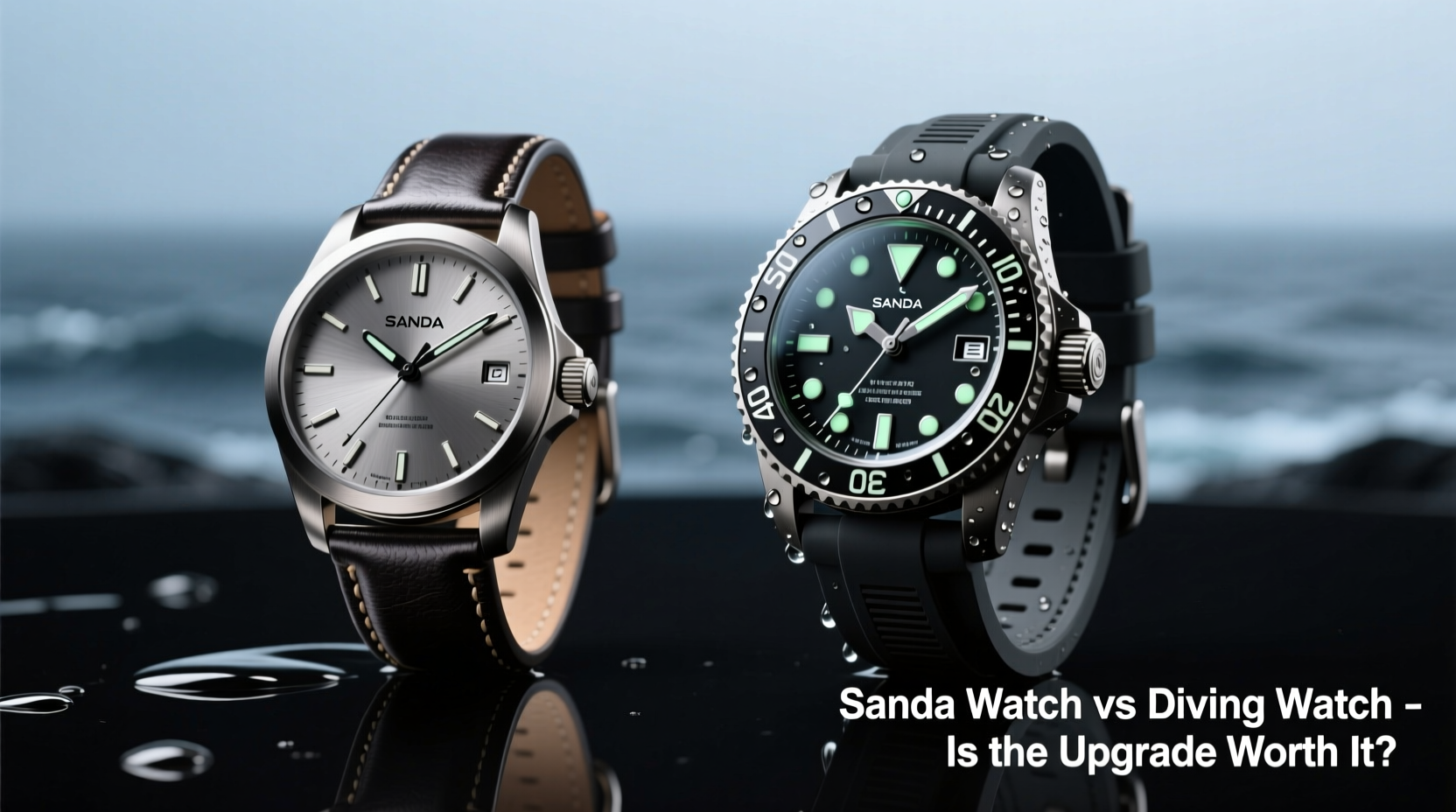
Sanda watches are typically constructed from lightweight resin cases, mineral glass (or occasionally sapphire), and nylon or silicone straps. They’re designed to be shock-resistant and water-resistant up to 200 meters, which sounds impressive on paper. However, “water-resistant” doesn’t mean “dive-rated.” Most Sanda models meet ISO 22810 standards for water resistance, suitable for swimming and snorkeling but not for scuba diving.
In contrast, true diving watches—such as those from Seiko, Citizen, or Swiss brands like Oris and Rolex—are built to comply with ISO 6425. This standard requires a minimum 100-meter depth rating, legibility in total darkness, magnetic resistance, shock resistance, and endurance under dynamic pressure changes during descent and ascent.
The materials used reflect this distinction. Diving watches often feature stainless steel or titanium cases, sapphire crystals (more scratch-resistant than mineral glass), unidirectional rotating bezels, and helium escape valves in professional-grade models. These components aren’t just aesthetic upgrades—they serve functional roles in extreme conditions.
Water Resistance: What 200 Meters Really Means
A Sanda watch labeled “200m water resistant” may seem equivalent to a dive watch, but there’s a critical difference in testing methodology. Sanda’s rating is based on static pressure tests in controlled lab conditions. In real-world use, factors like temperature shifts, rapid movement through water, and aging gaskets reduce effective resistance.
ISO 6425-certified dive watches undergo far more rigorous testing. For example, they must function after being submerged under 125% of their rated depth for two hours, endure thermal shock (sudden temperature changes), and remain legible in complete darkness at 25 cm distance.
| Feature | Sanda Watch | Diving Watch (ISO 6425) |
|---|---|---|
| Depth Rating | Up to 200m (static test) | 100–300m+ (dynamic & safety-tested) |
| Testing Standard | ISO 22810 | ISO 6425 |
| Legibility in Dark | Limited backlight | Super-LumiNova markers, continuous glow |
| Bezel Function | Decorative or non-rotating | Unidirectional, click-interval timing |
| Crystal Type | Mineral or acrylic | Sapphire or hardened crystal |
For most casual wearers, Sanda’s water resistance is more than sufficient. But if you’re logging dives below 10 meters, especially with compressed air tanks, only an ISO 6425-certified watch should be trusted.
Real-World Use Case: From Reef Snorkeling to Technical Diving
“Recreational divers often overestimate their equipment needs. A Sanda works fine for surface activities, but once you go beyond 15 meters, instrument reliability becomes a safety issue.” — Captain Lena Torres, PADI Master Instructor
Consider Mark, a weekend adventurer who enjoys kayaking, snorkeling, and occasional scuba trips in tropical reefs. He owns a Sanda G-Shock DW-5600, which has served him well for five years. Recently, he joined a deep wreck dive to 32 meters off the coast of Belize. His Sanda survived the dive without leaking—but its stopwatch function failed mid-descent, and the lack of a rotating bezel made tracking bottom time difficult.
Afterward, Mark upgraded to a Seiko Prospex Solar Dive Watch. The difference was immediate: precise elapsed time tracking via the bezel, glowing hands visible at depth, and peace of mind knowing his watch met international dive safety standards. While the Sanda wasn’t damaged, it simply wasn’t designed for that environment.
This scenario illustrates a crucial point: suitability depends on application. For surface-level activity, Sanda excels. For submersible precision, diving watches are purpose-built tools.
Value Comparison: Cost vs. Long-Term Utility
Sanda watches typically range from $50 to $150. High-quality dive watches start around $300 and can exceed $3,000 for mechanical or luxury editions. Is the jump justified?
It comes down to frequency of use and personal priorities. If you dive less than four times a year, a Sanda might offer enough functionality, especially if paired with a dive computer. However, frequent divers benefit from features like solar charging (in Citizen Eco-Drive or Casio Oceanus models), automatic time calibration, and superior build longevity.
- Battery Life: Sanda watches often last 7–10 years on one battery; dive watches with solar tech can operate indefinitely with proper light exposure.
- Maintenance: Dive watches require periodic seal replacement and pressure testing (~$50 every 2 years), adding to long-term cost.
- Resale Value: Brands like Seiko and Omega retain value better than Sanda, which rarely appreciates.
Still, Sanda wins in ruggedness-to-price ratio. Its shockproof design handles drops, sand, and impacts better than many metal-cased dive watches, making it ideal for hikers, climbers, and military personnel.
Step-by-Step Guide: How to Decide If You Need an Upgrade
- Assess Your Water Activities: Are you swimming, snorkeling, or doing shallow dives (under 10m)? Sanda likely suffices.
- Evaluate Depth Needs: Do you regularly dive deeper than 15 meters? Consider ISO 6425 certification essential.
- Check Timing Requirements: Do you rely on your watch to track dive duration, decompression stops, or surface intervals? A rotating bezel is critical.
- Review Environmental Exposure: Frequent saltwater, UV, or extreme temperatures accelerate wear. Stainless steel and sapphire fare better.
- Calculate Long-Term Investment: If you plan to keep the watch for a decade or more, higher initial cost may save money over time.
Frequently Asked Questions
Can I scuba dive with a Sanda watch?
You can, but it's not recommended for depths beyond recreational snorkeling. While some Sanda models are rated to 200m, they lack the safety redundancies and tested reliability of ISO 6425 dive watches. Relying on them for decompression timing introduces risk.
Do diving watches need servicing?
Yes. Every 2–3 years, a dive watch should undergo pressure testing, gasket replacement, and cleaning to maintain water resistance. Neglecting maintenance voids protection, regardless of original rating.
Is a Sanda G-Shock good enough for ocean use?
Absolutely—for swimming, sailing, surfing, and coastal exploration. Its shock resistance and decent water sealing make it resilient against splashes, waves, and sand. Just rinse it with fresh water after saltwater exposure.
Final Verdict: When the Upgrade Makes Sense
The upgrade from a Sanda watch to a dedicated diving watch isn't about prestige—it's about matching tool to task. For adventurers staying above 10 meters, Sanda remains a smart, economical, and highly capable choice. It offers excellent value, unmatched toughness, and reliable performance in wet environments.
But when diving becomes a serious pursuit—whether recreationally at depth or professionally—the investment in a true dive watch pays off in safety, precision, and confidence. Features like luminous markers, calibrated bezels, and certified water integrity aren’t luxuries; they’re safeguards.
Ultimately, ask yourself: do you want a watch that survives water, or one engineered for it?




 浙公网安备
33010002000092号
浙公网安备
33010002000092号 浙B2-20120091-4
Comments
No comments yet. Why don't you start the discussion?