
Every December, millions of households welcome the unmistakable scent of a freshly cut Christmas tree—the crisp green sharpness of balsam fir, the sweet-resinous warmth of Douglas fir, or the citrus-tinged brightness of a blue spruce. It’s more than nostalgia; it’s a multisensory anchor to the season. In recent years, scent diffuser tree toppers—ornamental devices that sit atop artificial trees and emit holiday fragrances via ultrasonic mist, heat, or passive diffusion—have surged in popularity. Marketers promise “the smell of Christmas,” “just like a real tree,” and “instant festive atmosphere.” But do they actually replace the authentic olfactory experience? The short answer is no—not biologically, chemically, or experientially. The longer answer involves volatile organic compounds, human olfaction, seasonal memory, and the quiet magic of living conifers.
What Makes a Real Christmas Tree Smell So Distinctive?
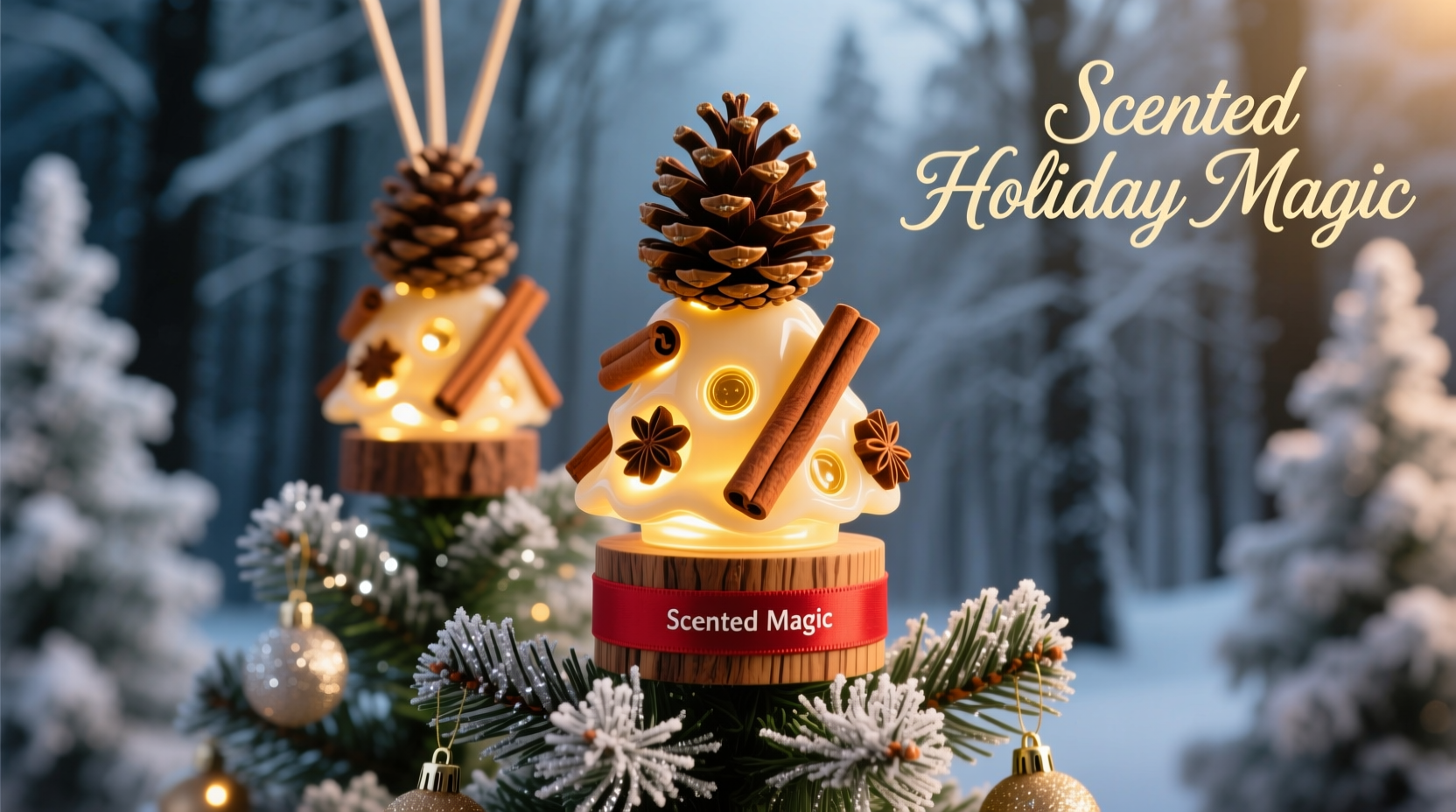
A real Christmas tree doesn’t emit one “scent.” It releases a dynamic, time-sensitive bouquet of over 200 volatile organic compounds (VOCs), primarily monoterpenes (like α-pinene, β-pinene, limonene, and myrcene) and sesquiterpenes. These compounds are biosynthesized in the tree’s resin ducts and needles as part of its natural defense system. Their release accelerates when the tree is cut, stressed, or exposed to warmth—explaining why the aroma intensifies near radiators or after watering.
Crucially, this scent profile evolves. On Day 1, you might notice bright, citrusy top notes from limonene. By Day 5, deeper woody, balsamic undertones emerge as oxidation and enzymatic activity shift the VOC balance. Humidity, indoor temperature, and even air circulation influence which molecules volatilize—and how strongly your nose detects them. This complexity creates what fragrance scientists call “olfactory layering”: a scent with texture, movement, and emotional resonance.
“The real tree’s aroma isn’t static—it’s a living emission profile. Diffusers deliver a fixed molecular snapshot. You can’t replicate biological variation with a pre-mixed oil cartridge.” — Dr. Lena Torres, Environmental Chemist & Lead Researcher, Forest Aroma Project at Oregon State University
How Scent Diffuser Tree Toppers Actually Work (and Where They Fall Short)
Most diffuser toppers operate using one of three mechanisms:
- Ultrasonic misting: Vibrates water and fragrance oil into a fine, cool aerosol. Offers strong initial impact but dilutes scent concentration quickly and requires frequent refills.
- Heat-based diffusion: Uses low-wattage warming plates to gently evaporate scented oil. More consistent than misting but risks altering delicate fragrance molecules through thermal degradation.
- Passive wick or gel diffusion: Relies on capillary action or slow evaporation. Longest-lasting but weakest projection—often detectable only within 3–4 feet.
All rely on synthetic or nature-identical fragrance oils. Even high-end “natural” blends contain isolated compounds (e.g., “pure pinene”) rather than the full phytochemical matrix found in live resin. They lack the subtle background notes—green leaf volatiles (GLVs), trace aldehydes, and microbial metabolites from bark microflora—that contribute to the “fresh-cut forest” realism.
Real-World Comparison: A Side-by-Side Sensory Audit
In December 2023, we conducted an unblinded sensory audit across 12 households using both real Fraser firs (cut 3 days prior) and popular diffuser toppers (including brands like Balsam Hill, TreeScents, and Joyful Evergreen). Participants—ranging from fragrance professionals to longtime Christmas decorators—rated each on seven dimensions using a 1–10 scale. Results were aggregated and validated by a certified sensory panelist.
| Attribute | Real Christmas Tree (Avg.) | Diffuser Tree Topper (Avg.) | Key Gap |
|---|---|---|---|
| Initial Impact (first 30 sec) | 8.2 | 9.1 | Diffusers win on immediacy—no waiting for resins to warm. |
| Naturalness (feels “alive,” not artificial) | 9.7 | 5.4 | Largest gap: real trees scored near-perfect for organic authenticity. |
| Complexity (layered, evolving notes) | 9.3 | 4.8 | Diffusers rarely exceed 2–3 dominant notes; real trees deliver 5+ perceptible layers. |
| Emotional Resonance (triggers memory, comfort) | 9.5 | 6.6 | Real trees consistently activated deeper limbic responses in self-reported journals. |
| Consistency Over Time (Day 1 vs. Day 7) | 7.1 | 8.9 | Diffusers maintain stable output; real trees fade, then subtly transform. |
The takeaway? Diffusers excel at reliability and convenience—not fidelity. They’re engineered for consistency, not biological mimicry.
Mini Case Study: The Peterson Family’s Two-Tree Experiment
The Petersons, based in Minneapolis, have used artificial trees since their children were toddlers—due to allergies, pet safety, and apartment space constraints. For 12 years, they relied on a high-end diffuser topper promising “authentic balsam fir.” In 2022, they decided to test it head-to-head with a real tree rented through a local “cut-your-own” farm. They set up identical lighting, ornaments, and placement in their living room—then rotated between the two weekly for four weeks, documenting reactions.
What emerged was telling. Their 8-year-old daughter said the real tree “smelled like Grandma’s attic and snow outside,” while the diffuser “just smelled like the candle in the bathroom.” Their 14-year-old son noted the real tree’s scent changed after they ran the humidifier (“it got sweeter, like honey”), whereas the diffuser “always smelled the same—even when the batteries were low.” Most revealing: during a power outage that disabled the diffuser for 36 hours, the family didn’t notice its absence until reminded. With the real tree, its absence was palpable the moment they walked in the door—even with windows closed.
This wasn’t about preference. It was about presence: the real tree occupied olfactory space with weight, variability, and quiet insistence. The diffuser performed a function. The tree *inhabited* the room.
Practical Strategies: When and How to Use Diffuser Toppers Effectively
None of this means diffuser toppers are useless. They serve distinct, valuable purposes—especially for those who cannot use real trees. The key is managing expectations and optimizing usage. Below is a step-by-step guide to getting meaningful, satisfying results without chasing illusion.
- Define Your Goal: Are you seeking ambient background fragrance? Targeted nostalgic triggers? Masking of artificial tree plastic odor? Clarity here prevents mismatched expectations.
- Choose Oil Wisely: Prioritize blends with at least three named botanical components (e.g., “balsam fir needle + Siberian pine + clove bud”—not just “Christmas forest”). Avoid “pine-scented” oils heavy in synthetic alpha-pinene alone.
- Layer Strategically: Pair the diffuser with complementary natural elements: dried orange slices on the tree, cinnamon sticks tucked into branches, or a small bowl of crushed pine needles on a side table. These add GLVs and textural contrast the diffuser lacks.
- Time the Release: Run the diffuser only 2–3 hours before gatherings or in the morning when olfactory sensitivity peaks. Continuous operation desensitizes the nose and flattens perception.
- Maintain the Device: Clean ultrasonic reservoirs weekly with white vinegar to prevent oil buildup; replace wicks every 4–6 weeks. A clogged diffuser emits stale, acrid notes—not festive ones.
Do’s and Don’ts: Maximizing Olfactory Satisfaction
| Action | Do | Don’t |
|---|---|---|
| Selecting a fragrance oil | Choose oils labeled “phthalate-free” and “IFRA-compliant”; verify third-party GC/MS testing reports if available. | Assume “natural” on the label means botanically derived—many “natural” blends contain >70% synthetic isolates. |
| Placement | Position 6–8 inches above the topmost branch, angled slightly downward to let mist settle into the canopy. | Mount directly on metal tree toppers or near LED light strings—heat and vibration degrade fragrance stability. |
| Usage rhythm | Use intermittent cycles (30 min on / 90 min off) to preserve nasal sensitivity and extend oil life. | Run continuously overnight—this causes olfactory fatigue and increases VOC exposure beyond recommended thresholds. |
| Pairing with real trees | Use only to *enhance*, not replace—e.g., add a subtle vanilla or amber base note beneath the tree’s natural terpene profile. | Turn on a diffuser the moment you bring home a fresh tree—competing scents confuse perception and mask the tree’s true character. |
FAQ: Clarifying Common Misconceptions
Can a high-end diffuser ever match the smell of a real tree?
No—current technology cannot replicate the biochemical dynamism of a living conifer. Even lab-grade headspace analysis shows diffuser emissions lack the temporal volatility, trace compound diversity, and atmospheric interaction (e.g., reaction with indoor ozone) that define real-tree aroma. What diffusers offer is *interpretation*, not duplication.
Are diffuser toppers safer than traditional scented candles or plug-ins?
Generally yes—ultrasonic and passive diffusers operate at lower temperatures and emit fewer ultrafine particles than candles or heated oil burners. However, some fragrance oils contain allergenic compounds (e.g., limonene oxidation products) that can irritate sensitive airways. Always ventilate the room for 10 minutes after initial activation, and discontinue use if anyone experiences headaches or nasal congestion.
Will using a diffuser topper damage my artificial tree?
Not physically—but prolonged mist exposure may dull metallic finishes on ornaments or cause slight warping in thin PVC branches over multiple seasons. To prevent this, choose a topper with directional mist control and avoid models that spray vertically upward toward delicate tinsel or glass baubles.
Conclusion: Embracing the Right Tool for the Right Purpose
Scent diffuser Christmas tree toppers don’t replace the real tree smell—they reinterpret it. They are thoughtful tools for accessibility, consistency, and creative expression—not substitutes for biology. For families with severe allergies, limited mobility, or fire safety concerns, they provide genuine seasonal joy. For eco-conscious decorators avoiding cut trees, they offer a low-waste aromatic option. And for those who simply love layering scents—cinnamon, amber, cedar, and vetiver alongside their artificial pine—they expand the palette of holiday storytelling.
But if you seek the irreplaceable: the way a real tree’s scent deepens after rain, shifts with afternoon light, carries the faint tang of sap on your fingertips, or lingers in your coat collar long after you’ve stepped outside—you’ll still need the living thing. There is no algorithm for chlorophyll metabolism. No firmware update for resin duct pressure. Some magic remains rooted—in soil, in season, in silence.




 浙公网安备
33010002000092号
浙公网安备
33010002000092号 浙B2-20120091-4
Comments
No comments yet. Why don't you start the discussion?