
Choosing between scented candles and essential oil diffusers isn’t just about preference—it’s about performance. How quickly a space fills with fragrance, how long that scent lingers, and how safely it’s delivered all matter in real-world use. Whether you're setting a mood, masking household odors, or seeking aromatherapy benefits, understanding the strengths and limitations of each method can help you make a smarter decision. This comparison dives deep into diffusion speed, longevity, scent intensity, maintenance, and health considerations.
How Fragrance Is Released: The Core Mechanism
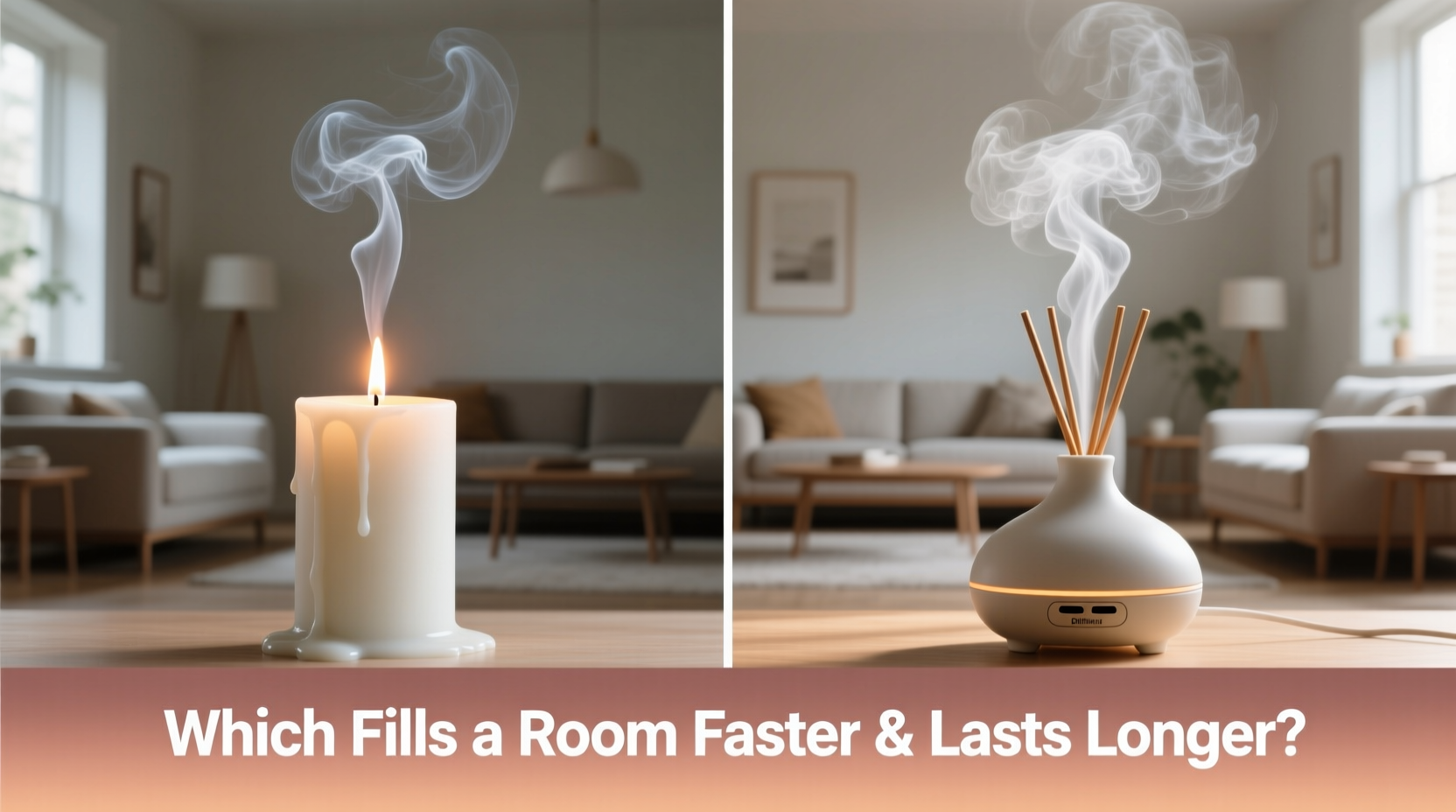
The way scent is dispersed fundamentally shapes its effectiveness. Scented candles rely on heat-driven evaporation. When lit, the flame melts the wax near the wick, releasing fragrance molecules into the air as vapor. This process requires active burning and produces both light and warmth—often part of their appeal—but also soot and potential airborne pollutants.
In contrast, essential oil diffusers use alternative methods to aerosolize oils without combustion. Ultrasonic diffusers mix water with essential oils and use high-frequency vibrations to create a fine mist. Nebulizing diffusers break oils into micro-particles using pressurized air, while evaporative models (like fan diffusers) accelerate natural evaporation. Because they don’t burn, diffusers avoid soot and open flames, making them safer for homes with children or pets.
From a dispersion standpoint, candles release scent gradually, concentrated near the source. Diffusers, especially ultrasonic and nebulizing types, actively push aromatic particles into the air, often achieving broader distribution. However, this doesn’t always mean faster room saturation—context matters.
Filling the Room: Speed of Aroma Dispersion
When it comes to filling a room quickly, essential oil diffusers generally outperform scented candles. An ultrasonic diffuser begins emitting scent within seconds of activation, and within 5–10 minutes, most standard-sized rooms (up to 300 sq ft) experience noticeable aroma coverage. Nebulizing diffusers act even faster due to higher oil concentration and no water dilution.
Scented candles, by comparison, take time to “warm up.” It can take 20–30 minutes for a candle to reach full melt pool development—the stage where maximum fragrance is released. Until then, scent projection remains weak. Once heated, candles do produce a strong, rich aroma, but it tends to stay localized unless aided by fans or open floor plans.
A study conducted by the Air Quality Research Center at the University of California found that diffusers achieved uniform volatile organic compound (VOC) distribution in under 15 minutes, while scented candles required over 40 minutes to reach similar levels—and only when multiple units were used.
“Diffusers offer more immediate and consistent scent coverage, especially in medium to large rooms. Candles are slower but provide a deeper, warmer olfactory experience once fully engaged.” — Dr. Lena Patel, Environmental Health Scientist
Longevity: Which Option Lasts Longer?
Longevity must be evaluated from two angles: lifespan per unit and cost efficiency over time.
A typical 8-ounce scented candle burns for 40–50 hours, depending on wick quality and wax type. Premium soy or coconut wax blends may last longer than paraffin, but frequent use adds up. If burned nightly for two hours, a single candle lasts about three weeks. Replacing them monthly becomes costly—especially with luxury brands averaging $25–$40 each.
Essential oil diffusers, meanwhile, consume 3–10 drops of oil per session, lasting 1–4 hours depending on settings. A 10ml bottle contains roughly 200–250 drops, equating to 25–80 uses per bottle. At an average price of $12–$18 per bottle, this translates to significantly lower recurring costs. Plus, the diffuser unit itself can last years with proper cleaning.
Beyond financial longevity, there's also shelf life. Unused scented candles degrade over time—typically 12–18 months—due to fragrance oil separation and wax oxidation. Essential oils vary; citrus oils last 6–12 months, while sandalwood or patchouli can remain potent for up to five years if stored in dark glass, away from heat and light.
Estimated Long-Term Cost Comparison (Over 1 Year)
| Method | Initial Cost | Annual Supply Cost | Total Yearly Cost | Lifespan of Device/Supply |
|---|---|---|---|---|
| Scented Candles (monthly replacement) | $0 | $30 x 12 = $360 | $360 | 1 month per candle |
| Essential Oil Diffuser + Oils | $25 (device) | $15 x 6 = $90 | $115 | Device: 3+ years | Oils: 6–24 months |
This table illustrates that while candles have no upfront device cost, their ongoing expense far exceeds that of a one-time diffuser purchase paired with periodic oil refills.
Safety, Air Quality, and Health Considerations
Safety is a decisive factor for many households. Open flames pose risks, particularly around curious children, pets, or flammable materials. The National Fire Protection Association reports that candles cause an estimated 7,000 home fires annually in the U.S. alone. Even when supervised, leaving a candle unattended increases fire hazard.
Beyond fire risk, combustion releases ultrafine particles, benzene, and formaldehyde—known respiratory irritants. Paraffin wax, commonly used in commercial candles, emits more soot than beeswax or soy. While occasional use is unlikely to cause harm, daily exposure in poorly ventilated spaces may aggravate asthma or allergies.
Diffusers eliminate flame risk and do not emit combustion byproducts. However, improper use can still affect air quality. Overuse of essential oils, especially in small rooms, can lead to headaches or sensitization in some individuals. Certain oils—like eucalyptus or tea tree—are toxic to pets when inhaled in high concentrations. Dilution and moderation are key.
Real-World Scenario: Evening Relaxation Routine
Consider Sarah, a remote worker living in a 750 sq ft apartment. She enjoys winding down after work with ambient lighting and calming scents. On Monday, she lights a lavender-scented soy candle in her living room. It takes nearly half an hour before the scent reaches her bedroom, and even then, it’s faint. She extinguishes it after two hours due to smoke concerns and plans to reuse it later—only to find the next day that the wick has tunneled, reducing future performance.
On Thursday, she tries an ultrasonic diffuser with a blend of lavender and bergamot. Within ten minutes, the entire apartment carries a soft, even fragrance. She sets it on a timer, runs it for 90 minutes, and turns it off remotely via smart plug. The scent lingers subtly for several hours. Over the week, she uses the same 10ml oil bottle twice more, spending less than $1 worth of oil. No residue, no flame, no cleanup beyond rinsing the reservoir.
Sarah finds the diffuser faster, safer, and more efficient. But on weekends, she still lights candles during dinner—they add ambiance that mist cannot replicate. Her solution? Use diffusers for daily scenting and candles for special moments.
Step-by-Step Guide: Choosing the Right Option for Your Needs
- Assess your primary goal: Are you seeking quick odor neutralization, therapeutic benefits, or atmospheric enhancement?
- Evaluate room size: Large or multi-room areas benefit more from diffusers; small bathrooms or bedrooms may suit candles.
- Consider safety: Homes with kids, pets, or mobility issues should lean toward flame-free options.
- Calculate budget: Estimate monthly usage and compare long-term costs using the table above.
- Test both methods: Try a high-quality candle and a basic diffuser side by side in the same space. Note which delivers better coverage and satisfaction.
- Optimize placement: Place diffusers near air vents or doorways; position candles at center points with airflow.
- Maintain consistently: Clean diffuser tanks weekly; trim candle wicks to ¼ inch before each burn.
Checklist: Maximizing Performance and Safety
- ✅ Trim candle wicks before every use to prevent sooting and uneven burns
- ✅ Use diffusers with automatic shut-off features to avoid dry running
- ✅ Choose 100% essential oils over synthetic fragrances for health and purity
- ✅ Avoid placing candles near drafts or vents that disrupt scent flow
- ✅ Clean diffuser components weekly with vinegar or manufacturer-recommended solutions
- ✅ Store unused candles in cool, dark places to preserve fragrance integrity
- ✅ Limit continuous diffuser use to 1–2 hours to prevent sensory overload
FAQ
Do essential oil diffusers really cover larger areas than candles?
Yes, especially nebulizing and fan-based diffusers. They actively disperse micro-droplets across the room, whereas candles rely on passive convection. In spaces over 300 sq ft, multiple candles may be needed to match a single powerful diffuser.
Can I make a candle scent fill a room faster?
You can improve dispersion by placing the candle in a central location, using multiple candles simultaneously, or pairing it with a gentle fan. However, this increases fire risk and fuel consumption. It won’t surpass the speed of a well-placed diffuser.
Which option is better for people with allergies?
Generally, diffusers using pure essential oils are preferable—provided the user isn't sensitive to specific botanical compounds. Unscented or hypoallergenic oils like fractionated coconut oil or mild lavender can be safer. Avoid paraffin candles, which emit irritants when burned.
Final Verdict: Speed vs. Experience, Efficiency vs. Ambiance
If your priority is speed and longevity, essential oil diffusers win decisively. They deliver fragrance faster, cover more area, last longer per unit, and cost less over time. They’re also safer and more adaptable to different environments. From a purely functional standpoint, they’re the superior choice for consistent, whole-room scenting.
But scented candles offer something diffusers cannot: atmosphere. The flicker of flame, the ritual of lighting, the depth of a well-crafted fragrance blooming slowly through warmth—these are sensory experiences that go beyond mere odor control. For intimate evenings, meditation, or romantic dinners, candles remain unmatched.
The smartest approach isn’t choosing one over the other, but integrating both. Use diffusers for everyday freshness, quick refreshment, and targeted aromatherapy. Reserve candles for occasions where mood and moment matter as much as scent.




 浙公网安备
33010002000092号
浙公网安备
33010002000092号 浙B2-20120091-4
Comments
No comments yet. Why don't you start the discussion?