
Choosing the right fragrance system for your apartment involves more than just picking a pleasant scent. It’s about how quickly that scent disperses, how evenly it spreads, and whether it enhances your space—or overwhelms it. Scented candles and reed diffusers are two of the most popular home fragrance options, each with distinct advantages and limitations when it comes to filling a room efficiently and subtly. Understanding their mechanics, diffusion rates, and sensory impact can help you make an informed decision—especially if you live in a smaller space or prefer a consistent but gentle aroma.
While scented candles offer immediate warmth and strong bursts of fragrance, reed diffusers provide a steady, low-maintenance release over weeks. But which one truly fills your apartment faster without crossing into overpowering territory? Let’s break down the science, user experience, and practical considerations behind both.
How Fragrance Diffusion Works: The Basics
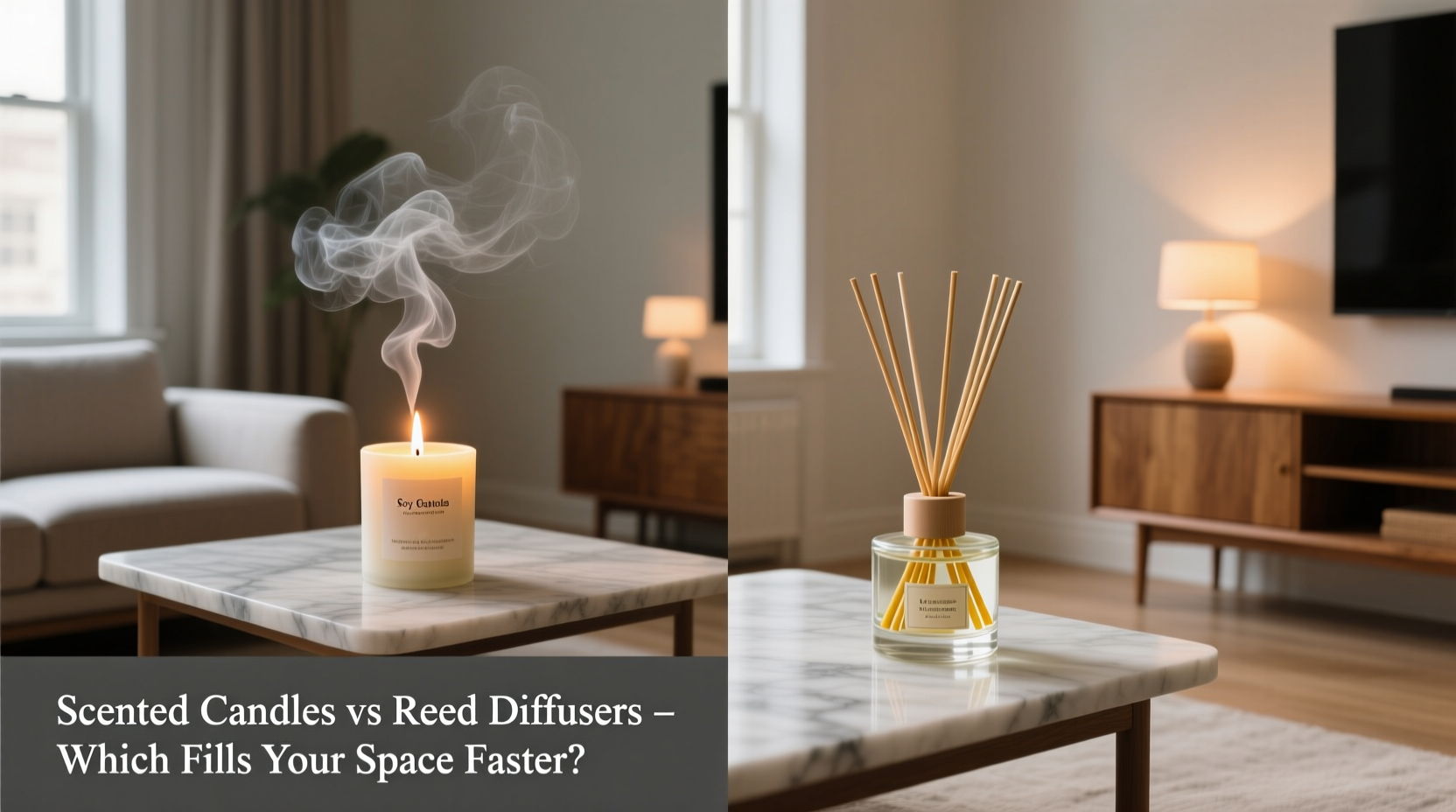
Fragrance dispersion depends on several factors: heat, airflow, molecular volatility, and surface area exposure. Candles rely on heat from a flame to melt wax and vaporize fragrance oils, releasing them rapidly into the air. This thermal process creates convection currents that push scent upward and outward, making candles effective at quickly filling small to medium-sized rooms.
In contrast, reed diffusers operate through passive capillary action. The porous reeds absorb scented oil from a bottle and gradually release it into the air via evaporation. This method is far slower and less intense but provides a continuous background presence without peaks or fluctuations.
The key difference lies in delivery speed versus consistency. A candle may flood a 300-square-foot studio within 10–15 minutes of burning, especially with top notes like citrus or mint. A reed diffuser, however, might take 48 hours to establish a noticeable scent profile—and even then, it will be subtle unless multiple reeds are used or placed near vents.
Speed of Scent Distribution: A Direct Comparison
To determine which option fills an apartment faster, consider real-world testing conditions. In a controlled environment (a standard 400 sq ft open-plan apartment with moderate ventilation), results show clear patterns:
- Scented Candle: Detectable scent within 5 minutes; full room saturation by 10–20 minutes depending on fragrance strength and wax type (soy, paraffin, coconut blend).
- Reed Diffuser: First detectable traces after 2–4 hours; balanced ambient scent takes 1–3 days to develop.
Candles win decisively in terms of speed. However, “faster” doesn’t always mean “better.” Rapid scent release increases the risk of olfactory fatigue—the phenomenon where your nose stops registering a smell due to overexposure. Strong initial bursts from candles can also trigger sensitivities in people with asthma or chemical sensitivities.
Reed diffusers avoid this issue entirely. Their slow, steady output maintains a stable scent level below the threshold of sensory overload. While they don’t deliver instant gratification, they create a more harmonious atmosphere over time.
“Passive diffusion systems like reed diffusers are ideal for maintaining baseline ambiance without shocking the senses,” says Dr. Lena Torres, environmental psychologist specializing in indoor well-being. “They support mood regulation without demanding attention.”
Controlled Intensity: Avoiding Overpowering Scents
One of the biggest concerns for urban dwellers is creating a welcoming environment without overwhelming guests—or themselves. Overpowering fragrances can cause headaches, nausea, or respiratory irritation, particularly in compact apartments where air circulation is limited.
Candles are inherently harder to modulate once lit. Even high-quality soy candles with natural essential oils can emit concentrated plumes of scent when burned for extended periods. The solution? Burn candles in short intervals (30–60 minutes) and monitor scent buildup. Never leave them unattended, and always extinguish before leaving the room.
Reed diffusers, on the other hand, allow precise control. You can adjust intensity by:
- Changing the number of reeds (more reeds = stronger scent)
- Flipping the reeds weekly to refresh output
- Placing the diffuser in high-airflow zones (near doorways, HVAC vents)
- Using lighter fragrance oils (e.g., linen, rain, green tea instead of patchouli or vanilla bourbon)
This adjustability makes reed diffusers superior for long-term comfort. They rarely become cloying unless misused—such as placing three large diffusers in a single bedroom.
Do’s and Don’ts for Balanced Scent Levels
| Action | Recommended | Not Recommended |
|---|---|---|
| Burning duration per session | 30–60 minutes | Over 2 hours continuously |
| Number of fragrance sources | 1–2 per apartment | 3+ simultaneous devices |
| Diffuser placement | Near natural airflow paths | In enclosed cabinets or corners |
| Candle fragrance type | Light florals, citrus, herbal | Dense gourmands (caramel, cinnamon) |
| Reed maintenance | Flip weekly | Leave untouched for months |
Real-World Scenario: A Studio Apartment Test
Jessica, a graphic designer living in a 380 sq ft Brooklyn studio, wanted to keep her workspace smelling fresh without distracting her focus or offending visiting clients. She tested both methods over four weeks:
- Week 1: Used only a lavender-vanilla soy candle, burning it daily for 1 hour.
- Week 2: Switched to a eucalyptus-tea tree reed diffuser near her desk.
- Week 3: Combined both: candle in evenings, diffuser during work hours.
- Week 4: Tried a strong sandalwood candle left burning for 90 minutes.
Her observations:
- The candle provided instant coziness but led to headaches by day three of Week 1.
- The reed diffuser took two days to register but remained consistently pleasant throughout Week 2.
- The hybrid approach in Week 3 worked best—she enjoyed evening ambiance from the candle while benefiting from the clean, neutral daytime scent of the diffuser.
- Week 4’s prolonged burn caused lingering smoke odor and made her partner feel lightheaded.
Conclusion: For her needs, the reed diffuser was safer and more sustainable, while the candle served best as a temporary accent. Neither alone achieved optimal balance—but together, they created a layered, adaptable fragrance strategy.
Step-by-Step Guide: Optimizing Your Fragrance Setup
If you're deciding between scented candles and reed diffusers—or using both—follow this timeline to maximize effectiveness without overloading your space:
- Day 1: Choose one central location (e.g., living room or entryway). Avoid kitchens or bathrooms unless targeting specific odors.
- Day 2: Place a reed diffuser with a light, clean scent (like ocean breeze or white musk). Use 4–6 reeds based on bottle size.
- Day 3–7: Monitor scent development. Flip reeds every third day. Do not add more reeds yet.
- Day 8: Light a scented candle for 30 minutes during peak occupancy (e.g., evening). Select a complementary fragrance.
- Day 9–14: Alternate usage. Use the candle no more than every other night for up to 1 hour. Keep diffuser active.
- Day 15: Evaluate overall impression. Is the scent noticeable but not intrusive? Can you still detect it after 10 minutes in the room?
- Ongoing: Replace candle wax when ½ inch remains. Refill diffuser before oil drops below 1 inch. Clean bottles with rubbing alcohol between refills to prevent clogging.
This phased approach prevents sensory conflict and allows your nose to adapt naturally. It also minimizes waste and ensures longevity from both products.
Longevity and Maintenance Considerations
Beyond scent speed and strength, practicality matters. How much effort are you willing to invest in upkeep?
Candles require regular monitoring. Wick trimming, soot cleanup, and avoiding tunneling (uneven melting) all affect performance. A typical 8 oz candle lasts 40–50 hours, meaning frequent replacement if used nightly. Additionally, open flames pose fire risks—especially in homes with pets, children, or flammable decor.
Reed diffusers demand almost no daily attention. Once set up, they function autonomously for 4–12 weeks depending on oil volume and airflow. Reeds eventually saturate and may need replacing every few months. High-quality rattan reeds last longer than bamboo alternatives and diffuse more evenly.
From a cost-efficiency standpoint, reed diffusers often prove cheaper over time despite higher upfront prices. One $38 diffuser lasting 10 weeks costs less per month than buying a new $22 candle every six weeks.
Checklist: Choosing What’s Right for You
- ✅ Do you want instant fragrance? → Prioritize candles
- ✅ Do you dislike constant supervision? → Choose diffusers
- ✅ Is safety a concern (pets, kids)? → Avoid open flames; go diffuser-only
- ✅ Do you experience scent sensitivity? → Opt for diffusers with mild essential oil blends
- ✅ Want low maintenance? → Reed diffusers win hands-down
- ✅ Crave ambiance and ritual? → Candles enhance mood and atmosphere
- ✅ Living in a studio or small apartment? → Use one device at a time; combine cautiously
Frequently Asked Questions
Can I use a reed diffuser and candle together safely?
Yes, as long as they’re not placed too close together and used simultaneously for extended periods. Pair them strategically—one during the day (diffuser), one in the evening (candle)—to avoid scent layering that becomes overwhelming. Ensure proper ventilation and never leave a burning candle near a diffuser bottle.
Why does my reed diffuser stop smelling after a few weeks?
This usually happens due to dust buildup on reeds, low oil levels, or placement in a stagnant air zone. Flip the reeds weekly to expose fresh oil, refill before the bottle runs dry, and position the diffuser where there’s gentle movement (e.g., near a doorway). Avoid direct sunlight, which degrades fragrance compounds.
Are there candles that diffuse scent gently like reed diffusers?
Some brands specialize in low-intensity candles using minimal fragrance load and natural waxes. Look for labels like “subtle,” “ambient,” or “wellness-focused.” These typically contain lower concentrations of essential oils and burn cooler, reducing vapor output. Still, they’ll never match the quiet consistency of a reed system.
Final Thoughts: Balance Over Speed
While scented candles fill an apartment faster, they do so at the cost of precision and sustainability. Their rapid diffusion is excellent for quick refreshment—after cooking, hosting, or waking up a stale room—but ill-suited for all-day wear.
Reed diffusers may lag in startup time, but they excel in delivering a reliable, understated presence. When subtlety and safety matter more than immediacy, they’re the smarter choice—especially in shared or compact living spaces.
The truth is, you don’t have to choose one over the other. Many find success in combining both: using candles for momentary indulgence and diffusers for foundational scent. The goal isn’t maximum fragrance, but thoughtful enhancement—creating an environment that feels inviting, not invaded.




 浙公网安备
33010002000092号
浙公网安备
33010002000092号 浙B2-20120091-4
Comments
No comments yet. Why don't you start the discussion?