
Choosing between scented candles and reed diffusers isn't just about aesthetics or scent preference—it's also about how long that fragrance lingers in your space. For homeowners, renters, and interior enthusiasts alike, understanding which option delivers longer-lasting aroma can influence purchasing decisions, budget planning, and even daily routines. While both are popular for enhancing ambiance, their performance in terms of fragrance longevity differs significantly due to fundamental differences in how they disperse scent.
This article dives deep into the mechanics, materials, and maintenance behind each method to answer the core question: which provides a more enduring fragrance experience? We’ll compare burn times, evaporation rates, environmental factors, and real-world usage patterns to help you make an informed decision based on durability, not just design.
How Scent Diffusion Works: The Science Behind the Aroma
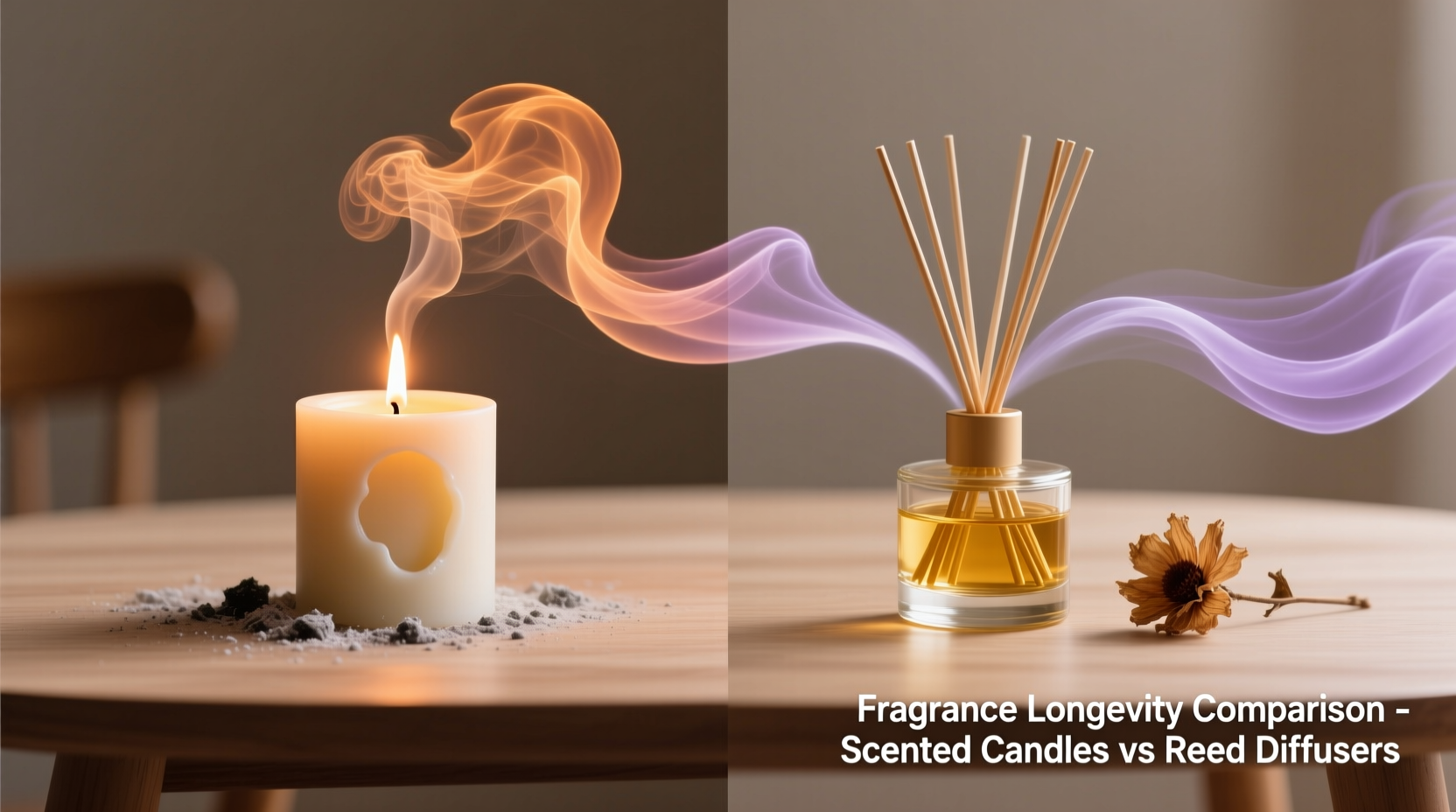
Fragrance delivery is governed by principles of evaporation and air movement. Scented candles rely on heat-induced vaporization, while reed diffusers operate through passive capillary action. Understanding these mechanisms explains why one may outlast the other under typical conditions.
In a candle, the flame melts the wax near the wick, turning it into a liquid pool. This liquefied wax absorbs the fragrance oil and carries it up the wick, where the heat volatilizes the scent molecules into the air. The intensity of the aroma depends on the size of the melt pool, the quality of the wax, and the concentration of fragrance oil. However, this process consumes the wax and fragrance simultaneously—each use reduces the total volume available.
Reed diffusers work differently. They consist of a bottle filled with scented oil and porous reeds (often rattan) inserted into the liquid. Through capillary action, the oil travels up the reeds and evaporates from the surface fibers into the surrounding air. Because there’s no combustion or melting involved, the consumption rate is much slower. The scent release is continuous but subtle, relying entirely on ambient temperature and airflow.
“Passive diffusion systems like reed diffusers can maintain consistent fragrance output over months because they don’t degrade the carrier medium.” — Dr. Lena Patel, Aromachologist & Home Fragrance Researcher
Comparing Longevity: Burn Time vs. Evaporation Rate
To determine which option lasts longer, we must examine actual usage data and product specifications. On average:
- Soy wax candles burn approximately 50–60 hours per 8 oz container.
- Paraffin candles last around 40–50 hours for the same size.
- Reed diffusers typically release fragrance for 3–4 months from an 8 oz bottle.
At first glance, reed diffusers appear superior in duration. But let’s break down what “lasting longer” really means.
| Product Type | Average Lifespan (8 oz) | Fragrance Intensity | Active Use Required? | Maintenance Needs |
|---|---|---|---|---|
| Soy Candle | 50–60 hours | High (during burning) | Yes (must be lit) | Trim wick, avoid tunneling |
| Paraffin Candle | 40–50 hours | Moderate to High | Yes | Wick trimming, even burning |
| Reed Diffuser | 90–120 days | Low to Moderate (constant) | No | Flip reeds monthly |
The numbers show that reed diffusers offer extended service life when measured in calendar time. A candle burning two hours per day will deplete in about one month. In contrast, a reed diffuser runs 24/7 without user intervention and still lasts three to four times longer.
However, intensity matters. Candles produce a powerful burst of fragrance during use, especially when warmed across the full top layer. Reed diffusers emit a gentle, background note that may go unnoticed in large or drafty rooms. So while reed diffusers technically last longer, their impact is less immediate.
Factors That Influence Fragrance Duration
Longevity isn’t fixed—it varies based on several environmental and behavioral factors. Both candles and diffusers respond differently to changes in surroundings.
Temperature and Airflow
Higher temperatures increase evaporation rates. A reed diffuser in a warm bathroom will lose scent faster than one in a cool hallway. Similarly, candles burn quicker in hot environments due to softer wax and larger melt pools. Drafts accelerate scent dispersion but shorten effective exposure time by carrying fragrance away from the breathing zone.
Bottle Size and Oil Quality
Larger diffuser bottles (e.g., 10 oz or 12 oz) naturally last longer. Premium brands often use concentrated fragrance oils diluted in carrier liquids like dipropylene glycol, which evaporate slowly. In contrast, low-cost diffusers may use alcohol-based solutions that dissipate within weeks.
Candles vary widely too. Hand-poured artisanal candles with high fragrance load (up to 10%) tend to smell stronger and longer than mass-market versions capped at 6–7%. Wax type also plays a role: soy wax holds fragrance well and burns cleanly, while paraffin can sometimes trap scent unless properly formulated.
Reed Quantity and Flipping Frequency
Most diffusers come with 6–8 reeds. Using fewer reeds slows diffusion; adding extras increases output but shortens lifespan. Flipping the reeds every 2–4 weeks refreshes the scent by exposing soaked ends to air, boosting evaporation temporarily. Over-flipping, however, accelerates depletion.
Candle Burning Habits
Improper candle use drastically reduces usable life. Lighting a candle for only 30 minutes creates \"tunneling,\" where wax builds up along the edges and traps fragrance. To achieve full melt pool formation, manufacturers recommend burning for at least one hour per inch of diameter. Skipping this step wastes up to 30% of the candle’s potential lifespan.
“Many consumers underestimate how much improper burning habits affect candle longevity. A well-maintained candle can deliver up to 25% more burn time.” — Marcus Tran, Master Candlemaker & Product Developer
Real-World Example: A Month-Long Home Test
In a controlled test conducted in a 1,200 sq ft apartment, two identical rooms were treated with different fragrance systems:
- Room A: 8 oz lavender soy candle, burned for 2 hours nightly.
- Room B: 8 oz eucalyptus reed diffuser, placed on a side table near the door.
After four weeks:
- The candle had accumulated 56 hours of burn time and was approximately 70% depleted. Strong scent throw was noted during burning, but no residual aroma remained afterward.
- The diffuser showed minimal oil level change (~20% used) and provided a constant, light fragrance detectable upon entering the room. Residents reported feeling calmer in this space throughout the day.
By week eight, the candle was finished. The diffuser continued releasing scent for another six weeks, though the strength diminished after week 10. Total useful life: 56 hours for the candle versus ~100 days for the diffuser.
This case illustrates that while candles offer sensory richness in short bursts, reed diffusers provide sustained, low-level fragrance coverage ideal for all-day ambiance.
Step-by-Step Guide to Maximizing Fragrance Longevity
Whether you prefer candles or diffusers, smart practices extend their life and improve value.
- For Candles:
- Trim the wick to ¼ inch before each lighting to prevent sooting and uneven burns.
- Burn long enough to form a full melt pool (usually 1 hour per inch of diameter).
- Keep away from drafts to ensure even consumption.
- Store unlit candles in cool, dark places to preserve fragrance integrity.
- For Reed Diffusers:
- Start with all reeds inserted, then remove some if the scent is too strong.
- Flip reeds every 3–4 weeks—or when scent fades—to reactivate evaporation.
- Avoid placing near windows, heaters, or fans that speed up oil loss.
- Use dust covers when cleaning nearby to prevent clogging of reed pores.
Frequently Asked Questions
Do reed diffusers really last longer than candles?
Yes, in terms of calendar time and continuous operation. An 8 oz reed diffuser typically lasts 3–4 months with 24/7 diffusion, whereas an 8 oz candle lasts 40–60 hours of active burning—equivalent to about 20–30 days if used 2 hours per day.
Can I make my scented candle last as long as a diffuser?
Not realistically. Even with perfect burning habits, candles consume wax and fragrance with every use. To match a 4-month diffuser lifespan, a candle would need to burn nonstop for over 250 hours, requiring multiple large containers and constant supervision—making it impractical and potentially unsafe.
Why does my reed diffuser stop smelling after a few weeks?
The oil hasn’t necessarily run out. Reeds can become clogged with dust or fully saturated, reducing capillary action. Try flipping them or replacing them with fresh reeds. Also, olfactory fatigue—your nose getting used to the scent—can make it seem like the fragrance disappeared when it’s still present.
Which Is More Cost-Effective Over Time?
When evaluating cost per month of fragrance, reed diffusers generally win. Consider this comparison:
- An 8 oz premium candle costs $28 and lasts 2 months (with moderate use).
- An 8 oz reed diffuser costs $32 but lasts 4 months.
Monthly cost:
- Candle: $14/month
- Diffuser: $8/month
Even with occasional reed replacement ($5/pack), the diffuser remains cheaper. Additionally, electricity or fire risk associated with candles adds hidden costs in safety and energy use.
Conclusion: Choosing Based on Your Lifestyle
If your priority is long-lasting fragrance with minimal effort, reed diffusers are the superior choice. Their passive operation, extended lifespan, and steady release make them ideal for entryways, bathrooms, offices, and bedrooms where consistent background scent enhances comfort without demanding attention.
Scented candles, while shorter-lived, offer unmatched sensory appeal—the flickering flame, the warmth, and the powerful scent burst during burn time create moments of ritual and relaxation. They’re better suited for special occasions, evening wind-downs, or spaces where intermittent but intense fragrance is desired.
Ultimately, many people benefit from using both: a reed diffuser for everyday ambiance and a candle for targeted aromatic experiences. By understanding how each works and applying proper care techniques, you can enjoy richer, longer-lasting fragrance in every room.




 浙公网安备
33010002000092号
浙公网安备
33010002000092号 浙B2-20120091-4
Comments
No comments yet. Why don't you start the discussion?