
In an age where smartphones are extensions of our daily lives, protecting the screen is not just about preserving aesthetics—it’s about maintaining usability, responsiveness, and long-term value. A cracked or scratched display can degrade touch sensitivity, distort visuals, and even compromise privacy. While many users assume all screen protectors offer equal protection, the reality is that performance varies dramatically based on material, thickness, adhesion method, and design. Among the most common concerns during selection are resistance to bubbles during installation and resilience against everyday scratches. Some materials are inherently more forgiving during application, while others provide superior scratch resistance due to hardness ratings. Understanding the differences between tempered glass, TPU film, PET plastic, and hybrid options allows consumers to make informed decisions that balance ease of use with durability.
Understanding Screen Protector Materials
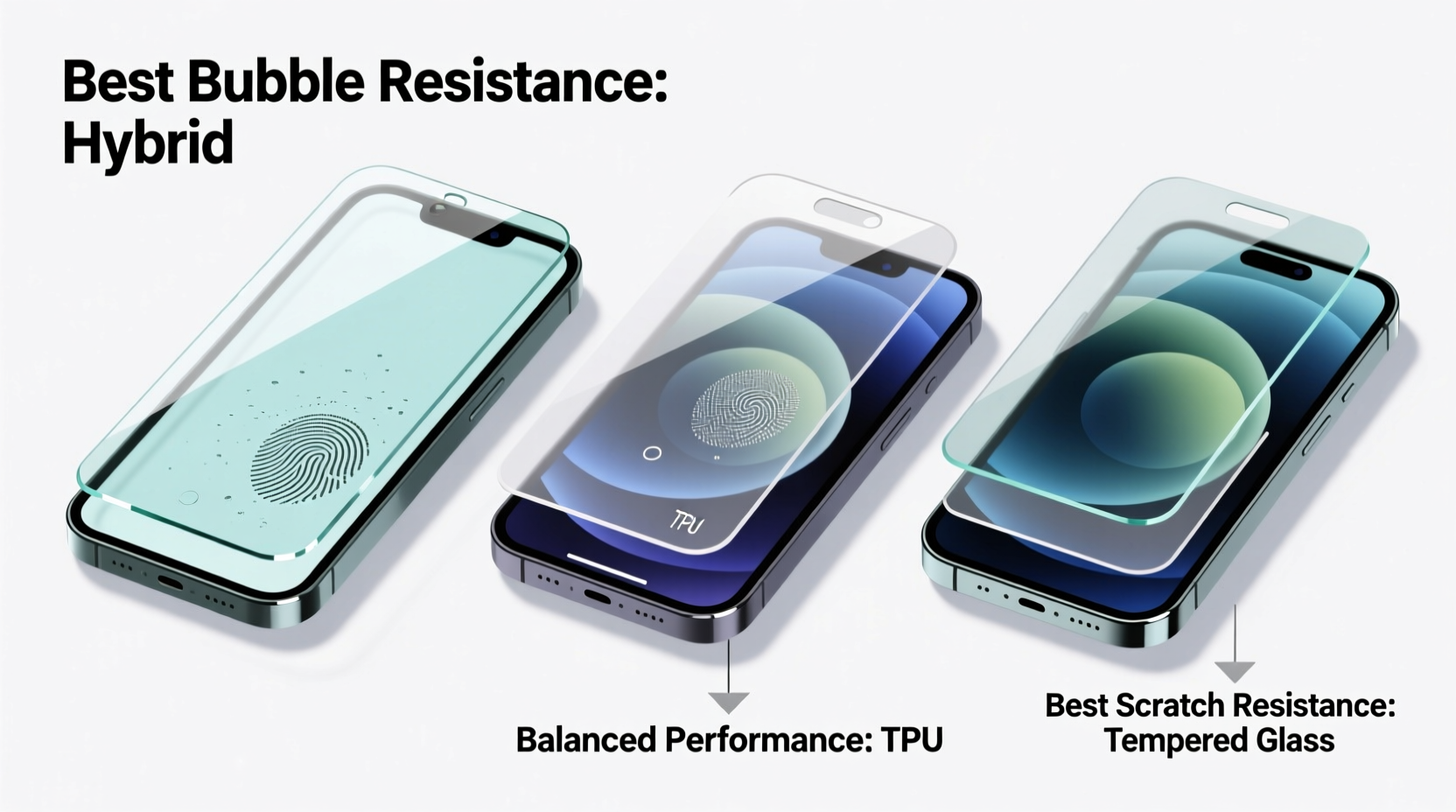
Screen protectors fall into several distinct categories, each defined by its base material and structural composition. The choice of material directly impacts both scratch resistance and bubble formation during installation. The three primary types are tempered glass, thermoplastic polyurethane (TPU), and polyethylene terephthalate (PET). Each has unique properties that affect clarity, tactile feel, impact absorption, and longevity.
Tempered glass protectors are made from chemically strengthened glass, typically ranging from 0.2mm to 0.3mm in thickness. They undergo a process called ion exchange, where smaller sodium ions on the surface are replaced with larger potassium ions, creating compressive stress that enhances strength. This gives them high scratch resistance—often rated at 9H on the pencil hardness scale, which means they can withstand sharp objects like keys and coins without marring. However, their rigidity makes precise alignment critical during installation, increasing the risk of trapped air bubbles if not applied carefully.
TPU film protectors, often marketed as “self-healing” or “flexible” films, are softer and more pliable than glass. They conform easily to curved screens, making them ideal for modern smartphones with edge displays. TPU is naturally adhesive and uses a static cling or silicone-based glue layer that bonds smoothly to the screen, significantly reducing the chance of bubbles. Minor scratches tend to disappear over time due to the material’s elasticity. However, TPU scores lower on scratch resistance—usually around 4H to 6H—making it vulnerable to deeper abrasions from sand or metal objects.
PET protectors are the oldest type, originally used in early smartphone accessories. Made from a thin polyester film, they are inexpensive and lightweight but offer minimal protection. With a typical hardness of 3H, they scratch easily and lack shock absorption. Their rigid flatness also increases the likelihood of bubbles unless perfectly aligned. While still available, PET is largely outdated except for budget-conscious buyers or temporary use.
Comparing Bubble Resistance Across Types
Bubbles form when air or dust gets trapped between the screen and the protector during installation. The likelihood of this happening depends on the material’s flexibility, adhesive type, and how forgiving the application process is.
TPU film protectors have the highest bubble resistance due to their elastic nature and advanced adhesive systems. Most use a hydrophilic or silicone gel layer that slowly spreads out air pockets over minutes or hours. Even if small bubbles appear initially, they often dissipate on their own. This self-adjusting property makes TPU ideal for DIY installations, especially on curved OLED displays found in flagship devices.
Tempered glass protectors rely on pre-applied OCA (optically clear adhesive) layers. These create a permanent bond once pressure is applied, but there's no room for error. If misaligned, the adhesive activates immediately, locking in any trapped air. Some premium kits include alignment trays to ensure perfect placement, reducing user error. Despite advancements, glass remains less tolerant of imperfect conditions than TPU.
PET films behave similarly to glass in terms of bubble risk—they require meticulous cleaning and steady hands. Because they don’t conform well to slight imperfections or micro-dust, even tiny contaminants lead to visible bubbles. Unlike TPU, they do not self-heal or reposition.
“Bubble-free installation isn’t just about skill—it’s about choosing a material that compensates for human error. For most users, TPU offers the best margin of forgiveness.” — Daniel Reyes, Mobile Accessory Engineer at TechShield Labs
Scratch Resistance Performance by Type
When evaluating scratch resistance, manufacturers use the pencil hardness test, which measures how resistant a coating is to being scratched by pencils of varying graphite hardness. Ratings range from 1H (softest) to 9H (hardest), with 9H comparable to sapphire crystal.
| Protector Type | Average Hardness Rating | Real-World Scratch Resistance | Bubble Risk Level |
|---|---|---|---|
| Tempered Glass | 9H | Resists keys, coins, sand; may chip under extreme impact | Medium to High |
| TPU Film | 4H–6H | Resists light scuffs; deep scratches from metal possible | Low |
| PET Film | 3H | Scratches easily from everyday contact | High |
| Hybrid (Glass + TPU) | 8H–9H | Near-glass hardness with better flexibility | Low to Medium |
The data shows a clear trade-off: higher scratch resistance correlates with increased installation difficulty. Tempered glass leads in surface protection but demands precision. TPU sacrifices some hardness for adaptability. Hybrid models attempt to bridge the gap by combining a rigid top layer with a flexible base, offering strong scratch resistance and improved bubble tolerance.
Step-by-Step Guide to Bubble-Free Installation
Even the most resilient protector fails if installed poorly. Follow this sequence to maximize success regardless of type:
- Wash your hands thoroughly to avoid transferring oils to the screen or protector.
- Power off the device to eliminate static attraction and improve visibility.
- Clean the screen using the included alcohol wipe, then dry with the microfiber cloth. Wipe in one direction to avoid spreading debris.
- Use the dust removal sticker (if provided) to lift remaining particles—press gently and repeat until no specks remain.
- Align the protector carefully. For glass, use the alignment frame. For TPU, center manually and lower slowly from one edge.
- Press from the center outward using a swipe card or soft cloth to push air toward the edges.
- Wait 15–30 minutes for TPU films to settle; bubbles should vanish naturally. For glass, bubbles usually indicate trapped dust and may require replacement.
Real-World Case Study: Daily Commuter vs. Outdoor Enthusiast
Consider two users with different lifestyles: Maria, a city commuter who carries her phone in a pocket alongside keys and change, and Jordan, a hiker who stores their phone in a backpack with gravel and tools.
Maria frequently notices fine scratches on her previous PET protector after just two weeks. After switching to a 9H tempered glass model, she observes no new marks—even after accidental contact with her house key. However, she struggled with bubbles during installation and had to replace the first attempt. Once properly applied, the glass remained flawless for six months.
Jordan opted for a TPU film due to its flexibility and bubble-resistant adhesive. While hiking, the phone was exposed to dirt, sand, and occasional drops onto rocky surfaces. The TPU developed minor surface scuffs but showed no cracks or lifting edges. More importantly, microscopic dust didn’t cause bubbles thanks to the adaptive adhesive. Although not as hard as glass, the self-healing feature erased light abrasions within hours.
This contrast illustrates that the “best” protector depends on usage patterns. Maria benefits from maximum scratch resistance despite installation challenges. Jordan prioritizes reliability in variable conditions, favoring ease of use and conformity over absolute hardness.
Expert Recommendations and Emerging Innovations
Industry experts increasingly recommend hybrid screen protectors for balanced performance. These combine a thin glass-like top layer (often silicon dioxide-coated polymer) with a TPU underlayer. The result is a product that scores 8H–9H in scratch tests while retaining the flexibility and bubble resistance of film-based designs.
Recent innovations include nano-adhesive coatings that allow repositioning during installation, UV-cured resins that bond instantly under blue light, and anti-microbial layers that inhibit bacterial growth on frequently touched surfaces. Some brands now offer “smart alignment” systems using magnetic guides or vacuum-assisted mounting for professional-grade results at home.
“The future of screen protection lies in intelligent materials—ones that are tough enough to resist damage but smart enough to forgive mistakes.” — Dr. Lena Park, Materials Scientist at Corning Incorporated
Frequently Asked Questions
Can a screen protector prevent my phone from cracking?
No screen protector can fully prevent a drop-induced crack in the underlying display, especially with modern OLED panels. However, tempered glass protectors absorb and distribute impact energy, reducing the chance of damage. They are far more effective at stopping scratches and minor scrapes than preventing shattering.
Do self-healing screen protectors really work?
Yes, but only for very fine surface scratches. Self-healing refers to the ability of certain polymers (like TPU) to flow slightly at a molecular level, closing shallow marks caused by fingernails or fabric. Deep gouges or those from metal objects will not repair themselves.
Is it worth paying more for a 9H-rated protector?
If you carry your phone loosely in pockets or bags with other items, yes. A 9H rating significantly improves resistance to everyday hazards like keys and coins. However, if your phone stays in a case or pouch, a high-quality TPU may offer sufficient protection with easier installation.
Final Verdict: Which Type Resists Bubbles and Scratches Best?
No single screen protector excels equally in both bubble resistance and scratch protection—but the closest compromise is the hybrid category. For users who prioritize scratch resistance above all, tempered glass with a 9H rating is unmatched. It withstands repeated contact with hard objects and maintains optical clarity over time. However, achieving a bubble-free finish requires patience and a controlled environment.
For those seeking hassle-free installation and reliable daily protection, TPU film remains the most bubble-resistant option. Its ability to conform to screens and eliminate trapped air makes it ideal for non-technical users or those with curved displays. While not as hard as glass, modern TPU formulations with enhanced coatings offer respectable scratch resistance for most scenarios.
In summary: If scratch resistance is your top priority → choose **tempered glass** (accept higher bubble risk). If bubble resistance and ease of use matter most → go with **TPU film**. For a balanced solution → invest in a **hybrid protector** combining durability and flexibility.




 浙公网安备
33010002000092号
浙公网安备
33010002000092号 浙B2-20120091-4
Comments
No comments yet. Why don't you start the discussion?