
In today’s digital economy, sharing your credit card information is often unavoidable—whether you’re shopping online, signing up for a subscription, or verifying identity with a service provider. However, simply entering your card details doesn’t guarantee they’ll be processed securely. A critical step in protecting yourself is knowing how to verify your credit card number safely—without risking exposure to fraud, phishing, or data breaches.
Verification isn’t just about typing digits correctly; it’s about confirming authenticity, ensuring system compatibility, and safeguarding your financial identity. This guide walks through practical, secure methods to validate your credit card number while minimizing risk. You’ll learn what checks are legitimate, which red flags to watch for, and how to use tools that protect rather than compromise your data.
Understanding Credit Card Number Structure
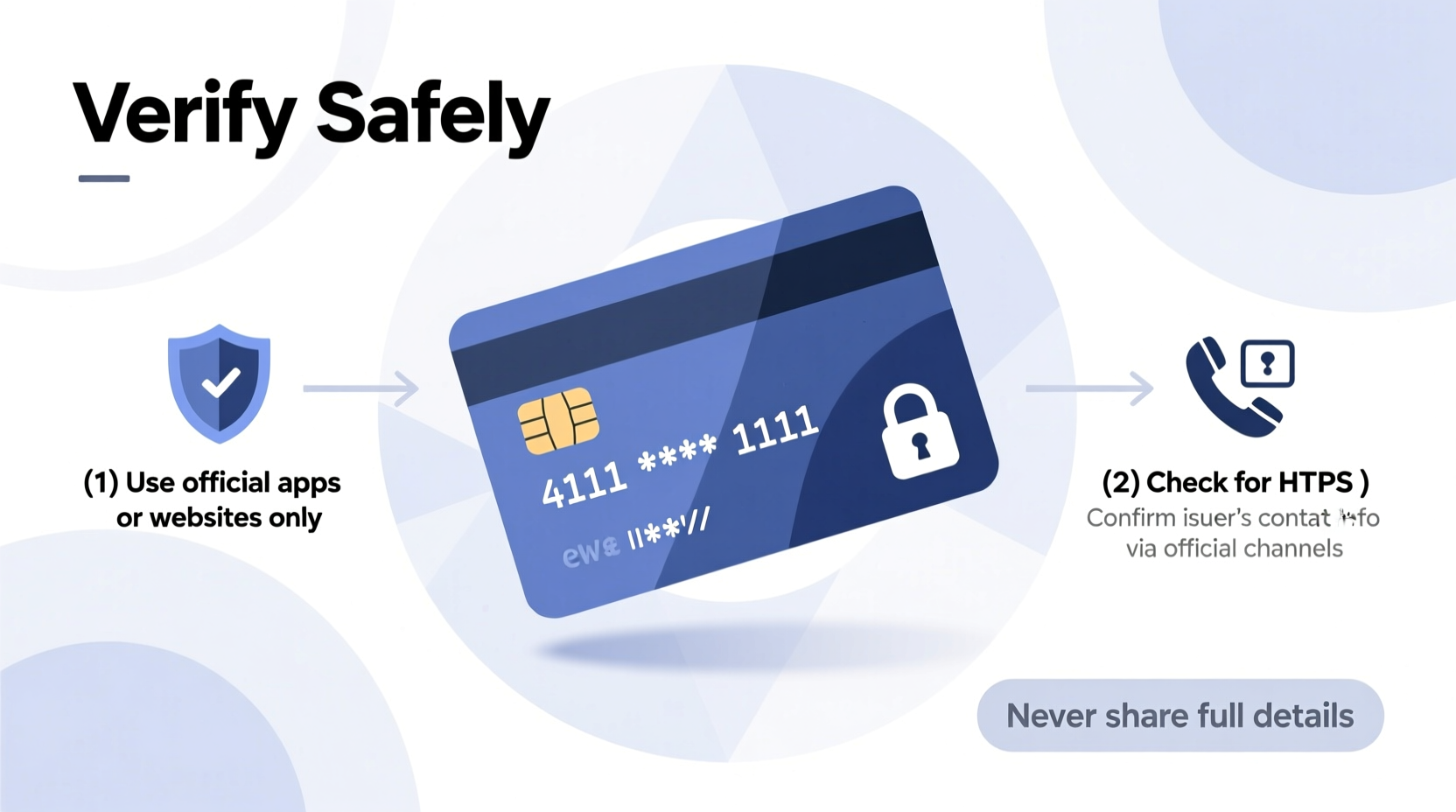
Every credit card number follows a standardized format defined by the International Organization for Standardization (ISO/IEC 7812). Knowing this structure helps you recognize valid numbers and detect potential errors or fraudulent attempts.
A typical credit card number contains 13 to 19 digits and includes three key components:
- Issuer Identification Number (IIN): The first 6 digits identify the institution that issued the card (e.g., Visa, Mastercard).
- Account Number: The middle digits (up to 12) represent your individual account.
- Check Digit: The final digit, calculated using the Luhn algorithm, verifies numerical integrity.
This built-in validation system allows systems—and informed users—to confirm whether a card number is structurally sound before any transaction occurs.
How the Luhn Algorithm Works for Safe Validation
The Luhn algorithm (also known as the \"modulus 10\" or \"mod 10\" check) is a mathematical formula used globally to validate identification numbers, including credit cards. It detects common input errors like transposed or mistyped digits—but importantly, it does not require access to your bank or personal data.
You can apply the Luhn test manually or via trusted software tools to verify if a card number is mathematically valid. Here's how it works:
- Starting from the rightmost digit (excluding the check digit), double the value of every second digit.
- If doubling results in a two-digit number, add those digits together (e.g., 12 becomes 1 + 2 = 3).
- Sum all the digits, including the unchanged ones and the modified ones.
- Add the original check digit to this total.
- If the final sum is divisible by 10, the card number passes the Luhn check.
For example, consider the number: 4532 1234 5678 9012
| Step | Action | Result |
|---|---|---|
| 1 | Double every second digit from right: 1→2, 9→18, 7→14, 5→10, 3→6, 1→2, 3→6, 4→8 | 2, 18, 14, 10, 6, 2, 6, 8 |
| 2 | Break down two-digit results: 18→1+8=9, 14→1+4=5, etc. | 2, 9, 5, 1, 6, 2, 6, 8 |
| 3 | Sum modified digits: 2+9+5+1+6+2+6+8 = 39 | 39 |
| 4 | Add remaining digits: 0+8+6+4+2+3+2+5 = 30 | 30 |
| 5 | Total: 39 + 30 + 2 (check digit) = 71 → Not divisible by 10 | Invalid |
This means the number fails the Luhn test and cannot be a real credit card number. While passing the test doesn’t prove legitimacy, failing it confirms an error or forgery.
“Using the Luhn algorithm is one of the simplest yet most effective front-line defenses against accidental entry mistakes or intentional fake submissions.” — David Lin, Senior Security Analyst at FinShield Labs
Safe Methods to Verify Your Credit Card Number
When verification is required—for account setup, payment processing, or identity confirmation—use these secure approaches:
1. Use Reputable Payment Gateways
Trusted platforms like Stripe, PayPal, or Square automatically validate card numbers during checkout using encrypted connections and backend Luhn checks. These services never store raw card data and comply with PCI DSS standards.
2. Leverage Bank-Provided Tools
Many banks offer mobile apps or web portals where you can view masked card details and verify active status. If you're unsure whether a card is still valid, log into your account directly through the bank’s official site—not via links in emails.
3. Employ Offline Validators (Open Source)
Developers and cautious users can run local scripts that perform Luhn checks without transmitting data. For instance, a simple Python function can validate a number on your device:
def luhn_check(card_num):
    digits = [int(d) for d in card_num if d.isdigit()]
    checksum = 0
    for i, digit in enumerate(reversed(digits)):
        if i % 2 == 1:
            doubled = digit * 2
            checksum += doubled if doubled < 10 else doubled - 9
        else:
            checksum += digit
    return checksum % 10 == 0
Since this runs locally, no data leaves your computer—making it ideal for testing forms or validating inputs securely.
4. Confirm Through Small Authorization Holds
Serious services may place a temporary $1–$2 hold to confirm card validity. These appear briefly on statements and are automatically reversed. This method confirms both number accuracy and card activity without charging you.
Red Flags: When Verification Requests Are Risky
Not all requests to “verify” your card are safe. Scammers often disguise phishing efforts as routine validations. Watch for these warning signs:
| Do’s | Don’ts |
|---|---|
| Verify cards only on HTTPS websites with padlock icons | Enter card details on sites reached via email links |
| Use virtual card numbers for online sign-ups | Share your CVV during initial number verification |
| Confirm requests by contacting the company directly via phone | Respond to unsolicited texts asking for full card numbers |
A real-world example illustrates the danger: Sarah received an email claiming her streaming subscription needed “immediate card re-verification.” The link led to a near-perfect replica of the service’s login page. She entered her card details, only to find $300 charged to unknown vendors within hours. The company later confirmed they never sent such a message.
This is classic social engineering. Legitimate companies do not ask for full card numbers via email or unsecured forms.
FAQ: Common Questions About Credit Card Verification
Can I verify my credit card number without making a purchase?
Yes. Many services use zero-dollar authorizations or small temporary holds ($0.00–$1.00) to confirm card validity. These are removed quickly and don’t count as purchases.
Is it safe to use online credit card validators?
Only if they are reputable, open-source, and do not transmit data. Avoid entering real card numbers into random websites—even if they claim to “test” validity. Stick to offline tools when possible.
Does passing the Luhn check mean the card is real?
No. The Luhn algorithm only verifies numerical consistency. Fake generators can produce valid-looking numbers that pass the test but aren’t tied to any actual account.
Conclusion: Stay Proactive, Stay Protected
Verifying your credit card number doesn’t have to mean exposing yourself to risk. By understanding the structure of card numbers, leveraging the Luhn algorithm, and relying on secure channels like official banking apps or PCI-compliant gateways, you maintain control over your financial information.
Always question unexpected verification requests, avoid public networks when handling payments, and use tools that keep your data local and encrypted. Digital convenience should never come at the cost of security.




 浙公网安备
33010002000092号
浙公网安备
33010002000092号 浙B2-20120091-4
Comments
No comments yet. Why don't you start the discussion?