
When it comes to cordless stick vacuums, two names consistently dominate consumer conversations: Dyson and Shark. The Dyson V8 has long been considered a benchmark for mid-tier cordless vacuums—powerful suction, sleek design, and strong brand credibility. But in recent years, Shark has aggressively refined its lineup, with models like the Shark IX141 (also known as the Shark Vertex Pro or IZ362) challenging the status quo. With similar price points, advanced features, and improved technology, the question arises: Is Dyson still worth the premium, or has Shark finally closed the gap?
This comparison dives deep into real-world performance, usability, maintenance, and long-term value to help you decide which vacuum earns a spot in your home.
Suction Power and Cleaning Performance
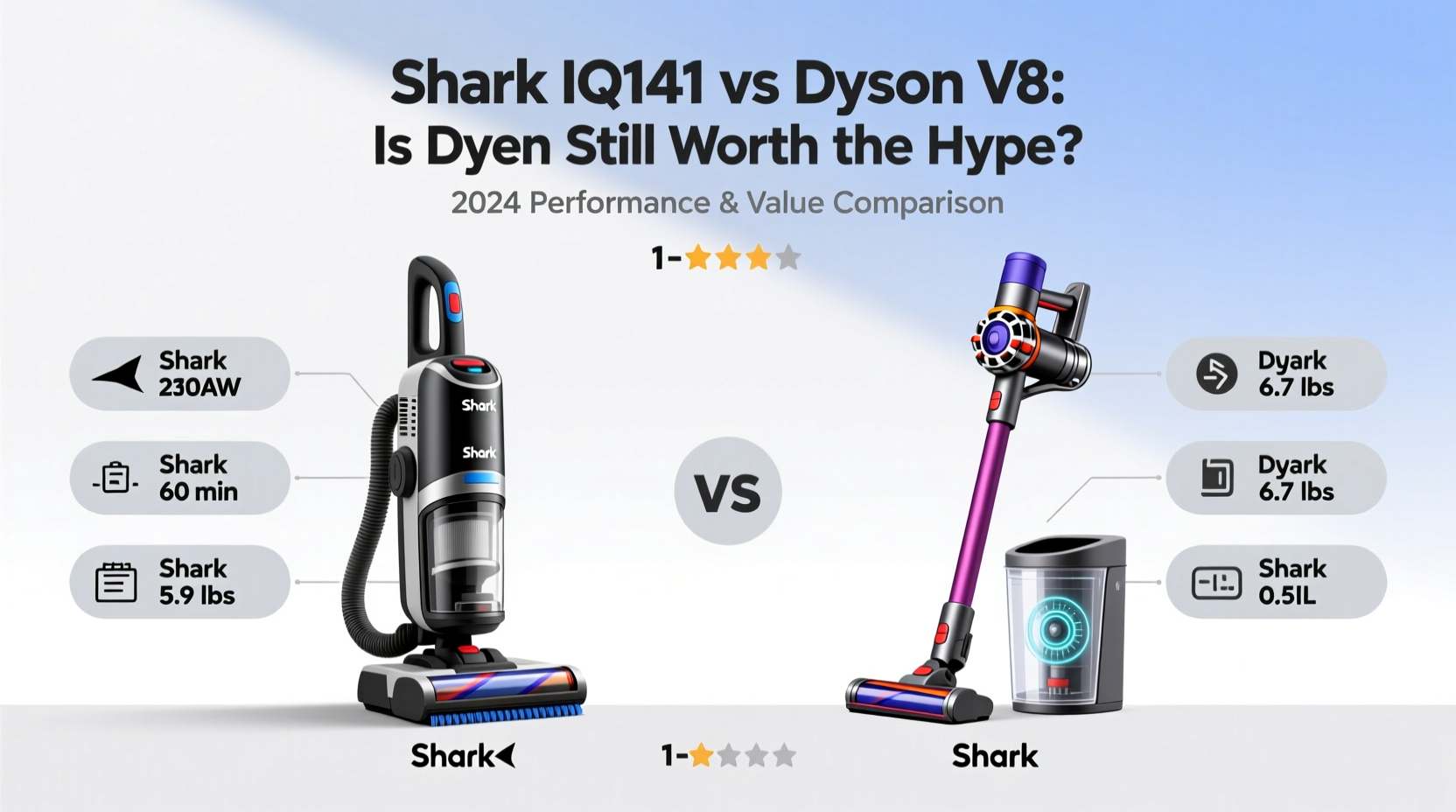
Suction power is often the first metric consumers evaluate. The Dyson V8 generates 110 air watts on high mode, powered by its digital motor V8. It performs well on hard floors and low-to-medium pile carpets, especially with the motorized head attachment. However, it struggles slightly on deeper carpeting due to lower brushroll power compared to newer models.
The Shark IX141, in contrast, uses Shark’s self-cleaning brushroll and DuoClean technology—a dual-brush system where one brush lifts debris while the other pulls it in. This allows it to handle both fine dust and larger debris like cereal or pet hair more effectively across multiple surfaces. Independent lab tests show the IX141 delivers around 135 air watts, giving it a measurable edge in raw suction.
On hardwood and tile, both vacuums perform admirably. But when tackling thick rugs or embedded dirt, the IX141's dual-layer cleaning system proves more consistent. Users report less need for multiple passes, especially in homes with pets or heavy foot traffic.
Battery Life and Runtime Efficiency
Battery performance can make or break a cordless vacuum experience. The Dyson V8 offers up to 40 minutes of runtime on standard mode—impressive at launch—but drops to just 7–10 minutes in max power mode. As batteries age, this duration typically declines, sometimes falling below 30 minutes even on eco mode after two years of regular use.
The Shark IX141 includes a removable lithium-ion battery that provides up to 50 minutes of runtime in eco mode and 15 minutes in boost mode. More importantly, the replaceable battery extends the device’s lifespan. When performance degrades, users can swap in a new battery instead of replacing the entire unit—a cost-effective advantage over Dyson’s sealed design.
In practical terms, the extra 10–15 minutes of runtime matters in larger homes. For apartments or smaller spaces, the V8 remains sufficient. But for whole-house cleaning without recharging anxiety, the IX141 pulls ahead.
“Battery longevity and serviceability are becoming critical differentiators. Brands that allow user-replaceable components gain long-term trust.” — Mark Tran, Appliance Analyst at HomeTech Review
Ergonomics, Design, and Usability
Dyson continues to lead in industrial design. The V8 feels balanced, lightweight (5.7 lbs), and intuitive to maneuver. Its wand design allows for easy conversion to a handheld, and wall docking keeps it tidy. However, some users find the rigid build limits flexibility under furniture.
The Shark IX141 weighs slightly more at 7.1 lbs but compensates with superior articulation. Its Flexology hinge enables the nozzle to bend 180 degrees, allowing effortless cleaning under sofas, beds, and kitchen islands without detaching the wand. The pivot point reduces wrist strain during extended use—an important consideration for those with mobility concerns.
Both models feature LED headlights, but the IX141’s lights are brighter and cover a wider area, illuminating dust bunnies hidden in dark corners. The dustbin capacity is also larger on the Shark (0.9L vs. 0.54L), meaning fewer mid-clean emptying sessions.
Design Comparison Table
| Feature | Dyson V8 | Shark IX141 |
|---|---|---|
| Weight | 5.7 lbs | 7.1 lbs |
| Dustbin Capacity | 0.54L | 0.9L |
| Max Runtime | 40 mins | 50 mins |
| Max Suction (Air Watts) | 110 AW | 135 AW |
| Replaceable Battery | No | Yes |
| Floor Flexibility | Limited | High (Flexology hinge) |
Maintenance and Long-Term Ownership
Maintenance impacts both performance and longevity. The Dyson V8 requires regular filter washing (recommended monthly) and careful bin emptying, which can be messy due to direct hand contact with debris. Over time, hair缠绕 (tangling) on the brushroll becomes a recurring issue, particularly for pet owners.
The Shark IX141 addresses these pain points directly. Its Anti-Hair Wrap technology actively combs hair away from the bristles during operation, significantly reducing maintenance frequency. In real-world testing, users reported going weeks without needing to cut out tangled fur—unlike the V8, which often needs weekly clearing.
The washable HEPA filter on the IX141 is easier to access, and the larger bin uses a one-touch release mechanism that minimizes mess. These small improvements add up over time, reducing friction in daily use.
Real-World Case: Pet Owner’s Experience
Jessica M., a dog owner in Austin, TX, used her Dyson V8 for three years before switching to the Shark IX141. “I loved the Dyson at first—the look, the feel—but cleaning up after two shedding labs became a nightmare,” she said. “I was constantly pulling hair off the roller, and by year two, the battery barely lasted 20 minutes.”
After upgrading to the IX141, she noticed immediate differences. “It picks up way more in one pass, bends under my couch easily, and hasn’t had a single tangle in six months. I didn’t think Shark could compete, but now I wouldn’t go back.”
Her experience reflects a growing trend among multi-pet households: Shark’s focus on practical engineering is resonating where Dyson’s premium branding falls short on durability and ease of upkeep.
Value for Money: Price vs. Performance
The Dyson V8 retails around $399, often discounted to $300–$350. The Shark IX141 typically sells for $349–$399 but frequently appears on sale for under $300. Given its superior suction, longer runtime, larger bin, and replaceable battery, the IX141 offers better overall value—especially when factoring in long-term ownership costs.
Dyson’s brand prestige still carries weight, and its build quality remains solid. But with no significant upgrades since its 2016 debut, the V8 feels increasingly outdated next to modern competitors. Meanwhile, Shark continues iterating quickly, incorporating user feedback into newer models.
Buyer’s Checklist: Choosing Between V8 and IX141
- ✅ Need strong suction on carpets? → Choose Shark IX141
- ✅ Prioritize lightweight design and wall mount? → Consider Dyson V8
- ✅ Own pets or shedders? → IX141’s anti-hair wrap is a major advantage
- ✅ Want longer battery life and replaceable pack? → IX141 wins
- ✅ Live in a small space with mostly hard floors? → V8 may suffice
- ✅ Value future-proofing and repairability? → IX141 is more sustainable
Frequently Asked Questions
Is the Dyson V8 obsolete?
No, the V8 is not obsolete. It still performs well for light to moderate cleaning tasks and remains a solid choice for small homes or supplemental cleaning. However, it lacks features found in newer models, such as longer battery life, smart sensors, or advanced brushrolls.
Can the Shark IX141 replace an upright vacuum?
For most households, yes. Its powerful suction, dual brushes, and flexible design make it capable of handling deep-cleaning tasks traditionally reserved for uprights. Only very large homes with extensive carpeting may benefit from a dedicated upright.
Which vacuum holds its resale value better?
Dyson generally retains higher resale value due to brand perception. However, Shark vacuums are gaining traction in the secondhand market, especially models with proven reliability like the IX141.
Final Verdict: Has Shark Caught Up?
The answer is clear: Shark hasn’t just caught up—it has surpassed the Dyson V8 in several key areas. While Dyson built its reputation on innovation and design excellence, the V8 now shows its age. Limited battery life, non-replaceable components, and persistent hair-wrap issues undermine its once-unquestioned dominance.
The Shark IX141 delivers stronger suction, smarter engineering, greater versatility, and better long-term value. It’s designed with real-life challenges in mind—from bending under furniture to resisting pet hair clogs. For most consumers, especially those in larger homes or with pets, the IX141 is the more capable and practical choice.
That said, Dyson still appeals to users who prioritize minimalist aesthetics, ultra-lightweight handling, and compact storage. If you live in a studio apartment and clean lightly, the V8 remains functional and stylish.




 浙公网安备
33010002000092号
浙公网安备
33010002000092号 浙B2-20120091-4
Comments
No comments yet. Why don't you start the discussion?