
Choosing window treatments is about more than aesthetics—it’s a balance of light, comfort, and privacy. During daylight hours, when natural light floods in and outdoor activity increases, the question arises: which curtain type—sheer or blackout—offers better privacy? The answer isn’t as straightforward as it seems. While sheer curtains invite sunlight and softness into a room, blackout curtains promise complete seclusion. However, each has distinct advantages and limitations depending on time of day, window placement, and surrounding environment.
Understanding how these two curtain types perform under real-world conditions helps homeowners make informed decisions that align with their lifestyle, security needs, and interior design goals.
How Privacy Works with Daylight Through Windows
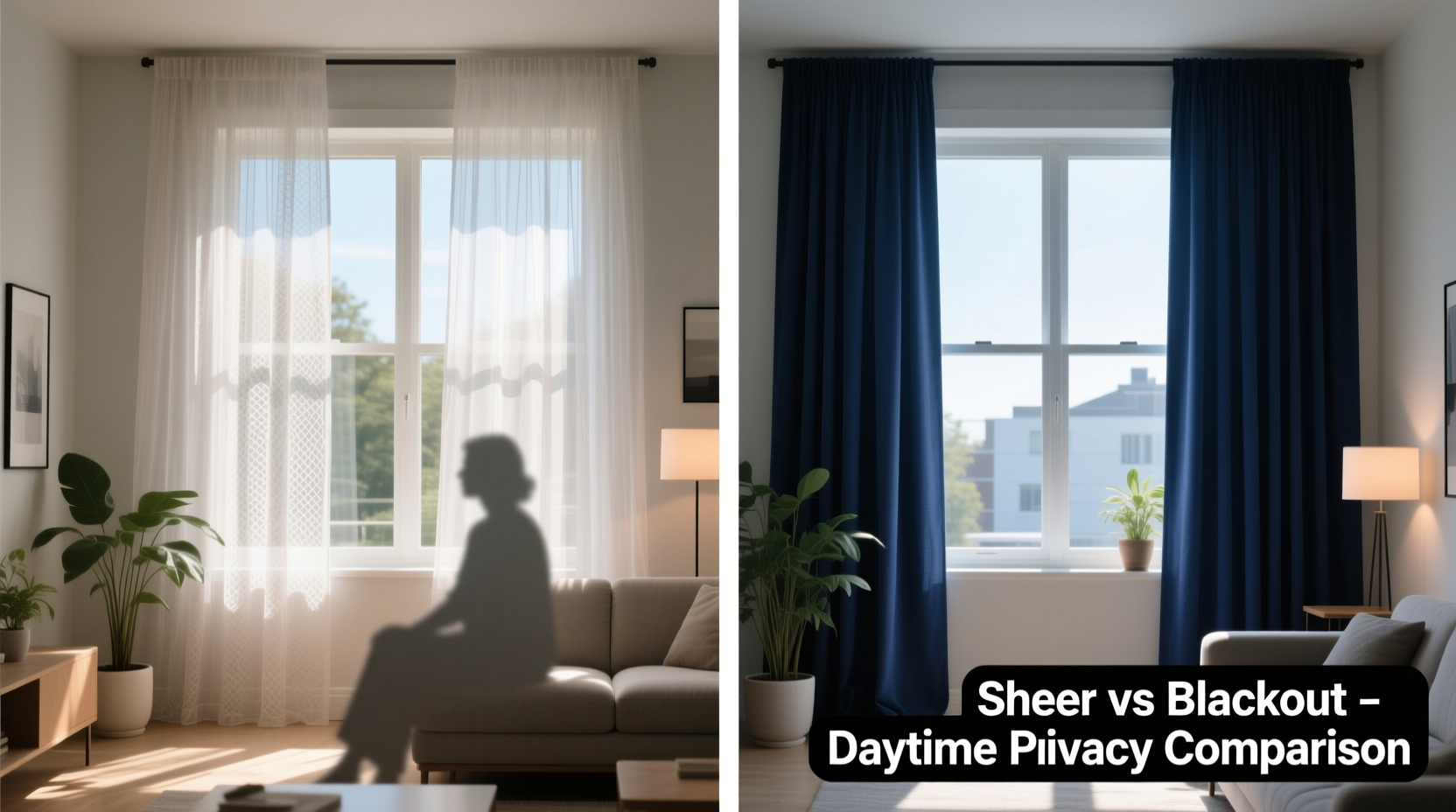
Privacy during the day depends on several factors: the opacity of the fabric, the intensity of outdoor lighting, the distance between your windows and neighboring properties, and whether there are reflective surfaces involved. During daylight, the brighter side of a window determines visibility. If it's significantly brighter outside than inside, people outside can see in less clearly—even through translucent materials—because the light overwhelms interior details.
This phenomenon, known as the \"mirror effect\" or \"luminance contrast,\" means that in most daytime scenarios, interiors appear darker from the outside, making it difficult to see fine details. However, movement, silhouettes, and recognizable shapes can still be visible through sheer fabrics, especially if someone is standing close to the window or the room is minimally furnished.
Blackout curtains, by design, eliminate nearly all light transmission. This makes them inherently more private because no interior light—or shadow—escapes to give clues about what’s happening inside. But even they have nuances in performance based on installation and material quality.
Sheer Curtains: Light, Airy—but Private?
Sheer curtains are crafted from lightweight, semi-transparent fabrics like voile, chiffon, or organza. Their primary function is to diffuse sunlight while maintaining an open, airy feel. They offer minimal barrier to vision, allowing outlines and motion to be seen from the outside, particularly when indoors are dimmer than the exterior.
In urban or densely populated neighborhoods, sheer curtains alone may not provide sufficient daytime privacy. A passerby might not discern facial features, but they can detect movement, furniture layout, or someone walking across the room. This level of exposure may be acceptable in upper-floor rooms or areas facing green spaces, but less so for ground-level bedrooms or bathrooms.
Many homeowners use sheers in combination with other window treatments—such as blinds, shades, or layered drapes—for enhanced control. When paired with a secondary opaque curtain, sheers contribute to a layered look that balances softness and seclusion.
“During peak daylight, sheer curtains create a beautiful glow but shouldn’t be relied upon for true visual privacy—especially on lower floors.” — Lena Torres, Interior Designer & Window Treatment Specialist
Blackout Curtains: Maximum Seclusion, But at What Cost?
As the name suggests, blackout curtains are engineered to block 95–100% of incoming light. Made from tightly woven, multi-layered fabrics—often with a coated backing—they prevent both light penetration and outward visibility. From the outside, a window dressed with closed blackout curtains appears dark and impenetrable, offering near-total privacy regardless of indoor activity.
Their effectiveness doesn’t depend on external lighting conditions. Whether it’s a bright summer afternoon or an overcast morning, blackout curtains maintain consistent privacy. This makes them ideal for bedrooms, media rooms, or homes located near busy streets or overlooking adjacent buildings.
However, using blackout curtains throughout the day can create a cave-like atmosphere. Without natural light, rooms may feel smaller and require artificial lighting even during sunny hours. For this reason, many users reserve blackout curtains for nighttime use or pull them back during the day to enjoy daylight—sacrificing privacy temporarily for brightness and openness.
Material and Installation Matter
Not all blackout curtains perform equally. Lower-quality versions may have thin edges, gaps around the sides, or poor overlap at the center, allowing slivers of light—and glimpses—to sneak through. Premium blackout panels often include features like:
- Triple-weave fabric construction
- Sided lining (white on room side, black on street side)
- Overlapping headers or magnetic seals
- Wrap-around rod systems to minimize side gaps
Proper installation enhances privacy. Mounting rods wider than the window frame and extending several inches beyond each side reduces peripheral visibility. Ceiling-mounted tracks can also eliminate top gaps where sightlines penetrate.
Comparative Analysis: Sheer vs Blackout for Daytime Privacy
| Feature | Sheer Curtains | Blackout Curtains |
|---|---|---|
| Daytime Privacy Level | Low to moderate; silhouettes visible | High to complete; no visibility |
| Light Transmission | High (70–90%) | Negligible (0–5%) |
| Best For | Living rooms, kitchens, upper floors | Bedrooms, nurseries, home theaters |
| Visibility from Outside | Movement and shapes detectable | Almost none when fully closed |
| Energy Efficiency | Minimal insulation | Good thermal and UV protection |
| Design Flexibility | Excellent; layers well with others | Limited; often bulky |
This comparison underscores a key insight: blackout curtains are objectively superior for daytime privacy. But that doesn’t mean they’re always the best choice for every room or homeowner preference.
Real-World Scenario: Urban Apartment Living
Consider Maria, who lives in a third-floor apartment in downtown Seattle. Her bedroom faces a courtyard shared with five other units. During the day, neighbors frequently pass by on patios just 15 feet from her window. Initially, she installed white sheer curtains for a soft, modern look. While they diffused light beautifully, she noticed people glancing up when voices carried indoors. One morning, a neighbor waved after spotting her changing clothes—despite thinking the sheers provided enough cover.
After consulting a designer, Maria added a pair of charcoal-gray blackout curtains behind the sheers. By day, she pulls the blackout panels shut when dressing or lounging, then opens them to let light in when privacy isn’t critical. At night, both layers remain closed. This hybrid solution gave her flexibility without compromising comfort or safety.
Her experience highlights a growing trend: layering window treatments to match functional needs throughout the day.
When Sheer Curtains Can Be “Private Enough”
In certain situations, sheer curtains do offer adequate daytime privacy:
- Elevated windows: On second or higher floors, distance naturally limits visibility.
- Obstructed views: Trees, fences, or architectural elements block direct lines of sight.
- Low foot traffic areas: Rooms facing backyards or alleys with little public access.
- Frosted glass pairing: Sheers over etched or textured glass enhance diffusion.
Additionally, some modern sheer fabrics incorporate subtle patterns or tighter weaves that increase opacity without sacrificing too much light. These “privacy sheers” strike a middle ground, reducing silhouette clarity while maintaining brightness.
Action Plan: Choosing Based on Your Needs
Selecting between sheer and blackout curtains should follow a structured assessment of your space and priorities. Use this checklist to guide your decision:
Privacy Needs Assessment Checklist
- Measure the distance between your window and potential viewing points (sidewalks, neighboring windows).
- Determine the floor level and angle of view from outside.
- Note daily sun exposure and how much natural light you want to preserve.
- Identify high-privacy zones (bedrooms, bathrooms) versus low-concern areas (dining rooms).
- Test visibility: Stand outside your home at noon and observe what’s visible through current or sample curtains.
- Decide whether you prefer permanent privacy or flexible control via layering.
- Factor in energy efficiency and noise reduction—blackout curtains often help here too.
If maximum daytime privacy is non-negotiable, go with blackout curtains—especially in sensitive rooms. If you value light and ambiance but still need some coverage, consider combining sheers with blinds or opting for upgraded privacy-enhanced sheers.
Expert Insight: Balancing Aesthetics and Function
“The biggest mistake I see is choosing curtains based solely on style. Privacy is a form of personal security. In cities, people underestimate how easily interiors can be seen. Layering is the smartest long-term strategy.” — James Reed, Architectural Consultant specializing in residential design
Reed emphasizes that window treatments are part of a broader environmental response. “People focus on color and texture, but forget that fabric weight, drape, and lining determine functionality. A well-designed room respects both beauty and boundaries.”
Frequently Asked Questions
Can sheer curtains provide any real privacy during the day?
Yes, but only limited privacy. Sheer curtains obscure clear vision and prevent detailed observation, but movement, shapes, and silhouettes remain visible—especially up close or in low-light interiors. They work best when combined with other遮挡 methods or used in elevated, less exposed areas.
Do blackout curtains need to be closed all day for privacy?
Only when privacy is needed. Many people open blackout curtains during the day to allow light in and close them during vulnerable moments (e.g., changing clothes) or at night. Motorized options can automate this process based on time or sunlight levels.
Are there curtains that offer both light and privacy?
Yes—some specialty fabrics like solar shades, privacy liners, or dual-layer drapes combine sheer tops with blackout bottoms. These “day-night” systems let you adjust privacy and brightness independently, offering the best of both worlds.
Final Recommendation: Match Solution to Lifestyle
For pure daytime privacy, blackout curtains are the superior choice. Their ability to block light equates directly to blocking visibility, giving unmatched seclusion. However, their heavy nature and light-blocking qualities aren’t ideal for every room or aesthetic.
Sheer curtains excel in ambiance and light diffusion but fall short in true privacy—making them better suited as part of a layered system rather than a standalone solution in exposed areas.
The smartest approach is customization: assess each room individually, prioritize privacy where it matters most, and use strategic layering to maintain comfort and design harmony.




 浙公网安备
33010002000092号
浙公网安备
33010002000092号 浙B2-20120091-4
Comments
No comments yet. Why don't you start the discussion?