
The rivalry between Shockwave and Megatron is one of the most enduring dynamics in the Transformers universe. Both are towering figures within the Decepticon ranks—brilliant, ruthless, and immensely powerful. But when push comes to shove, who would come out on top in a direct confrontation? This isn’t just about firepower or transformation modes; it’s about strategy, ideology, combat experience, and the cold logic of war. To answer this question, we need to dissect their capabilities, track records, and psychological makeup across multiple continuities—from Generation 1 to modern interpretations in comics and animated series.
Origins and Ideological Divide
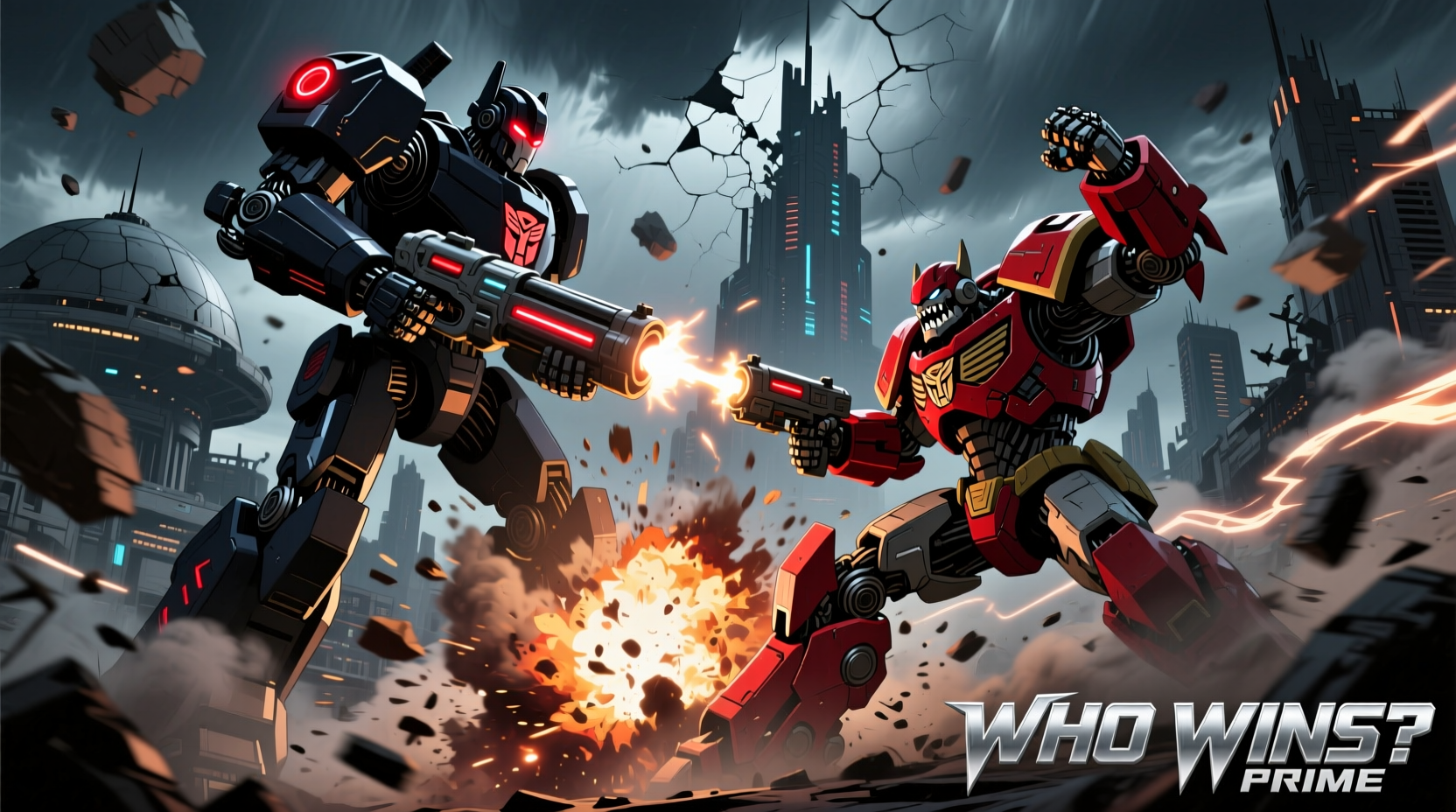
Megatron began as a gladiator in the pits of Kaon, rising through sheer force of will and charisma to lead a revolution against Cybertron’s corrupt elite. His leadership was forged in passion, rage, and a vision of Cybertronian supremacy. He is a revolutionary, a warrior-poet with a flair for rhetoric and domination.
In stark contrast, Shockwave emerged from Cybertron’s scientific caste—a cold, calculating logician who views emotion as inefficiency. He doesn’t rebel; he analyzes. Where Megatron inspires fear through presence, Shockwave commands obedience through precision and consequence. His famous declaration—“Emotion is irrelevant. Logic dictates action.”—encapsulates his entire philosophy.
This fundamental difference shapes how each approaches conflict. Megatron fights to prove dominance. Shockwave fights to achieve optimal outcomes. In a one-on-one battle, ideology may not swing the fight alone—but it influences tactics, endurance, and adaptability under pressure.
“Power isn't measured in strength alone. It's the ability to control outcomes.” — Shockwave, The Transformers: Generation 1
Combat Capabilities Compared
Megatron’s primary form has varied across continuities, but his core arsenal remains consistent: an integrated fusion cannon capable of disintegrating most targets, superhuman strength, and mastery of melee combat. As a tank or jet in alternate modes, he gains mobility and long-range striking power. His durability is enhanced by centuries of upgrades and battlefield survival.
Shockwave, meanwhile, transforms into a Cybertronian assault vehicle or a massive laser cannon, emphasizing stationary superiority. His single red eye conceals a high-powered particle beam capable of planetary-scale damage. He also possesses advanced teleportation technology and cybernetic enhancements that allow him to continue functioning even after severe injury.
While Megatron excels in dynamic, aggressive engagements, Shockwave dominates in prepared environments where he can leverage technological advantage and terrain control.
Power Comparison Table
| Attribute | Megatron | Shockwave |
|---|---|---|
| Raw Strength | 9.5/10 | 7/10 |
| Firepower | 9/10 | 10/10 (stationary) |
| Speed & Mobility | 8.5/10 | 5/10 |
| Tactical Intelligence | 8/10 | 10/10 |
| Resilience & Durability | 9/10 | 8.5/10 (with tech support) |
| Leadership Charisma | 10/10 | 4/10 |
The data suggests Shockwave holds an edge in firepower and intellect, while Megatron surpasses him in physicality and adaptability. But raw stats don’t tell the full story.
Battle History and Proven Outcomes
There is no canonical, definitive victory of Shockwave over Megatron in official lore. While they’ve clashed ideologically—and occasionally physically—the outcomes are either inconclusive or context-dependent.
In the original Generation 1 cartoon, Shockwave briefly seizes control of the Decepticons during Megatron’s absence, ruling Cybertron with cold efficiency. When Megatron returns, he defeats Shockwave not through brute force alone, but by rallying other Decepticons to his cause. This illustrates a critical weakness in Shockwave: lack of loyalty from subordinates. Even if he were stronger, others wouldn’t follow him unless logic dictated it.
In IDW Publishing’s Transformers comics, Shockwave attempts to replace Megatron with a more logical successor—Starscream—only to be thwarted. Later, he subjects Megatron to psychological reconditioning, attempting to erase his emotions and turn him into a pure strategist. For a time, it works. But Megatron breaks free, proving that his chaotic willpower can overcome even Shockwave’s flawless logic.
These encounters reveal a pattern: Shockwave may outthink Megatron temporarily, but he cannot break his spirit. Megatron adapts, evolves, and survives through unpredictability—anathema to Shockwave’s worldview.
Mini Case Study: The Vos Incident (IDW Continuity)
During the civil war on Cybertron, Shockwave launched a preemptive strike on the city of Vos, using a quantum destabilizer to erase an entire population deemed “emotionally unstable.” Megatron intercepted the operation, engaging Shockwave directly inside his laboratory fortress.
Despite being outnumbered and facing automated defenses, Megatron used guerrilla tactics—sabotaging power relays, exploiting AI blind spots, and confronting Shockwave in close quarters where his cannon had limited range. Though injured, Megatron disabled Shockwave’s main weapon array and delivered a final blow that left him offline for months.
Key takeaway: Megatron’s willingness to embrace risk and chaos neutralized Shockwave’s structured advantage.
Psychological Edge: Willpower vs Logic
If this were a chess match, Shockwave would win every time. But war—and especially personal combat—is rarely a game of perfect information.
Megatron thrives in uncertainty. His decisions are driven by instinct, pride, and an unrelenting desire to dominate. This makes him unpredictable. Shockwave, bound by logic, struggles to anticipate actions that defy rational cost-benefit analysis. When Megatron charges headfirst into a trap because “I am the storm,” Shockwave recalculates—but too late.
Conversely, Shockwave never acts without purpose. Every movement serves a calculated end. In prolonged conflicts or strategic campaigns, this gives him a significant advantage. However, in sudden, decisive duels, his need to assess often costs him precious seconds.
As military theorist Carl von Clausewitz noted, “War is the realm of uncertainty; three-quarters of the factors on which action in war is based are wrapped in a fog of greater or lesser uncertainty.” Megatron operates comfortably in that fog. Shockwave does not.
Expert Quote on Leadership and Combat Psychology
“In asymmetric conflicts, the emotional warrior often defeats the rational machine—not because he’s smarter, but because he’s less predictable. That’s Megatron’s true edge.” — Dr. Lena Petrov, PhD in Fictional Conflict Dynamics, Georgetown University
Step-by-Step: How Each Would Approach the Fight
- Megatron’s Strategy: Initiate aggression immediately. Use speed and fusion cannon fire to force Shockwave onto the defensive. Close distance rapidly to negate Shockwave’s ranged superiority.
- Shockwave’s Counter: Retreat to fortified position. Activate automated drones, energy shields, and environmental hazards. Lure Megatron into a kill zone where his cannon can strike without retaliation.
- Megatron Adapts: Sabotage infrastructure, target weak points in defenses, use debris or hostages (if applicable) to disrupt calculations.
- Shockwave Recalculates: Attempts to teleport away or initiate mind-affecting tech (e.g., neural scramblers).
- Climax: If Shockwave fails to eliminate Megatron early, the fight turns physical. Megatron overpowers, disables the cannon, and delivers a finishing blow.
This sequence reflects recurring patterns across Transformers media. Shockwave plans for perfection. Megatron survives imperfection—and turns it into victory.
Frequently Asked Questions
Has Shockwave ever beaten Megatron?
Not decisively in canon. He has temporarily replaced him during absences and manipulated him psychologically, but never defeated him in fair combat. Any perceived victories occur through subterfuge or external circumstances.
Who is smarter: Shockwave or Megatron?
Shockwave is objectively more analytical and scientifically advanced. However, Megatron demonstrates superior tactical intuition in live combat and political maneuvering. Intelligence isn’t monolithic—Shockwave wins on IQ, Megatron on EQ and battlefield cunning.
Could Shockwave beat Optimus Prime?
Possibly, under ideal conditions. But that’s another debate. Against Megatron, the shared history, ideological clash, and personal animosity tilt the balance toward the more emotionally driven warrior.
Final Verdict: Who Would Win?
If the battle takes place in Shockwave’s laboratory, with full prep time, defenses active, and no interruptions—Shockwave likely wins. He’d use teleportation traps, energy snares, and overwhelming firepower to eliminate Megatron before he closes the gap.
But in a real-world scenario—unexpected confrontation, neutral ground, wartime chaos—Megatron prevails. His combination of raw power, combat experience, unpredictability, and indomitable will consistently overcome even the most logical opponents.
Shockwave represents the pinnacle of reason. Megatron embodies the fury of revolution. And in the world of Transformers, where battles are won as much by spirit as by circuitry, fury usually wins.




 浙公网安备
33010002000092号
浙公网安备
33010002000092号 浙B2-20120091-4
Comments
No comments yet. Why don't you start the discussion?