
When it comes to on-camera appearances—whether you're filming a podcast, presenting at a conference, or starring in a brand campaign—the right outerwear can shape how you’re perceived. Two popular choices often debated in modern wardrobes are the short jacket and the oversized blazer. Both offer distinct silhouettes and stylistic flair, but under studio lights and high-definition lenses, their impact diverges significantly. The question isn't just about fashion; it's about optics, proportion, and presence. So which one truly performs better on camera?
The Visual Physics of On-Camera Style
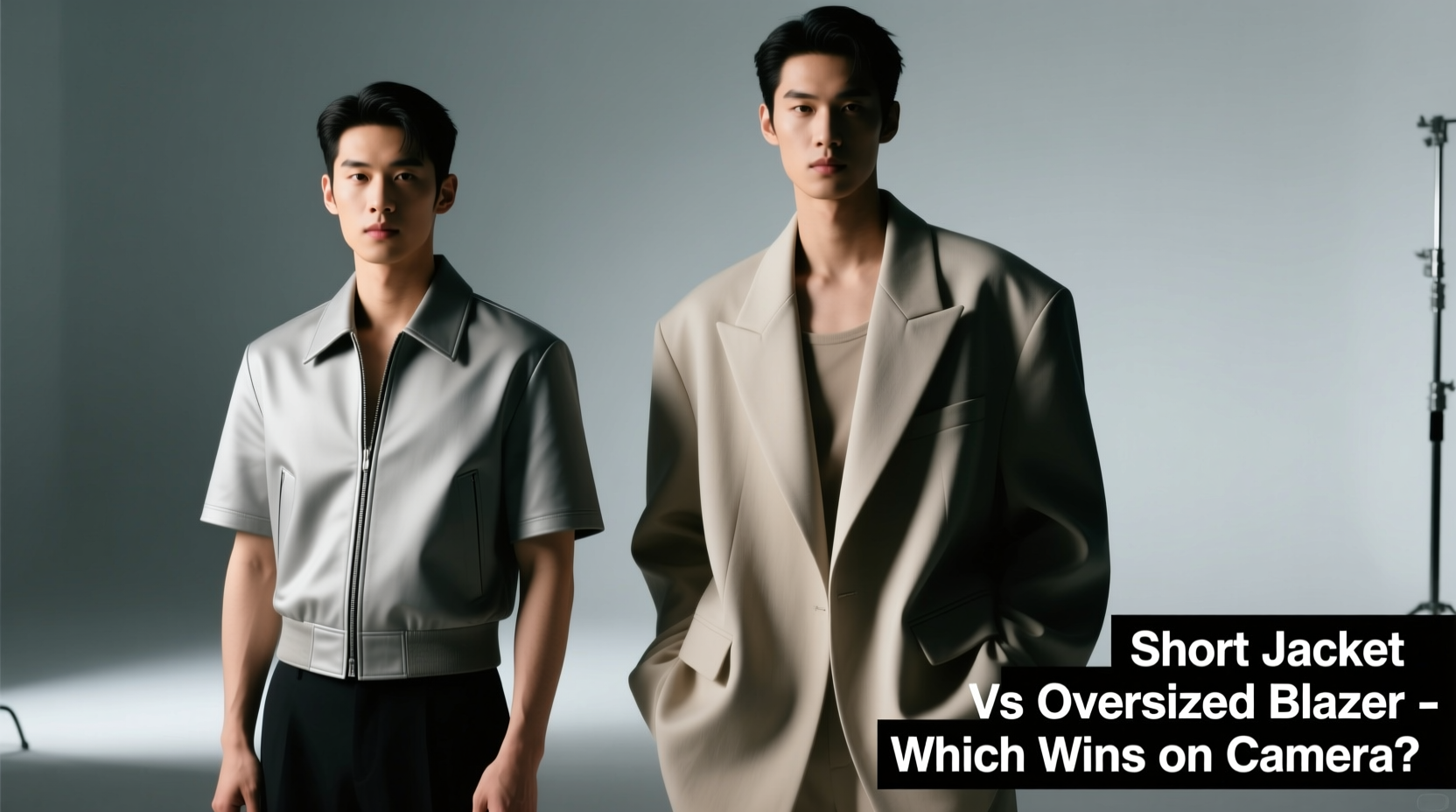
What looks balanced in real life doesn’t always translate well through a lens. Cameras compress depth, flatten angles, and exaggerate proportions. A garment that feels stylish in person might appear boxy, cropped too aggressively, or visually unbalanced when framed. This is where understanding camera-friendly tailoring becomes essential.
The torso-to-leg ratio, shoulder width, and waist definition all influence how authoritative, approachable, or polished you appear. Short jackets tend to emphasize the upper body by cutting off above the hip, while oversized blazers elongate the silhouette with volume and drape. But visual dominance doesn’t equal visual harmony.
“On camera, balance trumps boldness. A powerful look is one that guides the eye—not distracts it.” — Marcus Tran, Broadcast Stylist & Wardrobe Consultant for CNN and TED Talks
Short Jacket: Impact vs. Distortion
A short jacket—typically ending at or just below the waist—creates a sharp, tailored effect. Think bomber jackets, cropped moto styles, or structured cropped blazers. When fitted correctly, they accentuate the waist and give a clean break at the top of the lower body.
However, on camera, this brevity can backfire. If the jacket ends at the widest part of the hips, it creates a horizontal line that visually widens the frame. This is especially pronounced in close-up or three-quarter shots. Additionally, if paired with high-waisted bottoms, the leg length can appear shortened due to the lack of vertical continuity from torso to leg.
Short jackets also struggle under overhead lighting. The abrupt cutoff can cast shadows across the hip area, creating an unintended visual “cut” that disrupts the body’s natural flow. This makes them less ideal for seated interviews or panel discussions where the camera captures a tighter frame.
Oversized Blazer: Volume With Intention
An oversized blazer introduces controlled volume. It typically features extended shoulders, longer lapels, and a relaxed fit through the torso. Unlike ill-fitting clothing, intentional oversizing creates a dynamic silhouette that cameras often favor.
Why? Because the elongated lines draw the eye vertically. The longer hemline—usually hitting mid-hip to low-hip—creates a smoother transition between upper and lower body, preserving leg length. The wider shoulders add authority without appearing aggressive, making the wearer look both confident and composed.
In broadcast settings, this cut is frequently used for anchors and hosts. The added structure frames the face (especially when lapels are wide), and the soft drape avoids clinging to body contours—a common issue with tight garments under hot lights.
Real Example: The Podcast Presenter’s Pivot
Sarah Lin, host of the business interview series *Next Stage*, initially wore cropped tweed jackets for her recordings. Viewers commented she looked “cut off” or “top-heavy.” After consulting a wardrobe stylist, she switched to an oversized navy blazer with notch lapels. The change was subtle, but audience engagement metrics improved. Comments shifted to “You look so put together” and “Your presence really fills the screen.” The blazer didn’t just change her outfit—it changed her perceived authority.
Direct Comparison: Key Factors on Camera
| Factor | Short Jacket | Oversized Blazer |
|---|---|---|
| Vertical Proportion | Lowers perceived height; breaks torso abruptly | Enhances height; elongates silhouette |
| Shoulder Emphasis | Neutral to minimal | Strong; adds presence |
| Hip Line Effect | Can widen appearance if hem hits widest point | Smooths transition; reduces visual bulk |
| Fabric Movement | Stiff cutoff; limited drape | Natural fall; fluid motion |
| Lighting Performance | Prone to harsh shadow lines at hem | Distributes light evenly across fabric |
| Best For | Full-body shots, fashion-forward content | Close-ups, professional interviews, speaking events |
When the Short Jacket Wins
That said, the short jacket isn’t obsolete on camera. In full-body shots—such as stage presentations or lifestyle vlogs—it can create a modern, energetic vibe. Designers like Bottega Veneta and Prada have championed cropped tailoring in runway videos precisely for its youthful, edgy appeal.
The key is context. If your content leans creative, editorial, or avant-garde, a short jacket can signal innovation. Pair it with wide-leg pants or a midi skirt to offset the top’s brevity. Avoid pairing it with cropped tops or high-waisted jeans, which compound the visual shortening effect.
Action Plan: Choosing Your On-Camera Outerwear
Follow this step-by-step guide to determine which piece serves your next shoot best:
- Assess the shot type: Is it a close-up, medium, or full-body frame? Close-ups favor blazers; full-body allows more experimentation.
- Check your proportions: Measure where the jacket hem falls. If it aligns with your hip bones, consider a longer option.
- Evaluate lighting setup: Harsh overhead lights amplify hemlines. Soft, frontal lighting is more forgiving.
- Test movement: Sit down and stand up on camera. Does the short jacket ride up uncomfortably? Does the blazer stay aligned?
- Review playback: Watch footage in slow motion. Note where the eye is drawn—and where it gets stuck.
Expert Checklist: On-Camera Outerwear Do’s and Don’ts
- ✅ Do choose fabrics with slight texture (e.g., wool blend, bouclé) to avoid glare.
- ✅ Do roll sleeves neatly if showing forearms—adds control and polish.
- ✅ Do match lapel width to face size: wider lapels for broader faces, narrower for delicate features.
- ❌ Don’t wear stiff, boxy short jackets in seated interviews—they amplify torso width.
- ❌ Don’t let oversized blazers swallow your frame—shoulders should extend slightly beyond natural ones, not drastically.
- ❌ Don’t pair either with busy patterns unless intentionally styling for fashion content.
Frequently Asked Questions
Can I wear a short jacket if I’m petite?
Yes, but with caution. A well-tailored short jacket that ends above the hip can highlight a narrow waist and create balance. Avoid ultra-cropped lengths. Pair with monochrome lower halves to maintain vertical flow.
Won’t an oversized blazer make me look sloppy?
Only if it’s poorly chosen. An oversized blazer should still have structure—defined shoulders, clean lapels, and a hem that skims the hip. It’s about intentional volume, not sloppiness. Tailor the arms if needed for precision.
Does body type matter here?
It plays a role, but framing matters more. Tall individuals can carry both styles, but short jackets risk breaking proportion. Curvier figures often benefit from the elongating effect of an oversized blazer. However, confidence and posture outweigh strict rules—wear what makes you feel authoritative.
Final Verdict: Which Looks Better on Camera?
The oversized blazer generally outperforms the short jacket in most on-camera scenarios. Its ability to enhance vertical lines, frame the face, and adapt to lighting conditions makes it a reliable choice for professionals aiming to project competence and calm authority. It bridges fashion and function without sacrificing either.
The short jacket has its place—but it’s situational. Reserve it for full-frame visuals, creative direction, or when you want to make a deliberate stylistic statement. As a default choice for consistent on-camera performance, the oversized blazer remains superior.




 浙公网安备
33010002000092号
浙公网安备
33010002000092号 浙B2-20120091-4
Comments
No comments yet. Why don't you start the discussion?