
When it comes to increasing your income, two of the most accessible paths are working overtime at your current job or starting a side hustle. Both promise extra money, but only one has the potential to significantly accelerate long-term wealth building. The decision isn’t just about how much you earn today—it’s about how that income scales, compounds, and supports your financial independence over time.
Overtime pay offers immediate cash with minimal setup. A side hustle demands more upfront effort but can evolve into something far greater than supplemental income. So which path leads to real wealth? The answer depends on how you define “wealth,” your career stage, risk tolerance, and long-term goals.
The Real Cost of Time: How You Trade Hours for Dollars
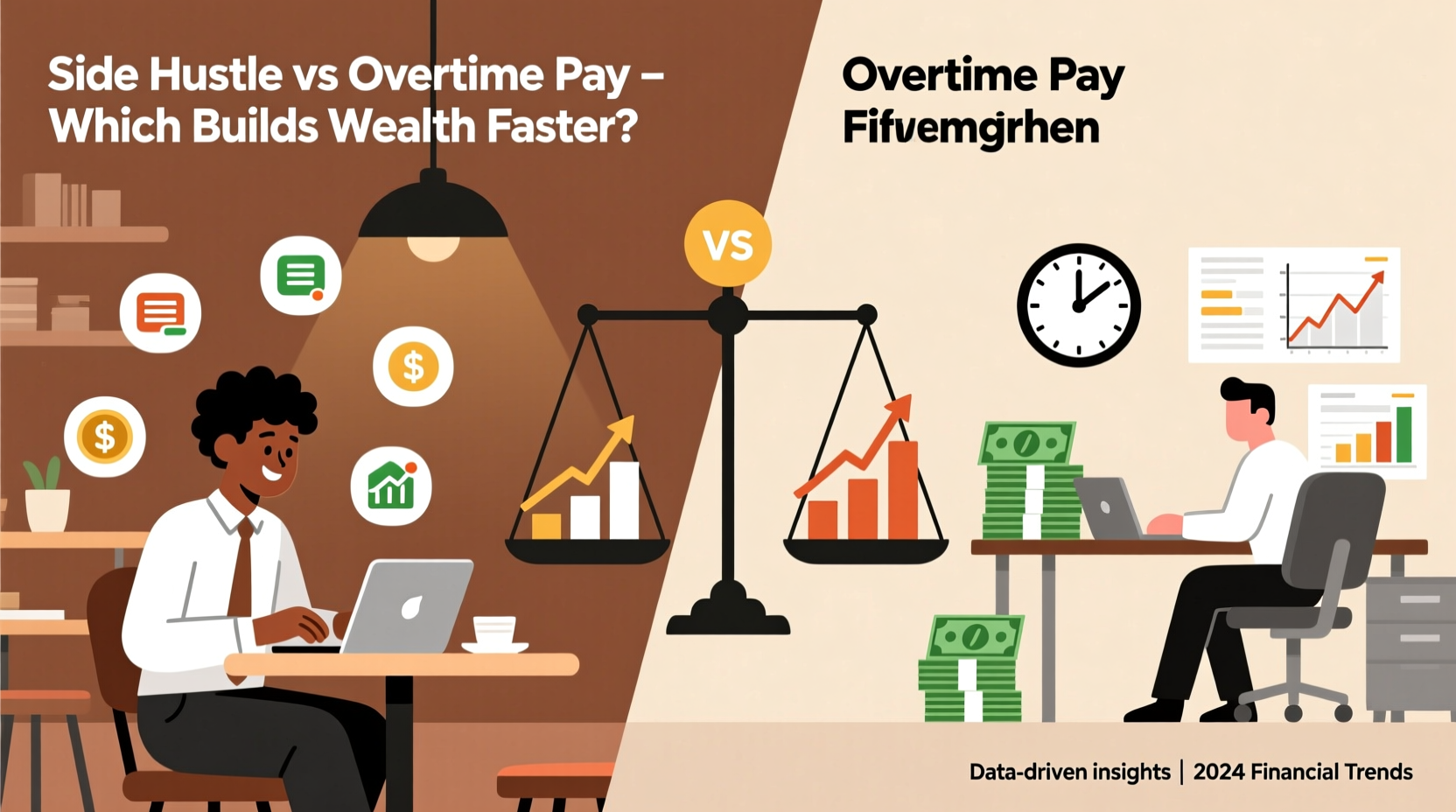
At their core, both overtime and side hustles involve trading time for money. But the nature of that exchange differs dramatically.
Overtime is typically an extension of your 9-to-5 role—more hours in the same environment, doing similar work. It often pays 1.5x or 2x your regular hourly rate, making it financially attractive in the short term. However, it’s capped by labor laws, employer policies, and personal endurance. Most people can’t sustain 60-hour workweeks indefinitely without burnout.
A side hustle, by contrast, allows you to choose how and when you work. Whether it’s freelancing, selling digital products, tutoring, or running an e-commerce store, you control the scope, pricing, and scalability. While initial earnings may be modest, the upside isn’t limited to hours worked. A successful side hustle can generate passive income, grow into a full-time business, or create multiple revenue streams.
Income Potential: Linear vs. Exponential Growth
Overtime follows a linear income model: more hours = more pay, up to a hard ceiling. If you earn $30/hour and get $45 for overtime, working 10 extra hours weekly adds $450 pre-tax. That’s substantial, but it doesn’t increase unless you work even more—which eventually becomes unsustainable.
Side hustles operate on an exponential or scalable model. In the beginning, you might spend 10 hours building a website or creating a course and earn little. But once launched, that same product can sell repeatedly with no additional labor. One digital template sold 500 times at $20 generates $10,000—without a single extra hour worked.
This distinction is critical for wealth building. Wealth isn’t just high income; it’s income that persists and grows without proportional effort. Overtime rewards presence. Side hustles reward creation, ownership, and systems.
Comparing Income Models Over Five Years
| Strategy | Year 1 Earnings | Year 3 Earnings | Year 5 Earnings | Key Limitation |
|---|---|---|---|---|
| Overtime (10 hrs/week @ 1.5x $30/hr) | $23,400 | $23,400 | $23,400 | Time-bound; no passive growth |
| Side Hustle (Freelance Writing) | $8,000 | $25,000 | $40,000 | Initial time investment required |
| Side Hustle (Digital Product Sales) | $2,000 | $18,000 | $75,000+ | Requires marketing & audience building |
Note: These figures assume consistent effort and gradual optimization. The freelance model scales through client rates and volume. The digital product model benefits from compounding sales and automation.
“True wealth is built not by trading time for money, but by creating assets that generate value independently.” — Robert Kiyosaki, Author of *Rich Dad Poor Dad*
Risk, Flexibility, and Long-Term Security
Overtime income is predictable—but fragile. It depends entirely on your employer’s willingness and ability to offer extra hours. Layoffs, restructuring, or policy changes can eliminate it overnight. You also have little control over scheduling, which can disrupt family life, health, and personal development.
Side hustles carry market risk. Not every idea succeeds. Some require learning new skills or facing rejection. But they build resilience. Even if one venture fails, the experience, network, and confidence gained transfer to future opportunities. More importantly, side hustles diversify your income—a key principle of financial security.
Consider this: during the 2020 economic downturn, many salaried workers lost jobs or overtime privileges. Those with side hustles—especially online businesses—were often able to adapt quickly, pivot services, or maintain income through digital channels.
Mini Case Study: Sarah’s Choice Between Overtime and a Side Hustle
Sarah, a 32-year-old accountant, regularly received offers for 10–15 hours of overtime each month, paying $60/hour (time-and-a-half). She earned an extra $9,000 annually but felt drained and had no time for personal projects.
In January, she declined overtime and instead launched a bookkeeping service for small businesses. The first three months brought only $400 in revenue. By month six, she had five clients and was earning $3,000/month. Within 18 months, she transitioned to full-time self-employment, doubled her income, and gained control over her schedule.
Had she continued taking overtime, she’d have earned $45,000 extra over five years—taxed as ordinary income. Instead, her side hustle generated over $180,000 in the same period and created an asset she could sell or scale further.
Building Systems vs. Selling Hours
Wealth accumulation hinges on leverage—using resources like capital, technology, or teams to multiply output. Overtime lacks leverage. You cannot “scale” punching a time clock.
Side hustles, however, allow for systemization. You can:
- Automate invoicing and client onboarding
- Create evergreen digital products (e-books, templates, courses)
- Hire subcontractors or virtual assistants
- Leverage social media and SEO for organic reach
These systems reduce your direct involvement while maintaining or increasing income. This is the foundation of financial freedom. Once a side hustle generates reliable profit, those funds can be reinvested into stocks, real estate, or retirement accounts—compounding wealth beyond active income.
Step-by-Step Guide: Transitioning from Overtime to a Scalable Side Hustle
- Assess Your Skills and Interests: Identify what you’re good at and enjoy. Examples: writing, coding, design, teaching, organizing.
- Validate Demand: Research whether people are willing to pay for your skill. Use platforms like Upwork, Fiverr, or Reddit communities to test interest.
- Start Small with Low Overhead: Launch a micro-service or digital product. Offer resume editing, budget templates, or consulting calls.
- Track Time vs. Revenue: Measure your effective hourly rate. Aim to increase it over time by raising prices or improving efficiency.
- Automate and Systemize: Use tools like Calendly, Zapier, or Canva to reduce manual work. Document processes so others can replicate them.
- Reinvest Profits: Allocate 20–30% of earnings into marketing, education, or tools that improve scalability.
- Evaluate Monthly: After six months, compare your side hustle income to potential overtime. Decide whether to continue, pivot, or scale.
When Overtime Makes Sense (And When It Doesn’t)
Overtime isn’t inherently bad. It can be a smart short-term strategy under specific conditions:
- You have high-interest debt and need fast cash to pay it off.
- Your side hustle is still in the testing phase and not yet profitable.
- You’re saving for a near-term goal (e.g., down payment, emergency fund).
- Your job offers overtime consistently and without excessive stress.
But if your goal is long-term wealth—financial independence, early retirement, generational assets—overtime alone won’t get you there. It keeps you dependent on an employer and caps your earning potential.
Moreover, high overtime hours can harm health, relationships, and creativity—all essential components of sustainable success. Chronic overwork increases risks of burnout, cardiovascular issues, and decreased cognitive performance, according to research published in *The Lancet*.
Checklist: Choosing the Right Path for Wealth Building
- ☐ I’ve calculated my true hourly cost of overtime (including taxes and stress)
- ☐ I’ve identified a side hustle idea with scalable potential
- ☐ I’ve tested demand with at least three potential customers
- ☐ I’ve set aside 5–10 hours per week to build my side hustle
- ☐ I’m tracking revenue, expenses, and time invested monthly
- ☐ I’m reinvesting profits into growth, not just lifestyle inflation
- ☐ I plan to review progress every 90 days and adjust accordingly
Frequently Asked Questions
Can I do both overtime and a side hustle?
Yes, but cautiously. Working 50+ hours at your job and then spending evenings on a side hustle often leads to burnout. A better approach is to use overtime income temporarily to fund your side hustle launch—buying tools, courses, or ads—then phase out overtime as your side income grows.
Which side hustles have the highest wealth-building potential?
Digital-first models tend to scale best. Examples include: creating online courses, selling print-on-demand products, affiliate marketing with a niche blog, app development, or subscription-based content (e.g., newsletters, Patreon). These require upfront work but can generate passive income over time.
Is overtime taxed differently than side hustle income?
No, both are considered earned income and taxed at your marginal tax rate. However, side hustle income may qualify for business deductions (home office, software, phone, etc.), potentially lowering your effective tax burden. Always consult a tax professional to optimize your filings.
Conclusion: Wealth Is Built on Ownership, Not Just Effort
Overtime pay delivers quick wins. It’s reliable, simple, and directly tied to effort. But it doesn’t build lasting wealth because it doesn’t create assets or leverage. You stop earning the moment you stop working.
A side hustle, even if it starts slowly, plants seeds for long-term financial growth. It teaches entrepreneurship, builds equity, and opens doors to passive income. The real advantage isn’t just higher earnings—it’s independence, optionality, and the power to design your financial future.
If your goal is to accumulate wealth that lasts beyond your working years, the choice is clear: prioritize building something you own. Start small, stay consistent, and focus on systems over hours. Over time, that shift—from employee mindset to owner mindset—becomes the difference between getting by and getting ahead.




 浙公网安备
33010002000092号
浙公网安备
33010002000092号 浙B2-20120091-4
Comments
No comments yet. Why don't you start the discussion?