
In a world saturated with marketing messages, product features, and transactional relationships, Simon Sinek’s Start With Why cuts through the noise by challenging leaders and organizations to lead not from what they do, but from why they do it. First published in 2009, the book has since become a cornerstone of modern leadership philosophy, influencing executives, entrepreneurs, and teams across industries. At its core, Start With Why is not just about business strategy—it’s about human motivation, trust, and the emotional drivers behind decision-making.
Sinek argues that truly influential leaders and organizations—those that inspire loyalty, innovation, and long-term success—operate from a clear sense of purpose. They begin with “Why,” then move to “How,” and finally “What.” Most companies do the opposite: they lead with what they sell, assume people care about features, and wonder why customers remain indifferent. This reversal, Sinek explains, is why so many fail to build lasting impact.
The Golden Circle: The Core Framework
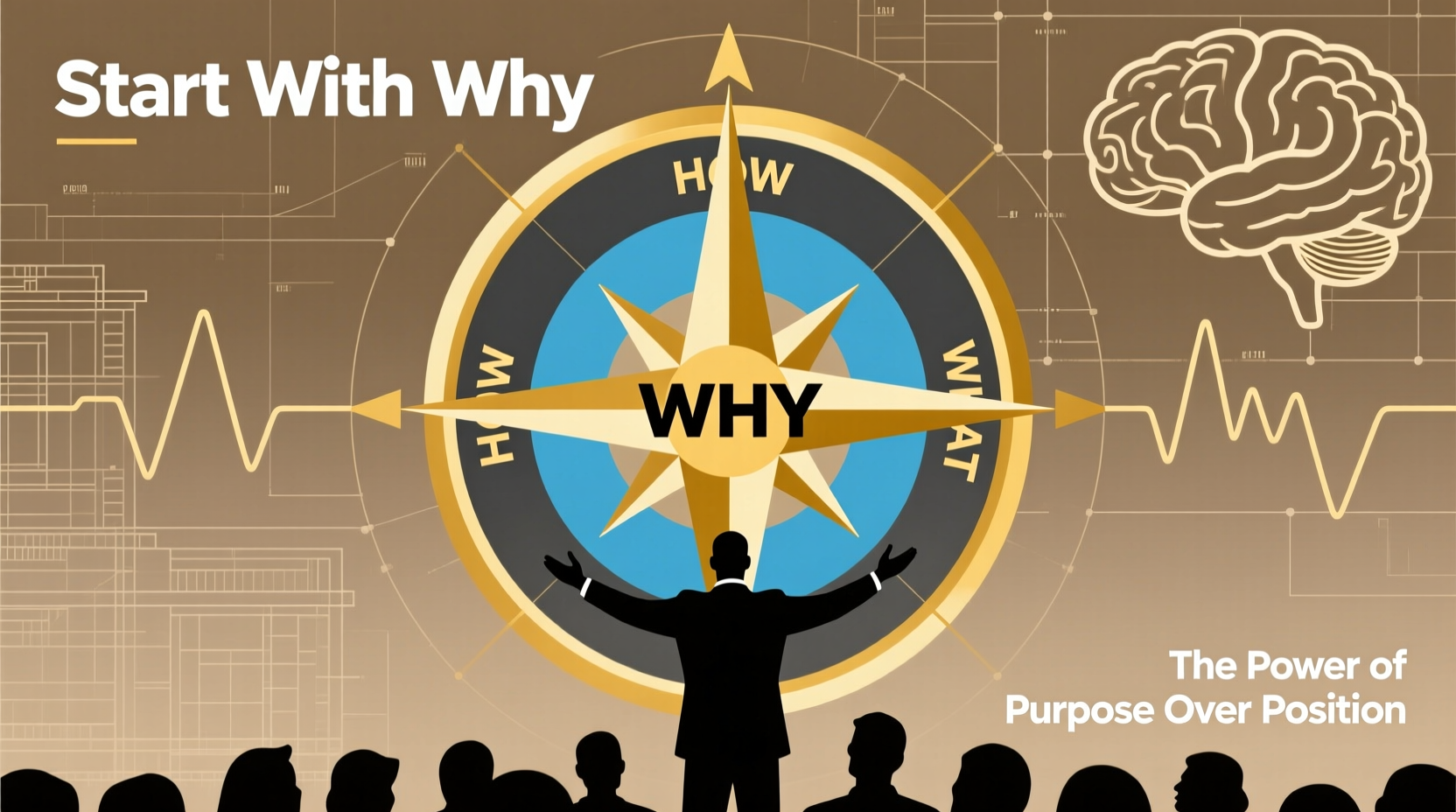
The central model of Start With Why is the Golden Circle—a simple but powerful three-layer framework:
- Why: Your purpose, cause, or belief. Why does your organization exist beyond making money?
- How: The specific actions or values that bring your “Why” to life. These are your differentiating principles.
- What: The products, services, or results you deliver. This is the most visible layer—but should be the last one communicated.
Sinek illustrates that while most organizations communicate from the outside in (What → How → Why), the most inspiring ones—like Apple, Martin Luther King Jr., and the Wright brothers—communicate from the inside out (Why → How → What). This inversion taps into the limbic brain, which governs emotions, trust, and decision-making, rather than relying solely on the neocortex, which processes facts and features.
Leadership and the Biology of Belief
One of Sinek’s most compelling arguments ties biology to behavior. He explains that the human brain’s limbic system controls feelings like trust and loyalty and is responsible for decision-making. It lacks the capacity for language, which is why people often say, “It just feels right,” when choosing between two similar options.
When an organization clearly communicates its “Why,” it speaks directly to this part of the brain. Customers don’t buy what you do—they buy why you do it. For example, Apple doesn’t market computers; it markets challenging the status quo and thinking differently. That message resonates emotionally, creating a tribe of loyal followers.
“People don’t buy what you do, they buy why you do it.” — Simon Sinek
This principle extends beyond marketing. Leaders who articulate a compelling “Why” attract employees who share their beliefs, fostering stronger cultures and higher engagement. Purpose becomes the glue that holds teams together during uncertainty and fuels perseverance in the face of obstacles.
Case Study: Apple vs. A Competitor
Consider two hypothetical tech companies launching a new laptop.
- Company A (Traditional Approach): “We make beautifully designed laptops. They’re fast, lightweight, and come with great software. Want to buy one?”
- Apple (Start With Why): “Everything we do, we believe in challenging the status quo. We believe in thinking differently. We challenge the status quo with beautifully designed, user-friendly products. And yes, we also make laptops. Want to buy one?”
The second message doesn’t just describe a product—it invites the customer into a worldview. Even if the specs were identical, the emotional connection makes the difference. This is why Apple has cultivated a near-cult following, while many technically superior competitors struggle to gain traction.
The Law of Diffusion of Innovation
Sinek integrates Everett Rogers’ theory of the Diffusion of Innovation to explain how movements grow. According to this model, adopters fall into five categories:
| Adopter Type | Percentage | Behavior |
|---|---|---|
| Innovators | 2.5% | Risk-takers; first to try new ideas |
| Early Adopters | 13.5% | Opinion leaders; embrace change early |
| Early Majority | 34% | Pragmatic; adopt after seeing proof |
| Late Majority | 34% | Skeptical; adopt under social pressure |
| Laggards | 16% | Resistant to change; traditional |
Sinek emphasizes that mass adoption only occurs when an idea crosses the chasm from Early Adopters to the Early Majority. But to reach that tipping point, you must first attract those who believe what you believe—not just those who need your product.
Organizations that start with “Why” naturally attract Innovators and Early Adopters. These believers spread the word, validate the idea, and create momentum. In contrast, companies focused solely on features may achieve short-term sales but lack the evangelists needed for sustainable growth.
How to Find Your Why
Discovering your “Why” isn’t always straightforward. Sinek suggests reflecting on pivotal moments in your personal or organizational journey. Ask yourself:
- What inspired you to start?
- When have you felt most fulfilled in your work?
- What causes would you fight for even if you weren’t paid?
Your “Why” is not a slogan or a marketing tagline—it’s a constant, enduring belief that guides decisions. For individuals, it might be “to empower others through knowledge.” For a company, it could be “to make technology accessible to everyone.”
Actionable Checklist: Defining and Living Your Why
- Reflect on your earliest motivations for starting your work or organization.
- Identify recurring themes in your proudest achievements.
- Write a draft “Why” statement in one sentence: “I believe [cause/purpose] because [reason].”
- Test it: Does it inspire action? Does it feel authentic?
- Ensure all communications—from job postings to customer emails—begin with your “Why.”
- Align hiring with belief, not just skill. Ask: “Do they share our cause?”
- Revisit your “Why” quarterly to ensure consistency and relevance.
Common Pitfalls and Warnings
Sinek warns of several traps that derail purpose-driven leadership:
- Manipulation over inspiration: Using price drops, fear, or gimmicks to drive sales instead of building trust.
- Why without How: Having a noble purpose but failing to operationalize it through values and practices.
- Success without succession: When a charismatic leader embodies the “Why,” but no one else can carry it forward.
- Confusing “Why” with “How” or “What”: Saying “Our why is to make great software” confuses the product (what) with purpose.
“The goal is not to do business with everyone who needs what you have. The goal is to do business with people who believe what you believe.” — Simon Sinek
FAQ
Can a company rediscover its Why after losing it?
Yes. Many organizations drift from their original purpose as they scale. Rediscovery requires honest reflection, input from long-time employees, and a willingness to realign strategy with core beliefs. It often involves letting go of short-term gains for long-term authenticity.
Is the Golden Circle applicable to individuals, not just companies?
Absolutely. Individuals can use the Golden Circle to clarify their career paths, improve communication, and build more meaningful relationships. Knowing your personal “Why” helps you make decisions aligned with your values, leading to greater fulfillment.
Does Starting With Why guarantee success?
No framework guarantees success, but starting with “Why” significantly increases the odds of building trust, loyalty, and resilience. It doesn’t replace execution, quality, or innovation—but it provides the foundation upon which they thrive.
Conclusion: Lead With Purpose, Inspire Action
Simon Sinek’s Start With Why is more than a business book—it’s a call to lead with courage, clarity, and conviction. In an age of distraction and disconnection, the organizations and individuals who stand out are those who stand for something. They don’t manipulate; they inspire. They don’t chase customers; they attract believers.
Whether you’re launching a startup, leading a team, or redefining your career, the question isn’t what you do. It’s why you do it. Answer that honestly, communicate it consistently, and watch people line up not just to buy from you, but to follow you.




 浙公网安备
33010002000092号
浙公网安备
33010002000092号 浙B2-20120091-4
Comments
No comments yet. Why don't you start the discussion?