
Whether you're scheduling appointments, tracking work hours, planning travel, or managing daily routines, the ability to accurately add minutes to a given time is essential. While it may seem straightforward, miscalculations can lead to missed deadlines, late arrivals, or inefficient planning. Unlike regular arithmetic, time operates on a base-60 system for minutes and seconds, and a 12- or 24-hour cycle for hours—making mental math tricky without a reliable method.
This guide presents practical, field-tested techniques to help you confidently and correctly add minutes to any starting time. From mental shortcuts to structured written methods, these approaches ensure precision in both personal and professional settings.
Understanding Time Arithmetic Basics
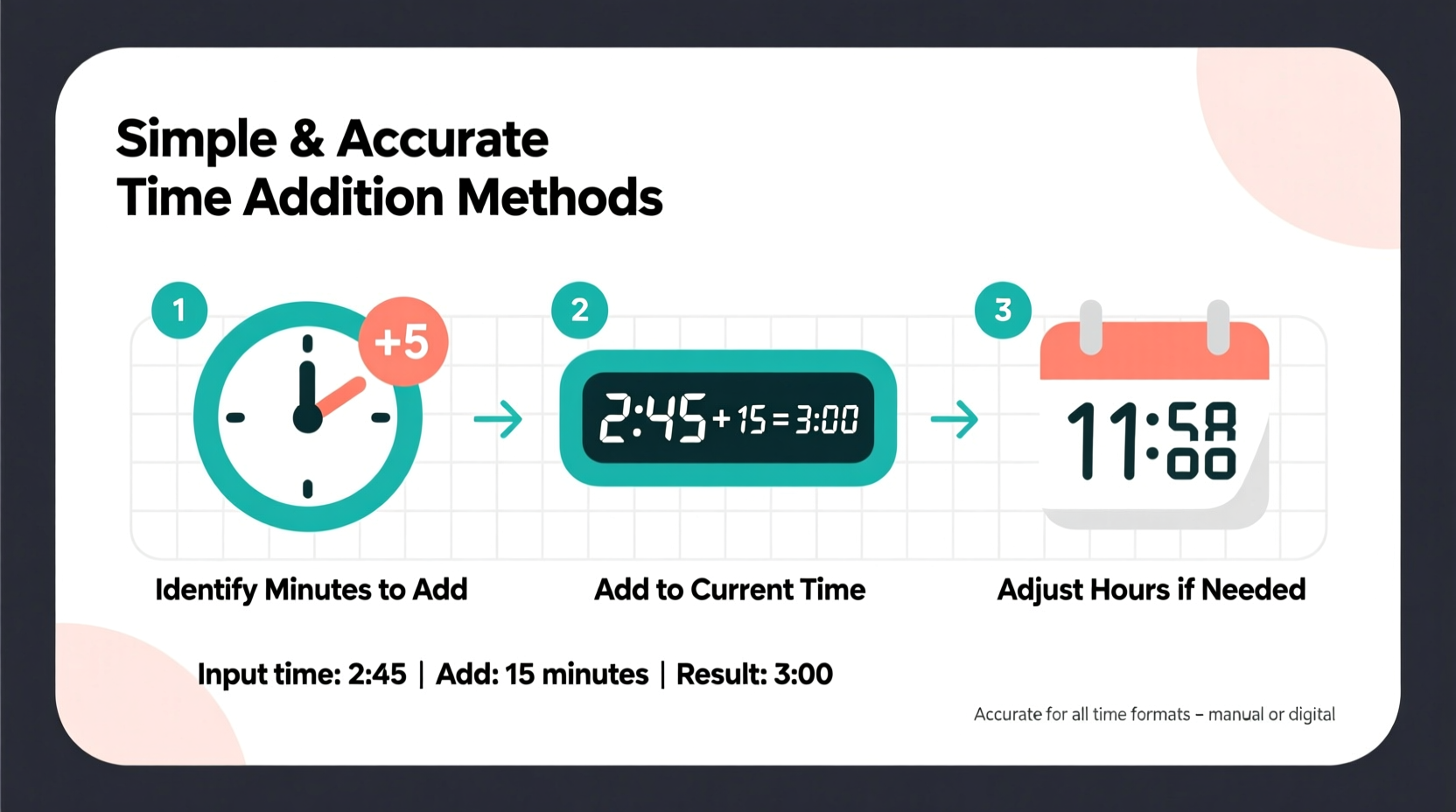
Time doesn’t follow standard decimal rules. There are 60 minutes in an hour, not 100. This means adding 45 minutes to 9:30 AM isn't as simple as treating \"30 + 45 = 75\" and calling it 9:75 AM. Instead, you must convert excess minutes into full hours and adjust accordingly.
The key principle: whenever the sum of minutes exceeds 59, subtract 60 and add one hour to the original time. Repeat if necessary—for example, adding 90 minutes requires two conversions (90 = 60 + 30 → 1 hour 30 minutes).
Consider this common scenario:
- Start time: 2:40 PM
- Add: 50 minutes
- Step 1: 40 + 50 = 90 minutes
- Step 2: 90 minutes = 1 hour 30 minutes
- Final time: 2:40 PM + 1 hour = 3:40 PM; then add remaining 30 minutes → 4:10 PM
Step-by-Step Guide: Adding Minutes Without Error
Follow this five-step process to consistently calculate time additions correctly:
- Identify the starting time (e.g., 10:25 AM).
- Determine the number of minutes to add (e.g., 78 minutes).
- Add the minutes to the existing minutes: 25 + 78 = 103 minutes.
- Convert excess minutes to hours: 103 ÷ 60 = 1 hour and 43 minutes (remainder).
- Add the whole hours to the original time, then append the leftover minutes: 10:25 AM + 1 hour = 11:25 AM, then +43 minutes = 12:08 PM.
This method works regardless of whether you're using a 12-hour or 24-hour clock. For instance, adding 100 minutes to 14:35 (2:35 PM):
- 35 + 100 = 135 minutes → 2 hours 15 minutes
- 14:35 + 2 hours = 16:35, then +15 minutes = 16:50
- Result: 16:50 (4:50 PM)
Using Rounding and Compensation for Mental Math
When speed matters—like estimating arrival times while driving or calculating break durations—you can use rounding to make mental calculations faster.
The strategy involves adjusting the number of minutes to the nearest multiple of 60 or 15, performing the addition, then compensating for the difference.
Example: Add 47 minutes to 8:10 AM.
- Round 47 up to 60 (adding 13 extra minutes).
- Add 60 minutes: 8:10 AM + 1 hour = 9:10 AM.
- Subtract the 13-minute overage: 9:10 AM – 13 minutes = 8:57 AM.
This technique reduces cognitive load and minimizes errors during quick estimations.
| Minutes to Add | Rounded To | Adjustment | Final Step |
|---|---|---|---|
| 38 | 45 (+7) | Subtract 7 after adding | Fast +45 min, then -7 |
| 63 | 60 (–3) | Add 3 after adding | +1 hour, then +3 min |
| 89 | 90 (+1) | Subtract 1 after | +1h30m, then –1 min |
Real-World Example: Planning a Workday Schedule
Sarah, a project manager, starts her day at 9:00 AM. She plans the following tasks:
- Team meeting: 45 minutes
- Email catch-up: 30 minutes
- Client call: 55 minutes
- Lunch break: 35 minutes
- Project review: 70 minutes
She wants to know when she’ll finish her morning block. Using cumulative time addition:
- 9:00 AM + 45 min = 9:45 AM
- 9:45 AM + 30 min = 10:15 AM
- 10:15 AM + 55 min: 15 + 55 = 70 → 1 hour 10 min → 10:15 + 1 hour = 11:15, +10 min = 11:25 AM
- 11:25 AM + 35 min = 12:00 PM (exactly—since 25 + 35 = 60)
- 12:00 PM + 70 min: 70 = 1 hr 10 min → 1:10 PM
Sarah now knows her focused work block ends at 1:10 PM. By applying structured addition, she avoids underestimating task durations and maintains realistic expectations with her team.
“Accurate time estimation isn’t just about math—it’s about respect for people’s schedules and effective resource management.” — Dr. Alan Reed, Time Management Researcher, Stanford University
Common Pitfalls and How to Avoid Them
Even small mistakes in time addition can cascade into significant delays. Here are frequent errors and how to prevent them:
| Pitfall | Why It Happens | How to Prevent |
|---|---|---|
| Treating time like decimal numbers | Adding 50 + 20 = 70 and writing 10:70 instead of 11:10 | Always check if minutes exceed 59; convert to hours |
| Forgetting AM/PM transitions | Adding 90 minutes to 11:45 AM results in 1:15 AM instead of 1:15 PM | Track hour increments carefully across noon/midnight |
| Miscounting carryover hours | Adding 125 minutes as only 1 hour instead of 2 hours 5 minutes | Divide total minutes by 60 to get correct hours |
Quick Checklist for Accurate Time Addition
Use this checklist every time you need to add minutes to a time:
- ✅ Write down the starting time clearly (include AM/PM or 24-hour format).
- ✅ Add the new minutes to the current minutes only.
- ✅ If the sum is 60 or more, divide by 60 to find how many full hours to carry over.
- ✅ Add the carried hours to the original hour value.
- ✅ Handle AM/PM rollover if crossing 12:00 (e.g., 11:30 AM + 90 min = 1:00 PM).
- ✅ Double-check your final time using reverse subtraction if accuracy is critical.
Frequently Asked Questions
What do I do when adding minutes goes past midnight or noon?
When time crosses 12:00, update the hour and toggle AM/PM accordingly. For example, 11:50 PM + 20 minutes = 12:10 AM. In 24-hour format, 23:50 + 20 minutes = 00:10 (next day). Always account for the day change in scheduling tools if relevant.
Can I use a calculator to add time?
Yes, but standard calculators don’t understand time format. Use a scientific calculator with a “time” or “DMS” function, or better yet, use spreadsheet software like Excel or Google Sheets. Enter times as 10:30, then add TIME(0,45,0) to add 45 minutes automatically.
Is there a way to add multiple time intervals quickly?
Absolutely. Sum all minutes first, then convert the total into hours and minutes. For example, adding 25 + 40 + 55 minutes = 120 minutes = 2 hours. Then add that directly to the start time. This reduces repetitive steps and improves efficiency.
Mastering Time Adds Up to Better Productivity
Adding minutes to a time might seem minor, but mastering it enhances punctuality, planning accuracy, and professional reliability. Whether you’re a student scheduling study blocks, a nurse calculating medication intervals, or a freelancer billing hourly work, precise time math pays dividends.
Practice these methods regularly. Start with written calculations, then transition to mental shortcuts as confidence grows. Over time, you’ll develop an intuitive sense of time progression—making scheduling feel effortless.




 浙公网安备
33010002000092号
浙公网安备
33010002000092号 浙B2-20120091-4
Comments
No comments yet. Why don't you start the discussion?