
Converting kilograms to grams is a fundamental skill used in cooking, science, fitness, and daily shopping. Despite its simplicity, many people still hesitate or make errors when performing the conversion. The good news is that it’s one of the most straightforward calculations in the metric system. With the right understanding and tools, anyone can master this conversion quickly and accurately. Whether you're measuring ingredients, tracking body weight, or working in a lab, knowing how to switch between kilograms and grams confidently saves time and prevents mistakes.
Understanding the Metric System Basics
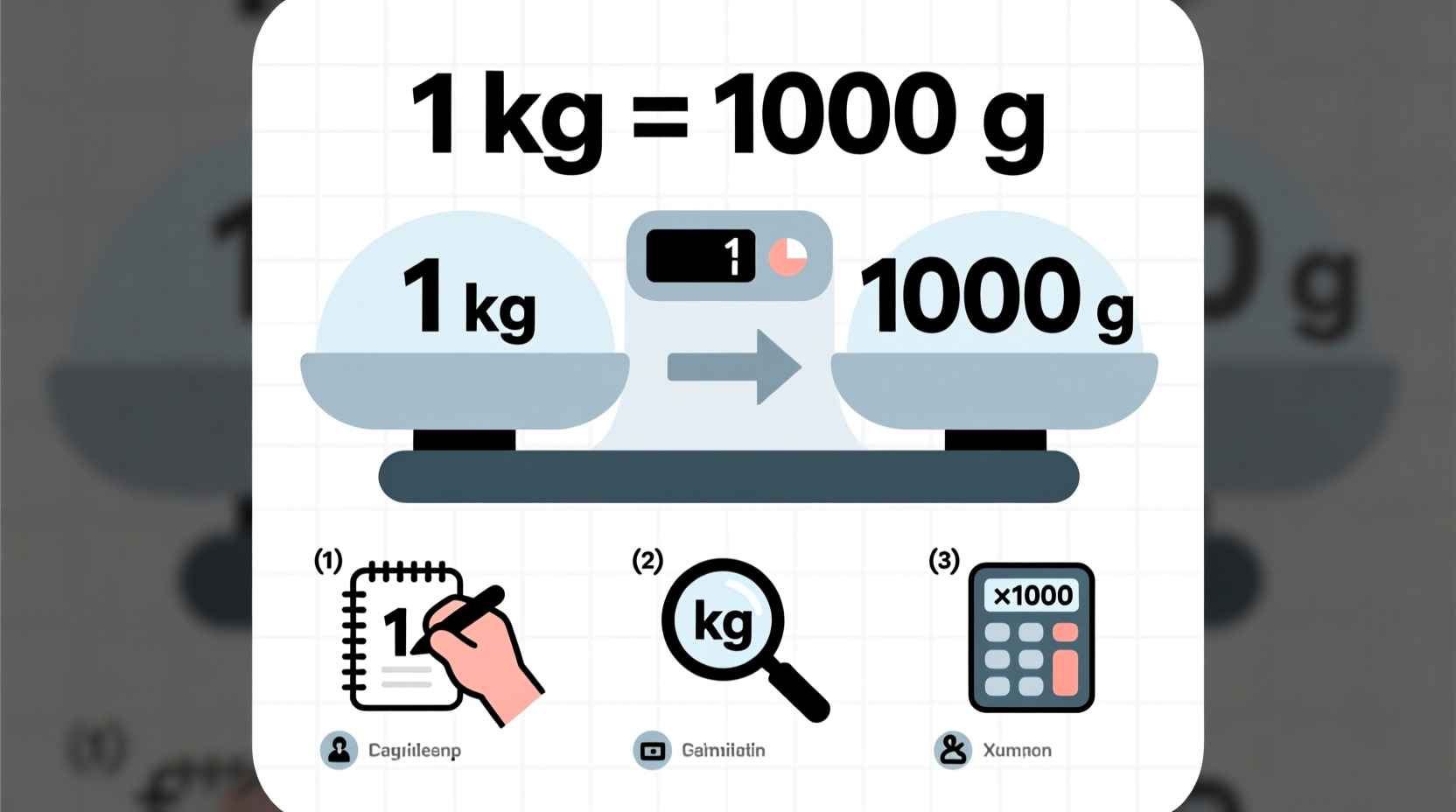
The metric system is a decimal-based system of measurement used worldwide. It simplifies conversions by relying on powers of ten. In this system, the gram (g) is the base unit of mass, and the kilogram (kg) is a larger unit equal to 1,000 grams. This relationship makes converting between the two units intuitive once you understand the prefix \"kilo,\" which means \"thousand.\"
So, 1 kilogram = 1,000 grams. That single fact is the foundation of all conversions between these units. Unlike imperial measurements such as pounds and ounces, where conversions involve fractions and irregular multipliers, metric conversions are consistent and predictable.
“Mastering basic metric conversions like kilograms to grams builds confidence in both academic and real-world settings.” — Dr. Lena Patel, Science Education Specialist
Step-by-Step Guide to Convert Kilograms to Grams
Converting kilograms to grams involves a simple multiplication process. Follow these steps to ensure accuracy every time:
- Identify the number of kilograms you want to convert. For example, let's say you have 2.5 kg.
- Multiply the kilogram value by 1,000. Since 1 kg equals 1,000 g, multiplying by 1,000 shifts the decimal point three places to the right.
- Write down the result in grams. So, 2.5 kg × 1,000 = 2,500 g.
This method works for any value—whole numbers, decimals, or even fractions. For instance:
- 0.75 kg = 0.75 × 1,000 = 750 g
- 4 kg = 4 × 1,000 = 4,000 g
- 0.02 kg = 0.02 × 1,000 = 20 g
Conversion Table for Common Weights
To speed up frequent conversions, refer to this quick-reference table showing common kilogram-to-gram equivalents:
| Kilograms (kg) | Grams (g) |
|---|---|
| 0.1 kg | 100 g |
| 0.25 kg | 250 g |
| 0.5 kg | 500 g |
| 0.75 kg | 750 g |
| 1 kg | 1,000 g |
| 1.5 kg | 1,500 g |
| 2 kg | 2,000 g |
| 3.25 kg | 3,250 g |
| 5 kg | 5,000 g |
Keep this table bookmarked or memorize key values like 0.5 kg = 500 g and 1 kg = 1,000 g to improve speed and accuracy in daily tasks.
Practical Applications in Daily Life
Understanding how to convert kilograms to grams isn’t just useful in math class—it has real-world applications across various areas of life.
In cooking and baking, recipes often list ingredients in grams for precision. If your kitchen scale only shows kilograms, or if a recipe gives an amount in kilograms, converting ensures accuracy. For example, 1.2 kg of flour equals 1,200 grams—critical for perfect dough consistency.
In fitness and nutrition, tracking food intake often requires gram-level detail. A protein bar labeled as 0.18 kg weighs 180 grams. Breaking down portions into grams helps manage calorie counting more effectively.
In science labs or medical settings, precise measurements are non-negotiable. A researcher might need to convert 0.004 kg of a chemical compound to 4 grams for proper dosing in an experiment.
Mini Case Study: Baking Bread at Home
Sophie was following a European sourdough recipe that called for “1.8 kg of bread flour.” Her digital scale displayed grams, not kilograms. Instead of guessing, she applied the conversion rule: 1.8 × 1,000 = 1,800. She measured exactly 1,800 grams of flour. Thanks to the accurate conversion, her dough had the right hydration and structure, resulting in a perfectly risen loaf. A small miscalculation could have led to dense or dry bread.
Common Mistakes and How to Avoid Them
Despite its simplicity, people often make avoidable errors when converting kilograms to grams. Here are the most common pitfalls:
- Moving the decimal point incorrectly: Some shift it only one or two places instead of three, leading to results that are off by a factor of 10 or 100.
- Confusing grams with milligrams: Remember, 1 kg = 1,000 g, but 1 g = 1,000 mg. Don’t skip steps when dealing with smaller units.
- Forgetting to convert decimals properly: 0.01 kg is 10 grams, not 1 gram. Always multiply the full decimal value by 1,000.
Checklist: Master Kilogram-to-Gram Conversions
Use this checklist to build confidence and accuracy:
- Confirm the original measurement is in kilograms.
- Multiply the value by 1,000.
- Move the decimal point three places to the right.
- Add trailing zeros if necessary (e.g., 0.4 kg → 400 g).
- Verify your result using reverse division (grams ÷ 1,000).
- Label the final answer with “g” for grams.
Frequently Asked Questions
How do I convert grams back to kilograms?
To convert grams to kilograms, divide the number of grams by 1,000. For example, 750 g ÷ 1,000 = 0.75 kg. Move the decimal point three places to the left.
Is 500 grams half a kilogram?
Yes, exactly. Since 1 kilogram equals 1,000 grams, 500 grams is one-half of a kilogram. This is a useful benchmark to remember for quick estimates.
Can I use a calculator for this conversion?
Absolutely. While mental math is fast for simple cases, using a calculator ensures precision—especially with complex decimals. Just type the kg value, multiply by 1,000, and read the result in grams.
Final Thoughts and Call to Action
Converting kilograms to grams is a simple yet essential skill that empowers accuracy in everyday decisions—from grocery shopping to scientific work. By understanding the “times 1,000” rule and practicing with real-life examples, anyone can perform this conversion effortlessly. No special tools or advanced math is required—just clarity and consistency.
Start applying these methods today. Use the conversion table, practice the step-by-step technique, and test yourself with random values. Share this knowledge with others who might struggle with measurements. After all, mastering the basics is the first step toward greater confidence in any field that relies on precise data.




 浙公网安备
33010002000092号
浙公网安备
33010002000092号 浙B2-20120091-4
Comments
No comments yet. Why don't you start the discussion?