
Sleep is essential for health, but few consider how it impacts the skin—especially the face. While factors like sun exposure and genetics dominate discussions on aging, a growing body of anecdotal and clinical evidence suggests that sleep position may influence wrinkle formation. Specifically, the debate centers on whether sleeping on your back prevents wrinkles more effectively than sleeping on your side or stomach. The answer isn't as simple as choosing one position over another, but understanding the mechanics of facial pressure, collagen breakdown, and skin elasticity reveals important truths about nighttime habits and long-term skin health.
The Science Behind Wrinkles and Sleep Position
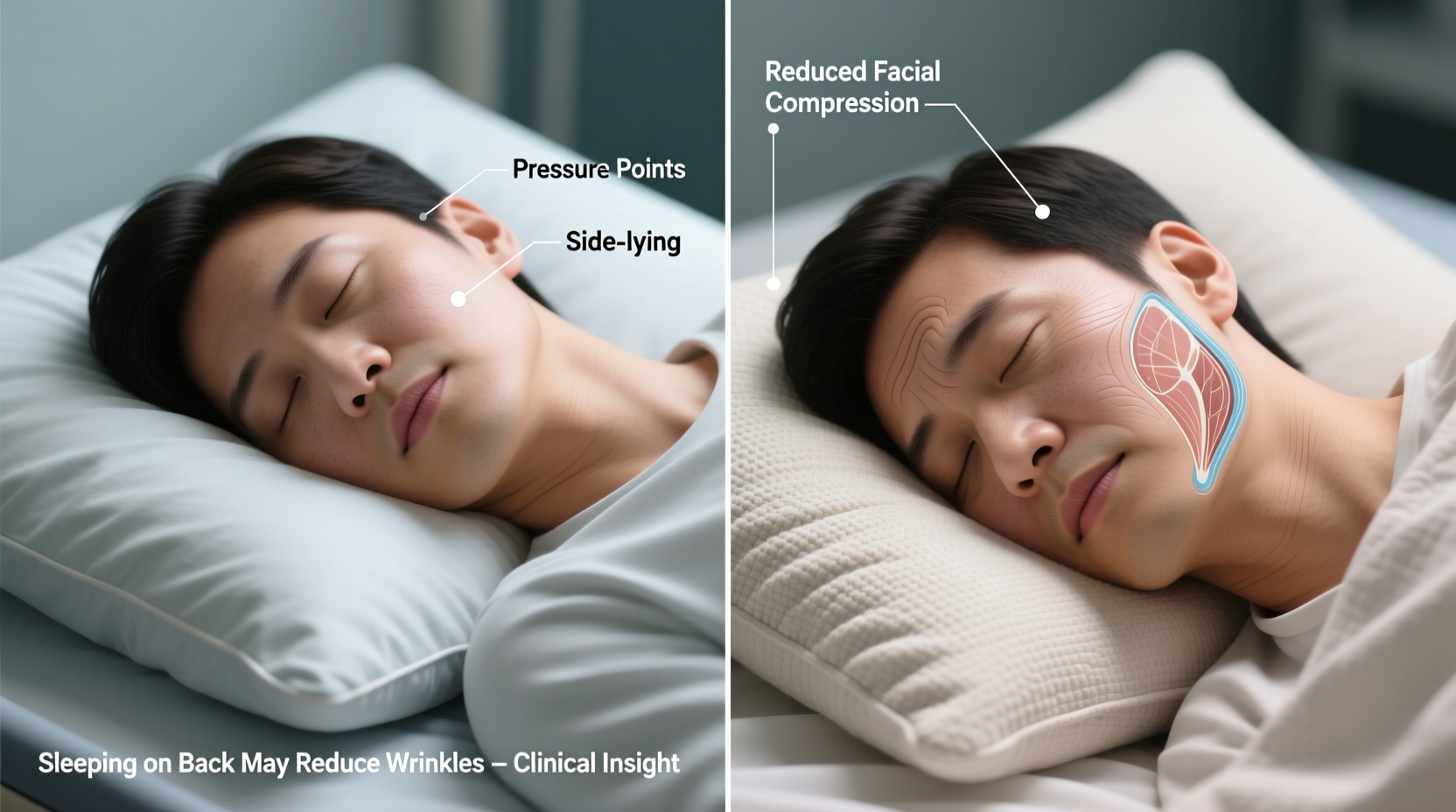
Wrinkles form due to a combination of intrinsic aging (natural loss of collagen and elastin) and extrinsic factors such as UV exposure, pollution, and repetitive mechanical stress. One often-overlooked contributor is \"sleep lines\"—temporary creases that appear on the face after waking from pressing it into a pillow. Over time, these repeated folds can become permanent if the skin’s ability to rebound diminishes with age.
When you sleep on your side or stomach, your face is compressed against the pillow for several hours each night. This sustained pressure can distort delicate facial tissues, especially around the cheeks, jawline, and forehead. In contrast, back sleeping minimizes direct contact between the face and surface, reducing friction and compression.
A 2007 study published in *Aesthetic Surgery Journal* observed that patients who consistently slept on one side developed deeper wrinkles on that side of the face compared to the opposite. The researchers concluded that prolonged lateral pressure contributes to asymmetric wrinkle development, particularly in individuals over 40 whose skin has reduced resilience.
“Sleep lines are real and can evolve into expression-independent wrinkles over time, especially when combined with aging skin. Back sleeping is one of the simplest preventive measures.” — Dr. Rachel Kim, Board-Certified Dermatologist
Back vs Side: A Comparative Breakdown
To understand the differences clearly, consider how each position affects facial structure, skin tension, and overall comfort.
| Sleep Position | Facial Pressure | Wrinkle Risk | Additional Considerations |
|---|---|---|---|
| Back (Supine) | Minimal to none | Low | May reduce acid reflux; ideal for preventing facial distortion |
| Side (Lateral) | High on cheekbone and jaw | Moderate to high | Common for snorers; linked to breast ptosis and facial asymmetry |
| Stomach (Prone) | Very high across entire face | Very high | Puts strain on neck and spine; worst for wrinkle formation |
The data shows that while side sleeping is the most common position—adopted by an estimated 60% of adults—it also poses the greatest risk for developing sleep-related facial creases. These creases typically appear along the upper cheek, nasolabial fold, and chin, depending on head rotation and pillow firmness.
How Repetitive Compression Accelerates Aging
Skin behaves like a fabric under stress. When folded repeatedly in the same direction, fibers weaken and lose their ability to spring back. This phenomenon, known as mechanical fatigue, applies not only to clothing but also to human tissue.
During sleep, gravity pulls the face into the pillow, creating shear forces that stretch collagen and compress blood flow. Reduced circulation limits oxygen delivery and slows cellular repair—processes critical for maintaining youthful skin. Over months and years, this micro-trauma accumulates, especially in areas where the skin is thinnest, such as the periorbital region (around the eyes).
Moreover, cotton pillowcases absorb moisture and create friction, exacerbating tugging on facial skin. Silk or satin alternatives reduce resistance, allowing the face to glide rather than grip during movement. However, even with smoother fabrics, side and stomach sleepers still experience significant deformation simply due to positioning.
Can Changing Your Sleep Position Really Prevent Wrinkles?
Yes—but with caveats. Switching to back sleeping won’t erase existing wrinkles, nor will it stop natural aging. However, it can slow the progression of sleep-induced lines and support overall skin integrity.
Prevention works best when started early. Individuals in their 20s and 30s who adopt back sleeping may delay the onset of certain static wrinkles by decades. For those already noticing fine lines, eliminating nocturnal compression gives the skin a chance to recover slightly overnight, potentially softening temporary creases before they harden.
It's important to note that not everyone can comfortably switch to back sleeping. Some find it difficult to stay in position, while others experience worsened snoring or sleep apnea symptoms when lying flat. In such cases, compromise strategies—like using specialized pillows or adjusting bedding materials—can mitigate damage without forcing an unsustainable change.
Step-by-Step Guide to Transitioning to Back Sleeping
Changing sleep posture takes time and consistency. Follow this gradual approach to increase success:
- Assess your current habits: Record your typical sleep position upon waking for three nights to establish a baseline.
- Optimize your sleep environment: Use a supportive mattress and a thinner pillow to keep your head aligned with your spine, avoiding excessive neck elevation.
- Add positional aids: Place firm cushions or rolled towels alongside your lower back and hips to prevent rolling onto your side.
- Try a wedge pillow: Elevating the upper body slightly can make back sleeping more comfortable, especially for those with reflux or breathing issues.
- Practice consistency: Allow 4–6 weeks for adaptation. Expect disruptions initially, but persistence improves retention.
- Monitor results: Take monthly front-facing photos in consistent lighting to observe changes in facial symmetry and line depth.
Complementary Strategies to Reduce Sleep-Related Skin Damage
No single habit operates in isolation. To maximize wrinkle prevention, combine improved sleep posture with other dermatological best practices.
- Switch to silk or satin pillowcases: These materials reduce friction by up to 43% compared to cotton, minimizing pulling on delicate facial skin.
- Apply night creams with reparative ingredients: Look for formulations containing peptides, hyaluronic acid, and niacinamide, which support barrier function and hydration while you sleep.
- Stay hydrated: Well-hydrated skin is more elastic and less prone to folding deeply under pressure.
- Avoid alcohol before bed: Alcohol dehydrates the skin and increases inflammation, weakening its structural resilience.
- Use a humidifier: Dry air strips moisture from the skin overnight, making it more vulnerable to stress.
Mini Case Study: Sarah’s Experience with Sleep Lines
Sarah, a 45-year-old marketing executive, noticed that her left cheek had developed a deeper groove than the right. Confused, she consulted a dermatologist, who asked about her sleep habits. Sarah admitted she always slept on her left side, cradling her head in her hand—a position she’d maintained since college.
Her dermatologist explained that the persistent pressure was likely responsible for the asymmetry. She recommended switching to back sleeping and using a silk pillowcase. Skeptical but motivated, Sarah began using a body pillow to stabilize her position and gradually trained herself to stay supine.
After five months, follow-up photos showed a visible reduction in the prominence of the left cheek line. While not fully erased, the wrinkle appeared softer and less defined. Sarah reported better morning skin texture and fewer instances of puffiness.
“Even subtle changes in sleep mechanics can have measurable effects on facial aging. Sarah’s case highlights how lifestyle tweaks complement clinical treatments.” — Dr. Lena Torres, Cosmetic Dermatology Specialist
Checklist: How to Minimize Wrinkles Through Better Sleep Habits
Follow this actionable checklist to protect your skin while you sleep:
- ✅ Assess your dominant sleep position
- ✅ Choose a supportive, low-profile pillow
- ✅ Replace cotton pillowcases with silk or satin
- ✅ Wash bedding weekly to remove oils and debris
- ✅ Gradually transition to back sleeping using positional supports
- ✅ Stay hydrated throughout the day
- ✅ Apply a nourishing night cream before bed
- ✅ Avoid sleeping with makeup on
- ✅ Use a humidifier in dry climates or heated rooms
- ✅ Monitor facial changes monthly with consistent photography
Frequently Asked Questions
Do sleep wrinkles go away on their own?
Temporary sleep lines usually fade within 20–60 minutes after waking, especially in younger individuals with resilient skin. However, with age and repeated folding, these lines can become permanent and no longer disappear during the day. Early intervention through position change can help prevent this progression.
Is side sleeping bad for other parts of the body?
While side sleeping is generally safe and even beneficial for digestion and breathing in some cases, it can contribute to shoulder and hip pain due to uneven pressure. In women, there’s emerging discussion—though limited evidence—about potential links between side sleeping and breast tissue stretching over time. However, the strongest documented concern remains facial distortion and wrinkle formation.
Can I prevent wrinkles just by changing my pillow?
Switching to a silk pillowcase helps reduce friction, but it doesn’t eliminate the root cause: facial compression. Without adjusting sleep position, even the smoothest fabric won’t fully prevent deep folding. For maximum benefit, combine pillow upgrades with positional awareness.
Conclusion: Small Changes, Long-Term Results
The way you sleep matters more than many realize. While genetics and sun protection remain the cornerstones of anti-aging skincare, daily habits—including sleep posture—play a cumulative role in how your skin ages. Sleeping on your back may seem like a minor adjustment, but over years, it reduces repetitive stress on facial skin, helping preserve its smoothness and symmetry.
This isn’t about perfection. You don’t need to maintain a rigid back-sleeping position all night. Even increasing the percentage of time spent on your back—from 20% to 60%—can make a meaningful difference. Combined with proper skincare and clean bedding, this simple behavioral shift becomes part of a holistic strategy for lasting radiance.




 浙公网安备
33010002000092号
浙公网安备
33010002000092号 浙B2-20120091-4
Comments
No comments yet. Why don't you start the discussion?