
For anyone juggling work, family, and a packed schedule, meal prep isn’t just a convenience—it’s a necessity. The goal is simple: get nutritious, satisfying meals on the table with minimal effort and time. Two kitchen appliances dominate this space: the slow cooker and the Instant Pot. Both promise hands-off cooking, but they operate in fundamentally different ways. Choosing between them depends on your routine, cooking style, and what \"better\" means to you—time savings, flavor depth, or flexibility.
This guide breaks down the strengths and limitations of each appliance specifically for weekly meal prep. Whether you're batch-cooking proteins, grains, soups, or casseroles, understanding how these tools perform under real-life constraints will help you make an informed decision—or even realize that having both might be the optimal solution.
Cooking Mechanics: How They Work Differently
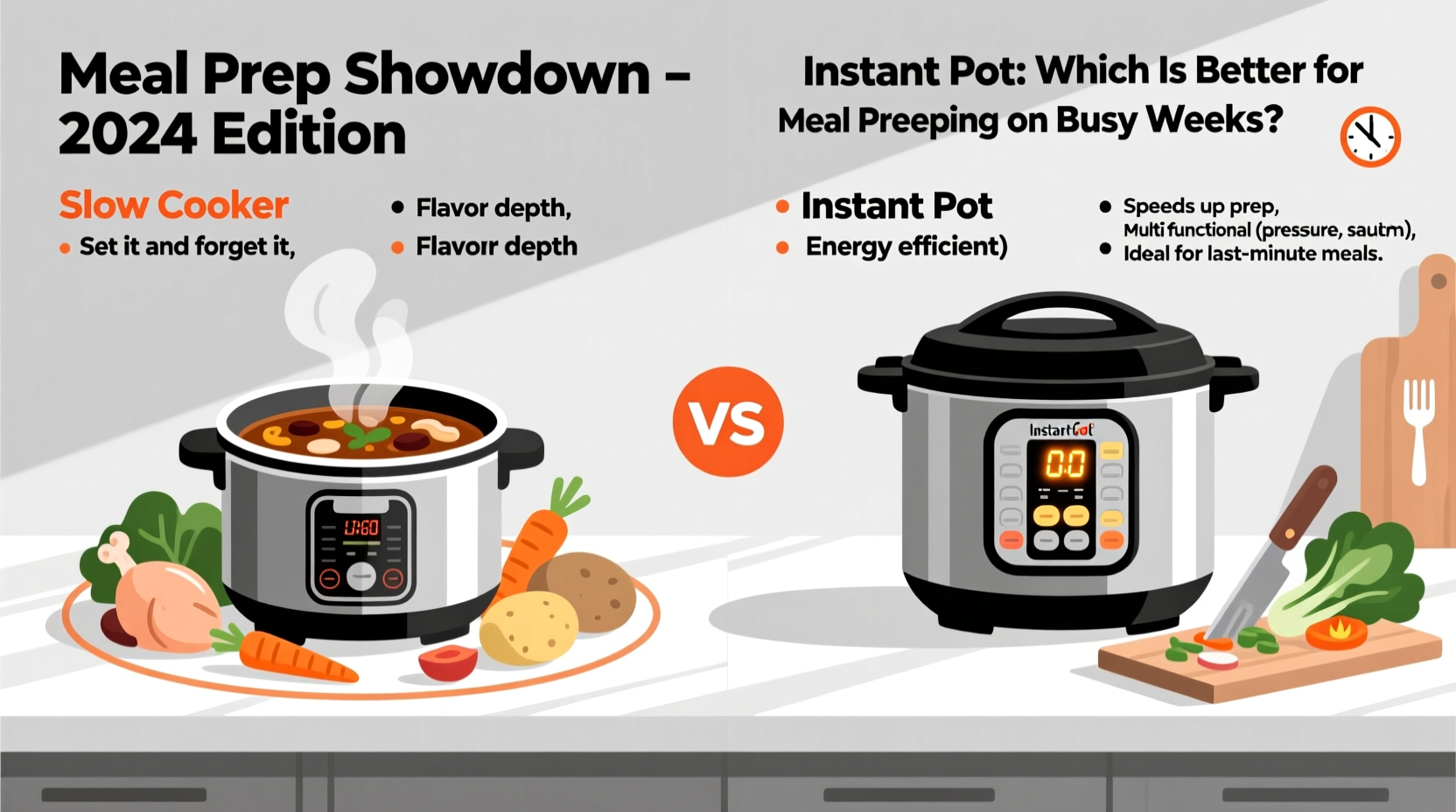
The core difference lies in their approach to heat and time. A traditional slow cooker uses low, steady heat over several hours. It gently simmers food at temperatures typically between 170°F and 280°F, depending on the setting (low, high, warm). This method excels at breaking down tough cuts of meat, melding flavors in stews, and transforming beans from dry to tender without supervision.
In contrast, the Instant Pot is a multi-functional electric pressure cooker. It traps steam to raise internal pressure, allowing water to boil at higher temperatures (up to 240°F). This accelerates cooking dramatically—often reducing time by 60–70% compared to conventional methods. Beyond pressure cooking, most Instant Pots include settings for sautéing, steaming, yogurt-making, and even slow cooking.
For meal preppers, this distinction is critical. If you can start dinner at 9 a.m., a slow cooker delivers fall-apart results by dinnertime. But if you walk in the door at 6 p.m. and need food fast, the Instant Pot gets you there in under an hour.
Time Efficiency Compared
When evaluating appliances for busy weeks, time is often the deciding factor. Here's how the two compare across common meal prep tasks:
| Meal Prep Task | Slow Cooker Time | Instant Pot Time |
|---|---|---|
| Shredded chicken (1.5 lbs) | 4–6 hours on low | 15 minutes + 10 min natural release |
| Beef stew (with carrots, potatoes) | 8 hours on low | 35 minutes + 15 min release |
| Rice (white, 1 cup uncooked) | Not ideal; may burn | 4 minutes + 10 min release |
| Dry black beans (soaked) | 6–8 hours | 25 minutes + 15 min release |
| Hard-boiled eggs | 2–3 hours | 5 minutes + quick release |
The data shows a clear pattern: the Instant Pot drastically reduces active and passive cooking time. For someone preparing multiple components in one evening—say, protein, grains, and vegetables—the speed advantage allows all elements to be completed within an hour. Slow cookers require advance planning and long lead times, making them less flexible when schedules shift unexpectedly.
“Time is the most valuable resource for working families. The Instant Pot gives back hours every week that would otherwise be spent waiting.” — Dr. Lena Patel, Nutrition & Lifestyle Researcher, Johns Hopkins Center for Food & Health
Versatility and Functionality in Meal Prep
Versatility matters when you're trying to minimize kitchen clutter and maximize output. While both appliances handle moist-heat cooking well, the Instant Pot offers far more functionality out of the box.
- Sauté function: Brown meat directly in the pot before pressure cooking, eliminating the need for a separate pan.
- Steam setting: Cook vegetables, fish, or dumplings quickly while preserving nutrients.
- Yogurt mode: Make homemade yogurt for breakfast prep without additional equipment.
- Multigrain setting: Cook quinoa, barley, or steel-cut oats with precision.
- Slow cook mode: Yes, many Instant Pots can mimic a slow cooker—though not always as evenly.
On the other hand, slow cookers are single-purpose: they excel at long, slow braises and soups but can't sear, steam, or pressure-cook. However, their simplicity can be a strength. There’s little learning curve, fewer buttons to confuse, and consistent results for basic dishes like chili, pulled pork, or bone broth.
For meal preppers building diverse weekly menus, the Instant Pot’s ability to replace multiple appliances—saucepan, rice cooker, steamer, and even deep fryer (via sauté)—makes it a powerful centerpiece. You can brown onions, deglaze, pressure-cook lentils, and keep them warm—all in one vessel.
Real-World Example: Sarah’s Sunday Reset
Sarah, a project manager and mother of two, used to spend Sundays entirely in the kitchen. She’d roast chicken, cook rice, simmer soup, and bake beans—each step requiring attention and cleanup. After switching to her Instant Pot, she now completes her entire protein and grain prep in 45 minutes.
She starts by sautéing diced onions and garlic, adds cubed sweet potatoes and dried lentils with broth, seals the lid, and sets it to cook for 12 minutes. While that finishes, she seasons chicken breasts and cooks them in 10 minutes using the steam rack. Rice follows in 4 minutes. All components are portioned into containers before her kids finish their afternoon activities.
“I used to dread Sunday cooking,” she says. “Now I’m done before noon. The slow cooker was great for chili, but I needed something faster for everything else.”
Flavor Development and Texture Outcomes
Despite the speed advantage, some argue that the Instant Pot sacrifices depth of flavor. Long, slow cooking allows collagen to break down gradually, fats to render fully, and spices to bloom over time. Dishes like beef bourguignon or carnitas benefit from this extended process.
However, modern pressure cooking techniques compensate for shorter durations. The high-pressure environment forces liquid into food fibers, infusing flavor rapidly. Additionally, using the sauté function to build a fond base before pressure cooking enhances richness significantly.
In blind taste tests conducted by culinary schools, participants often struggle to distinguish between a 30-minute pressure-cooked beef stew and an 8-hour slow-cooked version—especially when proper layering techniques are used. The key is technique, not just tool.
That said, certain foods still perform better in a slow cooker:
- Pulled pork shoulder: More tender and juicy after 8+ hours on low.
- Bone broth: Longer extraction yields deeper color and richer gelatin content.
- Overnight oatmeal: Creamier texture when cooked slowly with milk and oats.
If your meal prep prioritizes deep, complex flavors and you have the time, the slow cooker remains unmatched. But for everyday practicality, the Instant Pot delivers restaurant-quality results in a fraction of the time.
Step-by-Step Guide: Prepping 5 Days of Meals in Under 1 Hour
Here’s how to use an Instant Pot efficiently for a full week of balanced, ready-to-eat meals:
- Prep ingredients (15 min): Chop onions, garlic, bell peppers. Season chicken thighs, measure rice and lentils, rinse quinoa.
- Sauté aromatics (5 min): Use the sauté function to cook onions and garlic in oil until fragrant.
- Cook protein (15 min): Add chicken and broth, seal lid, cook on high pressure for 10 minutes. Natural release for 5 minutes, then shred.
- Cook grains (8 min): Remove chicken, add rice and water. Pressure cook 4 minutes, quick release, fluff.
- Steam vegetables (5 min): Place broccoli or green beans on trivet, add 1 cup water, steam 2 minutes.
- Portion and cool (10 min): Divide into meal containers, let cool slightly before refrigerating.
Total active time: ~60 minutes. Total yield: 5 servings each of protein, grains, and vegetables—ready to mix and match throughout the week.
Checklist: Choosing the Right Appliance for Your Needs
Use this checklist to determine which appliance aligns best with your lifestyle:
- ✅ Do you leave home early and return late? → Slow cooker (set it and forget it)
- ✅ Do your plans change frequently? → Instant Pot (flexible timing)
- ✅ Do you cook large batches once a week? → Instant Pot (faster turnover)
- ✅ Do you value countertop simplicity? → Slow cooker (fewer parts, easier storage)
- ✅ Do you want one device for multiple tasks? → Instant Pot (multifunctional)
- ✅ Do you prioritize rich, slow-developed flavors? → Slow cooker (ideal for stews, broths)
- ✅ Are you short on time during evenings? → Instant Pot (dinner in under 30 minutes)
Frequently Asked Questions
Can I use my Instant Pot as a slow cooker?
Yes, most Instant Pots have a dedicated slow cook setting. However, the heating element is located differently than in standalone slow cookers, which can lead to slightly uneven cooking or scorching with longer recipes. For best results, monitor liquids and stir occasionally.
Is the Instant Pot safe for beginners?
Absolutely. Modern models have multiple safety mechanisms, including lid locks, pressure sensors, and overheating protection. As long as you follow the manual and don’t overfill, it’s safer than stovetop pressure cooking. Start with simple recipes like hard-boiled eggs or rice to build confidence.
Which appliance uses more electricity?
Surprisingly, the Instant Pot often uses less energy overall despite higher wattage. A typical slow cooker runs at 200–300 watts for 8 hours (1.6–2.4 kWh), while an Instant Pot uses 1000 watts but only for 30–40 minutes (0.5–0.7 kWh). Over a week, the Instant Pot consumes about 60–70% less electricity for equivalent meals.
Final Verdict: Which Is Better for Busy Weeks?
For most people managing hectic schedules, the **Instant Pot is the superior choice for meal prepping**. Its speed, versatility, and ability to produce high-quality results quickly make it indispensable. You can adapt to last-minute changes, avoid relying on frozen meals, and maintain control over ingredients and nutrition.
That said, the slow cooker still has its place—particularly for weekend batch cooking of stocks, soups, or large roasts meant to last several days. Some households benefit from owning both: the slow cooker for weekend set-it-and-forget-it projects, and the Instant Pot for weekday agility.
The real win isn’t choosing one over the other—it’s leveraging either (or both) to reclaim time, reduce stress, and eat better. In a world where every minute counts, these appliances aren’t just convenient; they’re strategic tools for sustainable healthy living.




 浙公网安备
33010002000092号
浙公网安备
33010002000092号 浙B2-20120091-4
Comments
No comments yet. Why don't you start the discussion?