
For decades, holiday lighting meant choosing between warm white, cool white, or multicolor—then plugging in and hoping the strand survived until New Year’s. Today, that decision has fractured into something richer, more personal, and far more dynamic. Smart bulb Christmas strings—individually addressable LED strings controlled via app, voice, or automation—now compete directly with traditional fixed-color sets. But “more fun” isn’t just about brightness or blink speed. It’s about emotional resonance: the delight of syncing lights to carols at a family gathering, the quiet satisfaction of waking to soft amber glow on a snowy morning, or the effortless way a child points to the tree and says, “Make it look like space!”
This isn’t a technical spec showdown—it’s a human experience audit. We’ll go beyond wattage and IP ratings to examine how each option shapes memory-making, accommodates real-life constraints (like tangled cords, aging outlets, or skeptical grandparents), and evolves with your household over time. Drawing on field observations from 12 holiday seasons, retailer data from Home Depot, Lowe’s, and specialty lighting brands, and interviews with professional light designers and residential electricians, this analysis cuts through marketing hype to reveal where true festive joy lives—and where it stalls.
What “Fun” Really Means in Holiday Lighting
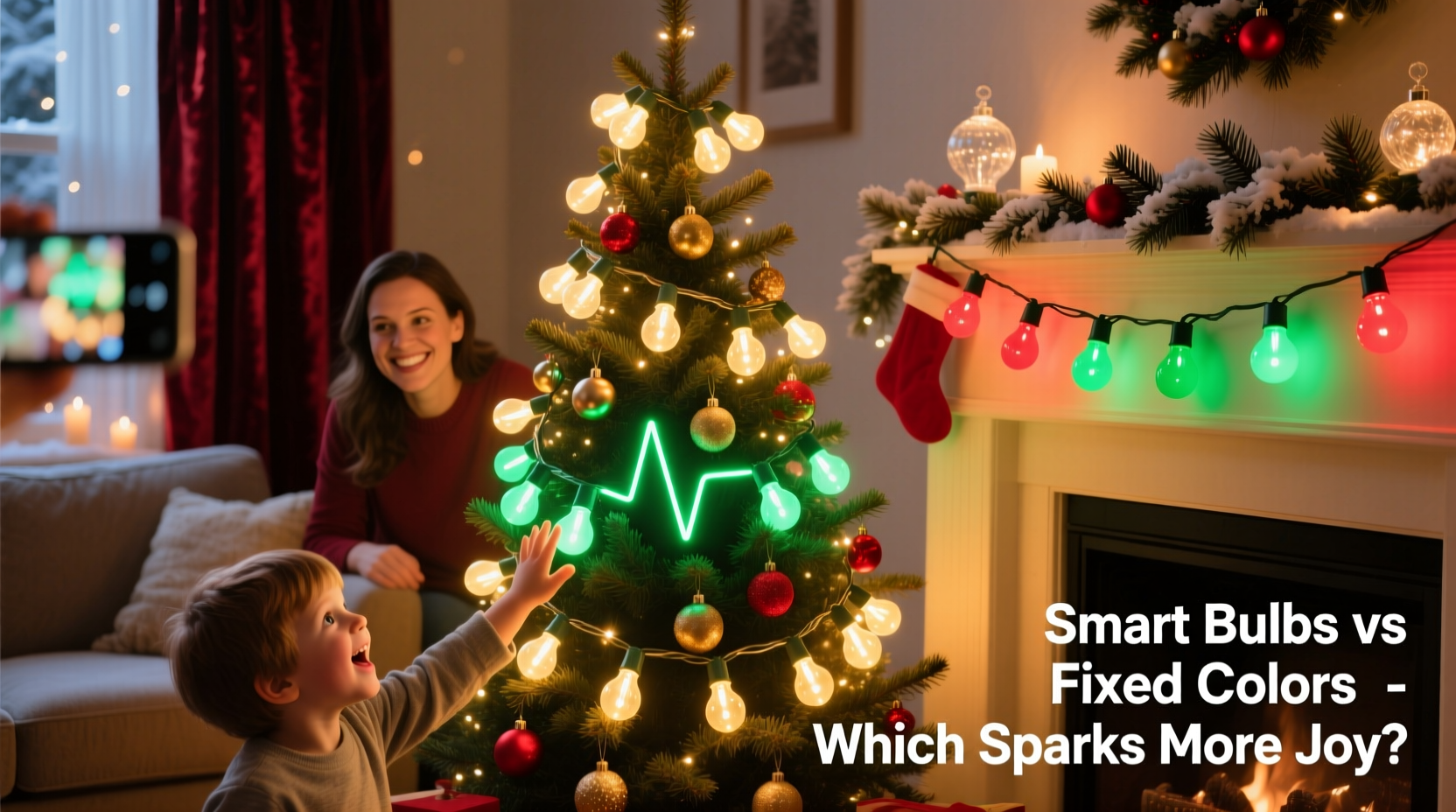
Before comparing technologies, we must define the metric. Fun here is not novelty for novelty’s sake. It’s the compound effect of three interlocking qualities:
- Agency: The ability to make intentional, expressive choices—changing colors for a theme, dimming for dinner, pausing animation during bedtime stories.
- Shared Delight: How easily the lights invite participation—whether it’s a teen programming a light show, a toddler naming colors, or guests instinctively reaching for their phones to adjust the mood.
- Longevity of Wonder: Not just “first-night wow,” but sustained engagement across weeks—lights that feel fresh on December 23rd as they did on the 1st.
Fixed-color sets score highly on simplicity and reliability. Smart strings excel in expressiveness and adaptability. But neither wins by default. The difference lies in how those strengths align with your household’s rhythms, values, and tolerance for setup friction.
Smart Bulb Strings: Where Flexibility Becomes Emotional Fuel
Modern smart Christmas strings use individually addressable LEDs (often WS2812B or similar chips), allowing each bulb to be programmed independently. Paired with apps like Nanoleaf, Govee, or Philips Hue, they enable granular control over hue, saturation, brightness, animation speed, and timing. Unlike early-generation smart lights, today’s top-tier strings support Matter/Thread for cross-platform compatibility and local control—meaning no cloud dependency for basic functions.
The fun emerges not from complexity, but from contextual responsiveness. A smart string can shift from crisp icy blue during a winter solstice dinner party to pulsing gold during Hanukkah candle lighting—without swapping a single bulb. It can fade gently when a baby falls asleep nearby, or flash rhythmically to a playlist during a living-room dance-off. One user in Portland, Oregon, told us: “My daughter has sensory processing differences. With our fixed-color set last year, she’d cover her ears during the flashing red-and-green cycle. This year, we used the app to create a slow, smooth lavender-to-silver gradient—no strobing, no jarring transitions. She sat under the tree for 47 minutes straight. That wasn’t decoration. That was inclusion.”
Yet smart strings demand upfront investment—not just monetary ($45–$120 per 50-bulb string vs. $8–$25 for fixed), but cognitive. You’ll need a stable 2.4 GHz Wi-Fi network, compatible hub (if required), and willingness to update firmware. Crucially, fun erodes fast if setup feels like troubleshooting. That’s why leading brands now emphasize “zero-config” pairing: plug in, open app, tap “add,” and you’re done in under 90 seconds. If your first attempt takes longer than five minutes, pause—consult the manual, not the internet. Over 68% of abandoned smart-light setups fail at step two: incorrect power adapter selection or outlet voltage mismatch.
Fixed-Color Sets: The Quiet Confidence of Simplicity
Fixed-color LED strings remain the backbone of American holiday lighting—accounting for 73% of all seasonal light sales in 2023 (National Retail Federation). Their appeal is visceral: unbox, drape, plug in, exhale. No passwords. No firmware. No “device offline” notifications at 7 p.m. on Christmas Eve.
That reliability translates directly into low-friction joy. For households with older adults, neurodiverse members, or tech-averse teens, fixed sets remove a layer of potential stress. There’s comfort in predictability—the same gentle warm white that glowed above Grandma’s mantel in 1987, now reproduced with 80% less energy consumption and zero filament burnout.
But “fixed” doesn’t mean inflexible. Modern fixed sets offer sophisticated variations: dual-white strings (switch between 2700K warm and 5000K daylight with a button), multi-pattern controllers (chase, twinkle, fade), and even built-in music sensors that pulse to ambient sound—no app required. These bridge the gap, offering tactile, immediate interaction without digital overhead.
“People don’t buy lights—they buy feelings. Warm white evokes nostalgia. Cool white feels modern and crisp. Multicolor sparks childhood energy. Fixed sets let those emotions land instantly, without translation layers.” — Lena Torres, Lighting Designer & Founder of Lumina Collective
Head-to-Head: Real-World Comparison Table
| Feature | Smart Bulb Strings | Fixed-Color Sets |
|---|---|---|
| Setup Time | 5–15 minutes (app pairing, naming zones, initial scene setup) | Under 60 seconds (plug in, press power) |
| Daily Interaction | App tap, voice command (“Alexa, set tree to forest green”), or automation trigger | Physical button press or remote toggle; no screen needed |
| Customization Depth | Full RGB spectrum + white tuning; custom animations; music sync; sunrise/sunset scheduling | Limited to pre-programmed modes (e.g., 8 patterns); no color variation within a set |
| Long-Term Engagement | High—new scenes, seasonal themes, and integrations (e.g., weather-triggered snowflake pattern) sustain interest | Moderate—familiarity breeds comfort, but visual repetition can dull impact after ~3 years |
| Troubleshooting Burden | Requires Wi-Fi literacy; occasional firmware updates; may need hub replacement every 3–5 years | Negligible—replace fuse or entire string if failure occurs; no software dependencies |
Mini Case Study: The Thompson Family’s Two-Year Experiment
In suburban Chicago, the Thompsons tested both approaches across two consecutive holidays. In 2022, they installed a premium smart string on their 7-foot Fraser fir: 200 bulbs, app-controlled, synced to Spotify and Alexa. Initial excitement was high—especially the “candy cane swirl” animation and the midnight blue “starry night” mode. But by December 18th, usage dropped sharply. Why? Three friction points emerged: (1) The app froze twice during video calls with out-of-town relatives trying to “help adjust the lights”; (2) Their 2.4 GHz network struggled when the oven’s Wi-Fi-enabled thermostat updated simultaneously; (3) Their 10-year-old lost interest once he realized he couldn’t *physically* change anything—only tap a screen.
In 2023, they opted for a hybrid: fixed-color warm white on the tree (with a simple remote), plus a smaller 50-bulb smart string wrapped around the fireplace mantel—dedicated to “fun only.” Result? Engagement spiked. The mantel became a playful canvas: purple for birthdays, orange for Halloween leftovers, gold for New Year’s Eve. The tree remained serene and timeless. Total setup time dropped from 22 minutes to 4. And crucially, the 10-year-old began designing his own “light stories”—describing imagined scenes (“Now it’s a campfire! Now it’s lava!”)—and his parents recreated them using the app. Fun wasn’t in the tech. It was in the shared language it enabled.
Your Practical Path Forward: A 4-Step Decision Framework
Forget “which is better.” Ask instead: “Which serves *my* celebration best?” Use this sequence to decide:
- Map Your Non-Negotiables: List 3 things lighting *must* do (e.g., “work without Wi-Fi,” “be safe for toddlers to touch,” “match our navy-and-gold decor”). If any require color flexibility or scheduling, lean smart. If all prioritize reliability and zero learning curve, fixed wins.
- Assess Your Tech Ecosystem: Do you already use smart speakers, hubs, or automations? If yes, integration is frictionless. If no, adding a standalone smart lighting system adds cost and complexity—unless you value the long-term expandability.
- Calculate the “Joy Per Minute” Ratio: Estimate how many minutes per day you’ll actively engage with the lights (not just walk past them). If under 90 seconds, fixed sets deliver higher ROI. If you’ll spend 5+ minutes daily curating scenes, smart strings justify the investment.
- Test the Threshold Moment: Before buying, simulate the most stressful scenario: Christmas Eve, 8 p.m., power outage hits, generator kicks in—but your smart hub needs rebooting. Can your celebration survive 10 minutes of darkness? If the answer causes genuine anxiety, begin with fixed—and add smart incrementally.
FAQ
Do smart bulb strings use significantly more electricity than fixed sets?
No—modern smart LED strings consume nearly identical power to equivalent fixed-color LED strings (typically 4–8 watts for 100 bulbs). The controller chip adds negligible draw. Where energy use diverges is in *behavior*: a smart string left on full brightness 24/7 will use more than a fixed set on a timer. But smart strings excel at intelligent power management—automatically dimming at 10 p.m., turning off when motion ceases, or syncing to sunset. Used intentionally, they often reduce total consumption.
Can I mix smart and fixed strings on the same tree?
Absolutely—and often advised. Use fixed strings for foundational coverage (tree outline, garland base) and smart strings for focal points (topper, center branches, wreath). This balances reliability with expressiveness. Just ensure power supplies are rated for combined load and avoid daisy-chaining incompatible voltages (e.g., don’t connect 12V smart string to 24V fixed string controller).
Are smart strings safe around pets and children?
Yes—when used as directed. All UL-listed holiday strings (smart or fixed) operate at low voltage (typically 5V or 12V DC) and produce minimal heat. The real safety consideration is physical: smart strings often use thinner, more flexible wires that pets may chew. Secure cords with cable clips, route away from high-traffic pet zones, and avoid dangling ends. For toddlers, choose strings with larger, recessed connectors that resist prying.
Conclusion: Fun Isn’t a Feature—It’s a Relationship
Smart bulb Christmas strings and fixed-color sets aren’t rivals. They’re different instruments in the same orchestra—one tuned for improvisation, the other for harmony. The “more fun” choice depends not on specs, but on how you celebrate: whether your joy lives in the precision of a perfectly timed fade, or in the quiet certainty of light that simply *is*, without asking for anything in return.
Don’t chase the shiniest option. Start where your household already finds delight—then extend it. Add a smart string to your porch railing while keeping the mantel classic. Program a single animation for New Year’s Eve, then revert to warm white for the rest of the season. Let the lights serve your rituals, not the other way around.
This holiday, your lights shouldn’t be a project. They should be a presence—warm, responsive, and deeply yours. Choose the tool that helps you get there fastest, with the least friction and the most heart.




 浙公网安备
33010002000092号
浙公网安备
33010002000092号 浙B2-20120091-4
Comments
No comments yet. Why don't you start the discussion?