
Home automation is no longer a luxury reserved for tech enthusiasts or high-end homes. With affordable devices like smart bulbs and smart plugs, anyone can begin transforming their living space into a responsive, energy-efficient environment. But when budget matters, a key question arises: which option offers more value for less money? Smart bulbs provide instant lighting control with color and brightness customization, while smart plugs turn any ordinary device into a smart one at a fraction of the cost. Understanding the real financial and functional differences between these two entry points to automation helps homeowners make informed choices that align with both their needs and their wallets.
Understanding the Basics: What Are Smart Bulbs and Smart Plugs?
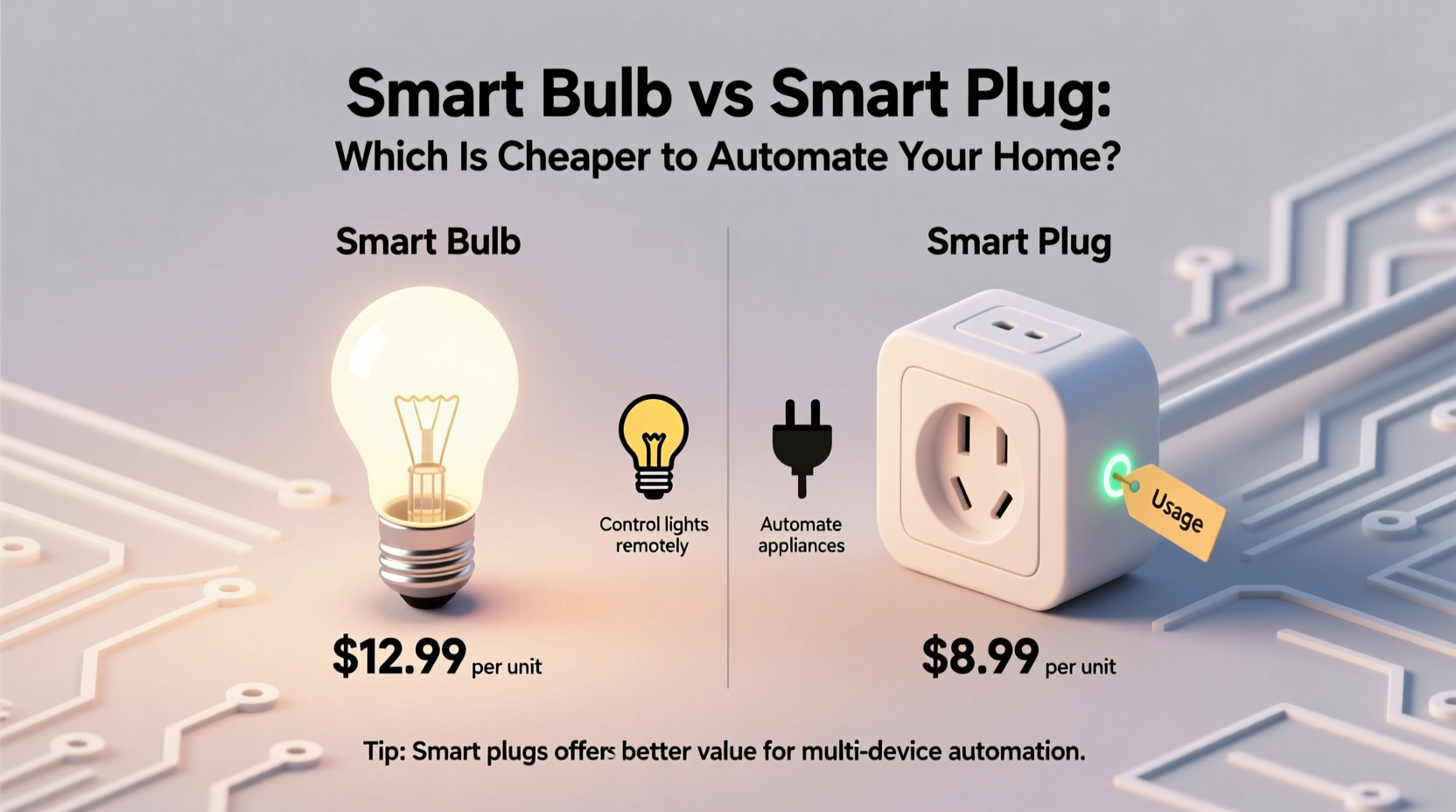
A smart bulb is an LED light source embedded with wireless technology—typically Wi-Fi or Bluetooth—that allows it to be controlled remotely via a smartphone app, voice assistant, or automated schedule. These bulbs often support dimming, color changes, and scene settings, making them ideal for ambiance creation in living rooms, bedrooms, or accent lighting.
In contrast, a smart plug is a small adapter that connects between a wall outlet and any standard electrical device—like a lamp, coffee maker, or fan. Once paired with your home network, it enables remote on/off control and scheduling for the connected appliance. Unlike smart bulbs, smart plugs don’t alter the function of the device itself—they simply add connectivity.
Both options integrate with platforms like Amazon Alexa, Google Assistant, and Apple HomeKit, but they serve different automation purposes. The choice between them often comes down to whether you want to upgrade your lighting specifically (smart bulbs) or gain broader control over various appliances (smart plugs).
Cost Comparison: Upfront Price and Long-Term Value
When evaluating affordability, start with the sticker price. On average, a single-color smart bulb ranges from $10 to $25, depending on brand and features. Full-color RGB models with tunable white temperatures can exceed $30 each. If your home has multiple lamps or ceiling fixtures, replacing every bulb adds up quickly. For example, automating five overhead lights could cost $75–$150 just in bulbs.
Smart plugs, meanwhile, typically retail between $12 and $20 per unit. Some premium models with energy monitoring or surge protection may reach $30, but basic versions remain consistently under $15. Because one plug controls an entire device, you need fewer units to achieve broad automation coverage.
Energy efficiency also plays a role in long-term savings. Smart bulbs use LED technology, consuming 75–80% less energy than incandescent bulbs. However, smart plugs shine in energy tracking: many models report real-time power usage, helping users identify energy-hungry appliances and reduce waste. While smart bulbs save on lighting costs, smart plugs empower users to cut electricity use across multiple devices—from space heaters to entertainment systems.
“Smart plugs offer the fastest return on investment for most households because they unlock automation for high-power devices without requiring full hardware replacements.” — David Lin, Home Automation Analyst at TechHaven Research
Detailed Feature Comparison
| Feature | Smart Bulb | Smart Plug |
|---|---|---|
| Initial Cost (per unit) | $10–$30 | $12–$20 |
| Installation | Replace existing bulb | Plug into outlet |
| Compatibility | Lamp/fixture dependent | Any AC-powered device |
| Dimming Support | Yes (built-in) | Limited (depends on device) |
| Color Customization | Yes (on RGB models) | No |
| Energy Monitoring | Rare | Common in mid-to-high-end models |
| Voice Control | Yes | Yes |
| Scheduling & Automation | Yes | Yes |
| Lifespan | 15,000–25,000 hours | 5+ years (no wear parts) |
The table highlights a crucial distinction: smart bulbs excel in lighting-specific enhancements, while smart plugs deliver versatility. A smart bulb cannot control a toaster or humidifier, but a smart plug can replicate much of a smart bulb’s functionality when used with a lamp. Simply screw a regular LED bulb into a lamp, plug it into a smart plug, and you’ve created a remotely switchable light source—often for less than the price of one smart bulb.
Real-World Scenario: Automating a Living Room on a Budget
Consider Sarah, a renter looking to add smart features to her apartment without permanent changes or overspending. Her living room has a floor lamp, a TV, a soundbar, and a small fan. She wants to turn devices on/off remotely and set evening schedules.
If she chooses smart bulbs, she’d replace the bulb in the floor lamp ($18). That gives her smart lighting—but nothing else. To control the TV and fan, she’d still need additional solutions, possibly infrared remotes or hubs, increasing complexity and cost.
Instead, she buys two smart plugs: one for the lamp ($15), another for the TV/soundbar power strip ($18). Now, she can schedule the lamp to turn on at sunset, shut off the entertainment system at midnight, and even use voice commands to “turn off everything” before bed. Total spent: $33. She achieves broader automation for less than the cost of three smart bulbs.
This scenario illustrates a common pattern: smart plugs offer faster scalability and wider application. They’re especially useful for renters or those unwilling to rewire or replace fixtures.
When Smart Bulbs Make More Sense
Despite the cost advantage of smart plugs, there are situations where smart bulbs are the better—or only—choice. If you want dynamic lighting effects, such as color-changing scenes for movie nights or sunrise simulations in the bedroom, smart bulbs are unmatched. No smart plug can adjust brightness gradually or shift from warm to cool white based on time of day.
Integrated ceiling fixtures also favor smart bulbs. Recessed lighting, chandeliers, or track lights often don’t use plug-in lamps, eliminating the option to use a smart plug. In these cases, upgrading to smart bulbs is the only path to automation.
Additionally, frequent switching can wear out mechanical relays in smart plugs over time. Lighting circuits cycled dozens of times daily may benefit from the solid-state design of smart bulbs, which have no moving parts and are built for rapid toggling.
Step-by-Step Guide to Choosing the Right Option
- Assess Your Devices: List all appliances and lights you want to automate. Note whether they’re plugged in or hardwired.
- Evaluate Usage Patterns: Determine if you need dimming, color control, or simple on/off scheduling.
- Check Compatibility: Confirm that your lighting fixtures accept smart bulbs (E26/E27 base, enclosed fixture ratings) and that outlets are accessible for smart plugs.
- Calculate Total Cost: Multiply the number of needed units by average prices. Include any required accessories (e.g., smart hub for Zigbee bulbs).
- Prioritize Based on ROI: Start with the solution that automates the most devices or saves the most energy per dollar spent.
- Test One Device First: Buy a single smart bulb or plug to evaluate app performance, responsiveness, and integration with your voice assistant before scaling.
This methodical approach prevents overspending and ensures compatibility. Many users find that a hybrid strategy—using smart bulbs for ambiance and smart plugs for utility—delivers optimal balance.
FAQ
Can I use a smart plug with a lamp instead of a smart bulb?
Yes, absolutely. Plugging a lamp into a smart plug allows remote on/off control and scheduling. You lose dimming and color features unless the lamp has its own dimmer switch, but it’s a cost-effective alternative.
Do smart bulbs work when the light switch is turned off?
No. Most smart bulbs require constant power to stay connected. If the wall switch cuts power, the bulb goes offline and can’t receive commands. For reliable operation, leave the switch on and control the bulb via app or voice.
Are smart plugs safe for high-wattage appliances?
Check the plug’s maximum load rating. Standard smart plugs handle up to 15A (1800W), suitable for lamps, fans, and TVs. Avoid using them with high-draw devices like space heaters, microwaves, or air conditioners unless explicitly rated for such loads.
Final Recommendation: Which Is Cheaper and Smarter?
In terms of upfront cost and versatility, smart plugs generally offer a more economical entry into home automation. They enable control over a wider range of devices at a lower per-unit price and are easier to deploy in rental properties or complex setups. For someone aiming to automate multiple appliances without breaking the bank, smart plugs are the logical starting point.
However, if lighting quality, mood enhancement, or aesthetic customization is a priority, investing in smart bulbs is justified—even if it comes at a higher cost. Their ability to transform a room’s atmosphere is something smart plugs simply can’t replicate.
The smartest path forward isn’t choosing one over the other—it’s combining both strategically. Begin with smart plugs to gain immediate, broad control over everyday devices. Then, selectively introduce smart bulbs in spaces where lighting experience matters most. This tiered approach maximizes value, minimizes waste, and builds a truly intelligent home—one plug and bulb at a time.




 浙公网安备
33010002000092号
浙公网安备
33010002000092号 浙B2-20120091-4
Comments
No comments yet. Why don't you start the discussion?