
For those stepping into the world of smart home technology, choosing the right starting point can be overwhelming. Two of the most accessible entry-level devices are smart bulbs and smart plugs. Both promise convenience, energy savings, and voice control—but they serve very different purposes. Understanding their strengths, limitations, and real-world applications is essential for making a decision that aligns with your lifestyle and budget. This guide breaks down the practical differences, helping beginners determine which option delivers greater long-term value.
Understanding Smart Bulbs and Smart Plugs
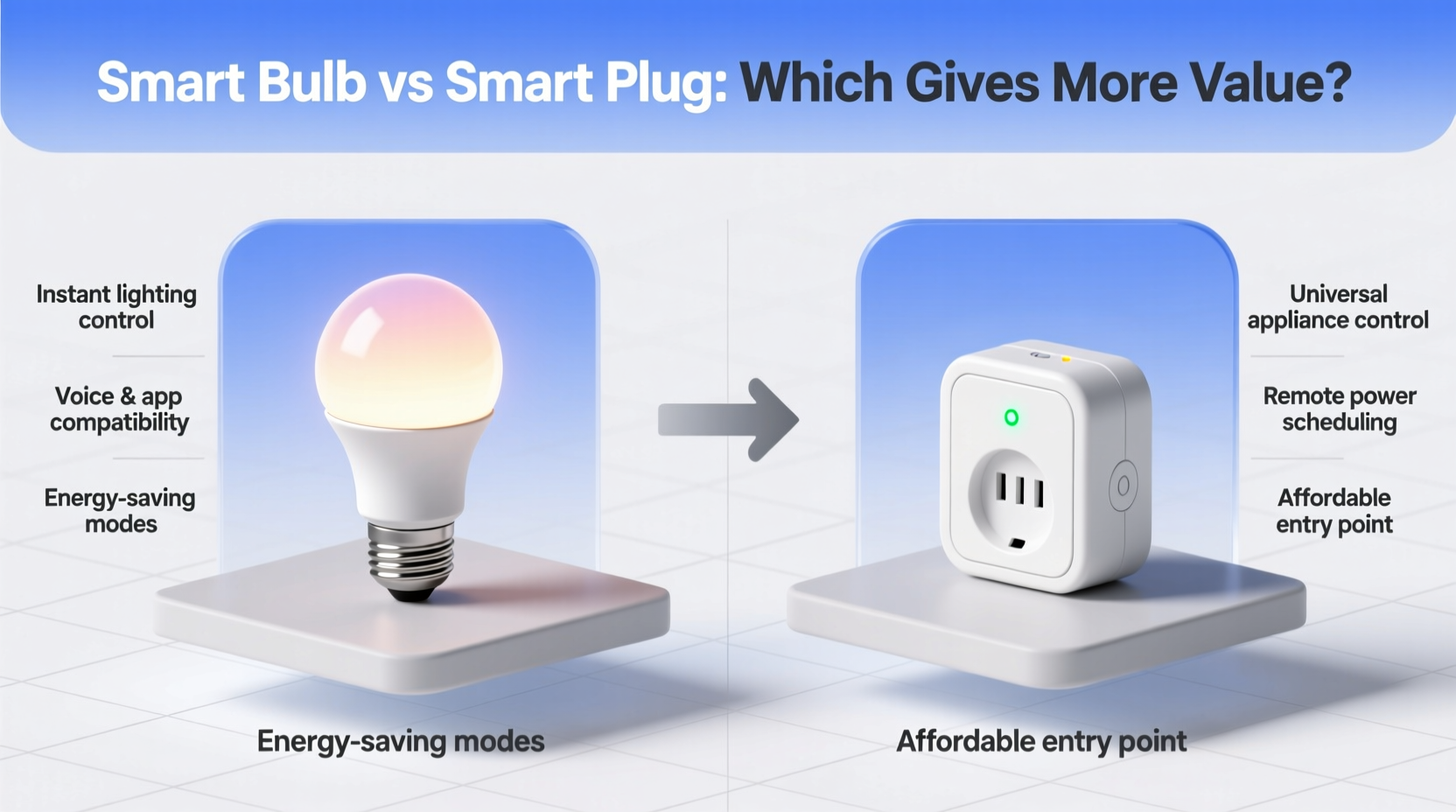
At first glance, smart bulbs and smart plugs may seem interchangeable—they both connect to your Wi-Fi network and can be controlled remotely via smartphone apps or voice assistants like Alexa, Google Assistant, or Siri. However, their functionality diverges significantly based on what they control and how they integrate into your environment.
Smart bulbs replace traditional light bulbs in existing fixtures. Once installed, they allow you to adjust brightness, color temperature, and even change colors (in RGB models), all from your phone or through voice commands. Some models support scheduling, scene creation, and integration with motion sensors or sunrise/sunset triggers.
Smart plugs, on the other hand, act as intermediaries between a standard electrical outlet and any plug-in device—lamps, fans, coffee makers, space heaters, or holiday lights. They enable remote on/off control and often include energy monitoring features. Unlike smart bulbs, they don’t alter the function of the device itself; they simply add remote switching capability.
Cost Comparison and Long-Term Investment
One of the most immediate considerations for beginners is cost. While both types of devices have become more affordable, their price structures differ substantially.
Smart bulbs typically range from $15 to $50 per unit, depending on brand, color capabilities, and brightness. High-end models like Philips Hue or LIFX offer advanced features such as tunable white light and superior color accuracy but come at a premium. Since lighting setups often involve multiple bulbs (e.g., ceiling fixtures, bedside lamps, outdoor lights), the total investment can quickly escalate.
Smart plugs, by contrast, usually cost between $15 and $30 each. Because one plug controls an entire device, you generally need fewer units to achieve meaningful automation. For example, one smart plug can automate a floor lamp, a fan, and a humidifier if they're plugged into a power strip.
“Beginners should focus on high-impact, low-cost entry points. A single smart plug can unlock automation for several devices, whereas smart bulbs require one-to-one replacement.” — David Lin, Home Automation Consultant
| Feature | Smart Bulb | Smart Plug |
|---|---|---|
| Average Price Per Unit | $15–$50 | $15–$30 |
| Installation Effort | Moderate (requires bulb replacement) | Low (plug-and-play) |
| Remote On/Off Control | Yes | Yes |
| Brightness Adjustment | Yes | No* |
| Color Changing | Yes (RGB models) | No |
| Energy Monitoring | Rare | Common |
| Works With Existing Lamps | Limited (depends on socket type) | Yes |
*Note: Smart plugs cannot dim most incandescent or LED lamps unless paired with compatible dimmable switches or smart bulbs.
Flexibility and Use Case Scenarios
The true value of any smart device lies in how well it adapts to daily routines. Let’s examine real-life situations where each option shines.
Smart bulbs excel in environments where ambiance matters. Bedrooms, living rooms, and entertainment areas benefit from customizable lighting scenes—such as warm evening tones or vibrant party colors. Their ability to gradually brighten in the morning mimics sunrise, aiding natural wake-up cycles. Additionally, outdoor smart bulbs can enhance security when programmed to turn on at dusk or during motion detection.
Smart plugs offer broader utility. Consider a bedroom setup: instead of replacing every bedside lamp bulb, a single smart plug can control a lamp, a diffuser, and a speaker dock simultaneously. In the kitchen, a smart plug can power a coffee maker to brew automatically at 7 a.m., creating a seamless morning ritual. During vacations, plugs can cycle lights and radios on and off to simulate occupancy, improving home security without rewiring anything.
Mini Case Study: Sarah’s First Smart Home Upgrade
Sarah, a 32-year-old teacher, wanted to reduce her electricity bill and simplify her routine. She started with two smart bulbs in her living room but soon realized she was still manually turning off her TV, soundbar, and floor lamp every night. After researching alternatives, she switched to a smart plug connected to a power strip. Now, a single “Goodnight” command shuts off all electronics. She estimates saving 15% on standby power monthly and appreciates the reduced clutter of managing only one app instead of multiple bulb settings.
Setup Complexity and Compatibility
For beginners, ease of installation is critical. A frustrating setup can discourage further exploration of smart home tech.
Smart bulbs require physical replacement, which may involve ladders, tight fixtures, or incompatible bases (E12 vs E26). Once installed, they must be paired via Bluetooth or a hub (like Hue Bridge), adding complexity. Some brands require specific hubs for full functionality, increasing both cost and technical overhead.
Smart plugs, however, are nearly universal. Simply plug them into an outlet, connect the device, and follow the app instructions—usually involving Wi-Fi selection and password entry. Most work directly over Wi-Fi without additional hardware, though Zigbee or Z-Wave models exist for advanced users.
Both devices generally support major voice assistants, but compatibility varies. Always check whether your preferred ecosystem (Amazon, Google, Apple HomeKit) supports the model before purchasing.
Step-by-Step Guide: Getting Started with Either Device
- Assess Your Needs: Identify which rooms or appliances you want to automate. Is lighting the priority, or do you want to control appliances?
- Check Your Network: Ensure strong Wi-Fi coverage where the device will be used. Weak signals cause lag or disconnections.
- Purchase Compatible Devices: Choose products certified for your voice assistant (e.g., “Works with Alexa” or “Apple HomeKit Secure Router Compatible”).
- Install and Connect: For bulbs, screw them in and follow pairing steps. For plugs, insert into outlet and use the companion app to complete setup.
- Create Routines: Set up automations like “Turn on lights at sunset” or “Power off coffee maker after 30 minutes.”
- Test and Optimize: Run through scenarios to ensure reliability. Adjust schedules or sensitivity as needed.
Which Offers More Value for Beginners?
The answer depends on your goals. If your primary interest is mood lighting, ambiance, or color effects, smart bulbs provide unique capabilities no plug can replicate. However, for most beginners seeking broad, practical automation with minimal effort and cost, smart plugs deliver superior versatility.
They allow control over a wider range of household items beyond lighting—from holiday decorations to air purifiers—and often include useful features like energy tracking and overload protection. Their plug-and-play nature makes them ideal for renters or those unwilling to modify fixtures.
Moreover, smart plugs future-proof your setup. Even if you later invest in smart bulbs, plugs can still manage non-lighting devices, creating a layered automation system.
Checklist: Choosing the Right Option for You
- ✅ Do you want to change light colors or create lighting scenes? → Smart bulb
- ✅ Are you looking to automate lamps, fans, or small appliances? → Smart plug
- ✅ Is your budget under $50 for initial experimentation? → Smart plug (better ROI)
- ✅ Do you rent and can’t modify light fixtures? → Smart plug
- ✅ Do you already have favorite lamps you’d like to keep? → Smart plug
- ✅ Do you want energy usage data? → Smart plug
- ✅ Are you sensitive to blue light at night? → Smart bulb (with warm dimming)
Frequently Asked Questions
Can I use a smart plug with a lamp that has a smart bulb?
Yes, but it defeats the purpose. Turning off the smart plug cuts power to the bulb, preventing remote activation until the plug is turned back on. It’s best to choose one method of control per fixture.
Do smart bulbs work when the switch is turned off?
No. Most smart bulbs require constant power. If the wall switch is off, the bulb loses connectivity and cannot respond to voice or app commands. To maintain functionality, leave the switch on and control brightness digitally.
Are smart plugs safe for high-wattage appliances?
Only if rated for it. Standard smart plugs handle up to 15A (1800W). Avoid using them with large heaters, refrigerators, or AC units unless explicitly designed for heavy loads. Check manufacturer specifications before connecting.
Final Thoughts: Start Simple, Scale Smart
Home automation doesn’t require expensive gear or complex installations. The goal for beginners should be building confidence through reliable, visible results. While smart bulbs offer aesthetic appeal, smart plugs provide broader functional benefits at a lower entry cost. They empower users to automate everyday devices, reduce energy waste, and experience the convenience of voice and app control without altering their existing setup.
That said, the ideal path may involve both. Begin with a smart plug to gain hands-on experience. Once comfortable, expand into smart lighting where ambiance enhances comfort. Over time, these components form a cohesive, responsive environment tailored to your habits.




 浙公网安备
33010002000092号
浙公网安备
33010002000092号 浙B2-20120091-4
Comments
No comments yet. Why don't you start the discussion?