
Home automation has evolved from a luxury to a mainstream convenience, with lighting often serving as the entry point for most smart homes. Two of the most popular options—smart bulbs and smart switches—offer remote control, scheduling, voice commands, and integration with platforms like Alexa, Google Assistant, and Apple HomeKit. But when it comes to long-term usability, installation complexity, and overall value, which option truly wins?
The choice isn’t just about technology; it’s about lifestyle, room usage, existing infrastructure, and future scalability. While smart bulbs are plug-and-play in theory, they come with hidden limitations. Smart switches offer whole-circuit control but require electrical work. Understanding the trade-offs helps avoid costly mistakes and ensures your automation system works seamlessly for years.
How Smart Bulbs Work: Pros and Limitations
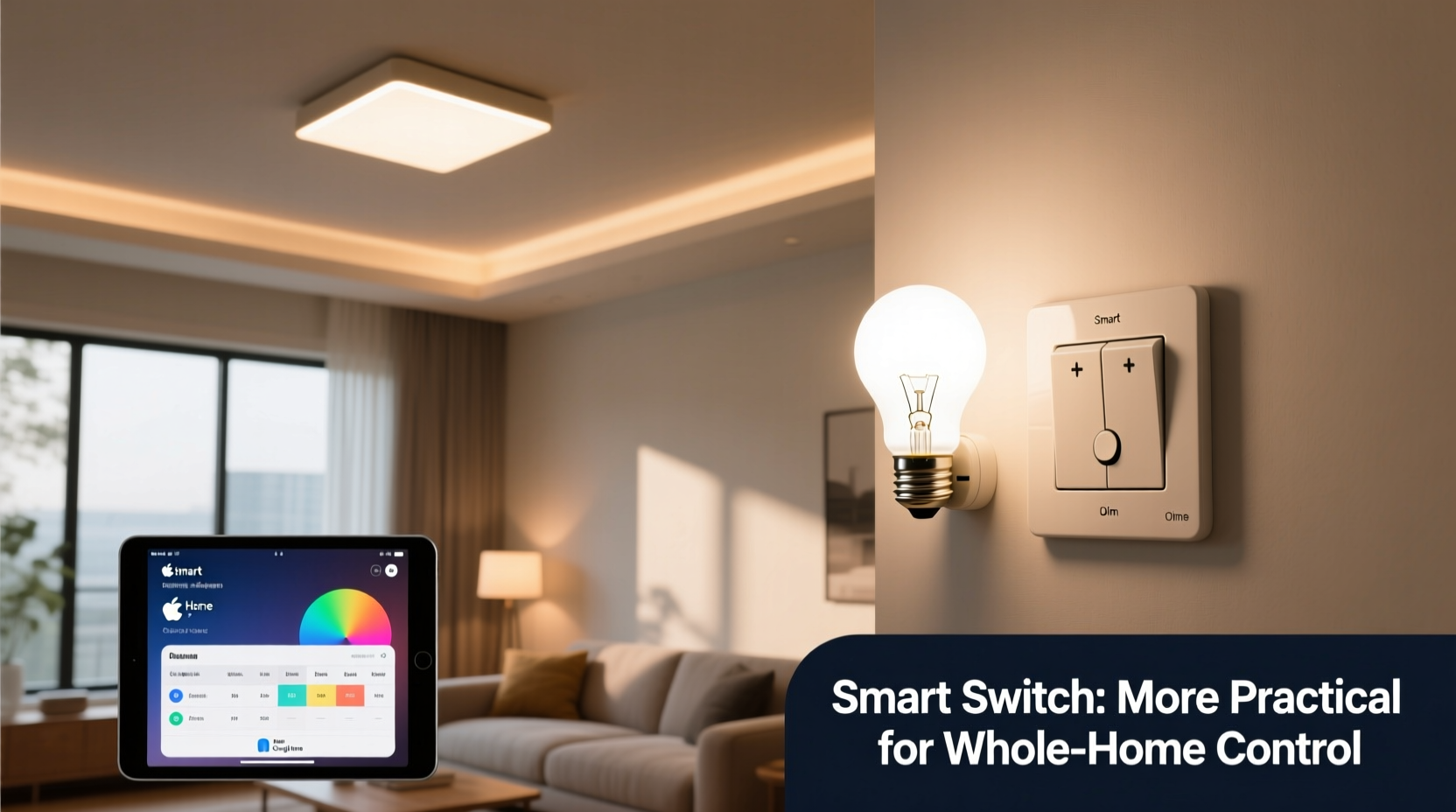
Smart bulbs replace traditional light bulbs with Wi-Fi or Bluetooth-enabled versions that connect to your network. You control them via smartphone apps, voice assistants, or automation routines. Most models support dimming, color temperature adjustment, and even full RGB color changes.
One major advantage of smart bulbs is their ease of installation. No rewiring is needed—just screw them into existing fixtures. This makes them ideal for renters or those hesitant to touch their home’s electrical system. Brands like Philips Hue, LIFX, and TP-Link Kasa dominate the market with strong app ecosystems and broad compatibility.
However, smart bulbs have notable drawbacks. Each bulb must be replaced individually, which becomes expensive when outfitting multiple rooms. A single living room with six recessed lights could require six $20–$50 bulbs, totaling over $300 before taxes. Additionally, if the physical switch controlling the fixture is turned off, the bulb loses power and can no longer receive commands—even if you want it on, it won’t respond until power is restored.
Bulb-based systems also degrade faster due to heat exposure inside enclosed fixtures. Firmware updates can lag across devices, and reliance on individual bulb connectivity increases the chance of one dropping off the network. While convenient, smart bulbs demand ongoing management that scales poorly across large homes.
Smart Switches: Whole-Circuit Control with Permanent Integration
Smart switches replace standard wall switches with intelligent versions that control the flow of electricity to connected lights. Instead of embedding intelligence in each bulb, the switch itself becomes the brain. When you turn the switch on or off—either manually or remotely—it sends power (or cuts it) to every light on that circuit.
This centralized approach reduces device sprawl. One switch can manage multiple lights, ceiling fans, or even outlets. Installation requires basic electrical knowledge and ideally a neutral wire (common in homes built after 1980), though some newer models support “no-neutral” setups using micro-leakage currents.
Because the switch maintains constant power, it stays connected to your network reliably. Even if individual bulbs burn out, replacing them with standard ones doesn’t break automation. You retain scheduling, geofencing, and voice control through the switch’s capabilities. This makes smart switches far more resilient and scalable than bulb-centric systems.
“Switch-level automation provides better reliability and lower lifetime costs. Once installed correctly, it’s essentially invisible and just works.” — David Lin, Smart Home Systems Engineer at NestAware Labs
Another benefit is aesthetics. With smart switches, you can use any type of bulb—including high-efficiency LEDs, halogens, or even vintage-style filaments—without sacrificing functionality. There’s no need to match bulb firmware or worry about compatibility with dimmers.
Comparative Analysis: Key Decision Factors
To determine which solution suits your needs, consider these five critical factors:
| Factor | Smart Bulbs | Smart Switches |
|---|---|---|
| Installation Difficulty | Easy – screw-in replacement | Moderate – requires wiring, possible electrician |
| Upfront Cost per Light Point | High – $20–$60 per bulb | Low to Medium – $30–$70 per switch (covers multiple bulbs) |
| Power Dependency | Fails if wall switch is off | Always powered; unaffected by manual toggle |
| Scalability | Poor – cost and complexity grow with each bulb | Excellent – one switch controls many lights |
| Lifetime Maintenance | Higher – firmware updates, bulb replacements | Lower – minimal interaction once set up |
| Renter-Friendly? | Yes – removable without damage | No – permanent modification required |
The data shows a clear pattern: smart bulbs win on accessibility, while smart switches win on efficiency, durability, and total cost of ownership. For homeowners planning long-term automation, switches are typically the superior investment.
Real-World Example: The Johnson Family's Living Room Upgrade
The Johnsons wanted to automate their open-concept living area, which includes eight recessed ceiling lights, two floor lamps, and a pendant above the dining table. Initially, they opted for smart bulbs, spending nearly $400 on eight Hue White and Color Ambiance bulbs and two standalone smart plugs for the floor lamps.
Within weeks, issues arose. The dining pendant flickered during firmware updates. One recessed light stopped responding because the attic-mounted fixture overheated the bulb. When guests used the wall switch to turn off the overheads, the entire circuit lost power—rendering the bulbs unreachable until someone flipped the switch back on.
After consulting a smart home installer, they replaced the main ceiling circuit’s switch with a Lutron Caséta smart dimmer. They swapped the Hue bulbs for standard LED equivalents, saving energy and eliminating update hassles. Now, the same lighting scenes run reliably through voice commands and automations, with manual toggles still functional. Total rework cost: $65 for the switch and labor. Long-term savings exceeded $300.
Their experience reflects a common journey: starting with bulbs for simplicity, then upgrading to switches for stability and control.
When to Choose Smart Bulbs
Despite their limitations, smart bulbs excel in specific scenarios:
- Renters or temporary dwellers who cannot modify wiring.
- Accent lighting, such as under-cabinet strips or decorative lamps where individual control matters.
- Color-changing needs in entertainment spaces like bedrooms or media rooms.
- Testing automation before committing to whole-home upgrades.
If you only want to automate a single lamp or create mood lighting in a guest room, smart bulbs remain the most practical entry point. Just ensure the controlling wall switch remains permanently on.
When to Invest in Smart Switches
Smart switches make sense when:
- You own your home and plan to stay long-term.
- You’re automating multi-light fixtures (e.g., kitchens, hallways, bathrooms).
- You value consistent performance over flashy features.
- You already have neutral wires in your switch boxes (check with a multimeter or electrician).
- You want seamless integration with home security or occupancy sensors.
Top-tier models like the Lutron Caséta, Leviton Decora Smart, and TP-Link Kasa Smart Wi-Fi Wall Dimmer offer robust reliability, local control (no cloud dependency), and smooth dimming curves. Some even support “smart toggle” behavior—tap once for on/off, hold for dimming, double-tap for presets—mimicking advanced lighting panels at a fraction of the cost.
Actionable Checklist: Choosing Your Setup
- ✅ Determine if you're a renter or homeowner.
- ✅ Count how many lights are on each circuit.
- ✅ Check if your switch boxes have neutral wires (required for most smart switches).
- ✅ Decide whether color tuning is essential or just nice-to-have.
- ✅ Calculate total cost: bulbs x quantity vs. switch + installation.
- ✅ Test voice assistant compatibility with your preferred ecosystem.
- ✅ Plan for fallback: will lights work manually if Wi-Fi fails?
Frequently Asked Questions
Can I use smart bulbs with a smart switch?
Technically yes, but it’s redundant and risky. If the smart switch cuts power, the bulbs lose connectivity. It’s better to use one or the other. If you choose both, configure the switch to stay on and use it only for emergency cutoffs.
Do smart switches work during internet outages?
Most do. Unlike cloud-dependent bulbs, quality smart switches like Lutron and Hubitat models operate locally. You can still use physical toggles, and automations run on-device. Cloud-based switches (e.g., some Kasa models) may lose remote access but retain local control.
Are smart switches safe to install myself?
If you’re comfortable turning off the breaker and connecting wires by color (black to black, white to white, ground to ground), many DIY-friendly models exist. However, if you’re unsure, hire a licensed electrician. Safety outweighs cost savings.
Final Recommendation: Build Smart, Not Hard
The question isn’t whether smart bulbs or smart switches are “better” in absolute terms—it’s which aligns with your living situation, budget, and automation goals. For renters, students, or those testing the waters, smart bulbs provide immediate gratification with zero commitment. But for anyone serious about building a reliable, scalable smart home, smart switches deliver superior performance, lower long-term costs, and fewer points of failure.
Consider a hybrid approach: use smart switches for primary lighting circuits (living rooms, kitchens, hallways) and reserve smart bulbs for decorative or portable fixtures where individual addressability adds value. This balances control, flexibility, and economy.
“The best smart home fades into the background. It doesn’t ask for attention—it just works.” — Maya Tran, UX Designer at SmartDwell Innovations
Take Action Today
Start by auditing one room. Map your lights, test your switches, and calculate the true cost of each option. Try a single smart bulb in a low-risk lamp. Then install a smart switch in a frequently used overhead fixture. Compare reliability, ease of use, and daily satisfaction. Let real experience—not marketing—guide your next move.




 浙公网安备
33010002000092号
浙公网安备
33010002000092号 浙B2-20120091-4
Comments
No comments yet. Why don't you start the discussion?