
For decades, holiday lighting followed a simple ritual: untangle, plug in, hope for the best. A single flicker meant checking every bulb; a burnt-out section often meant replacing the entire string. Today, that ritual is being rewritten—not just with brighter LEDs, but with embedded intelligence. Smart Christmas lights promise synchronized animations, voice-controlled ambiance, and app-driven scheduling. Yet many homeowners pause before upgrading: Is the convenience worth the price? Does “smart” actually deepen the emotional resonance of the season—or merely add complexity? This isn’t about gadgetry for its own sake. It’s about whether technology can meaningfully support, rather than overshadow, the warmth, tradition, and shared joy that define holiday lighting.
What Makes Lights “Smart”—And What It Actually Means for Your Display
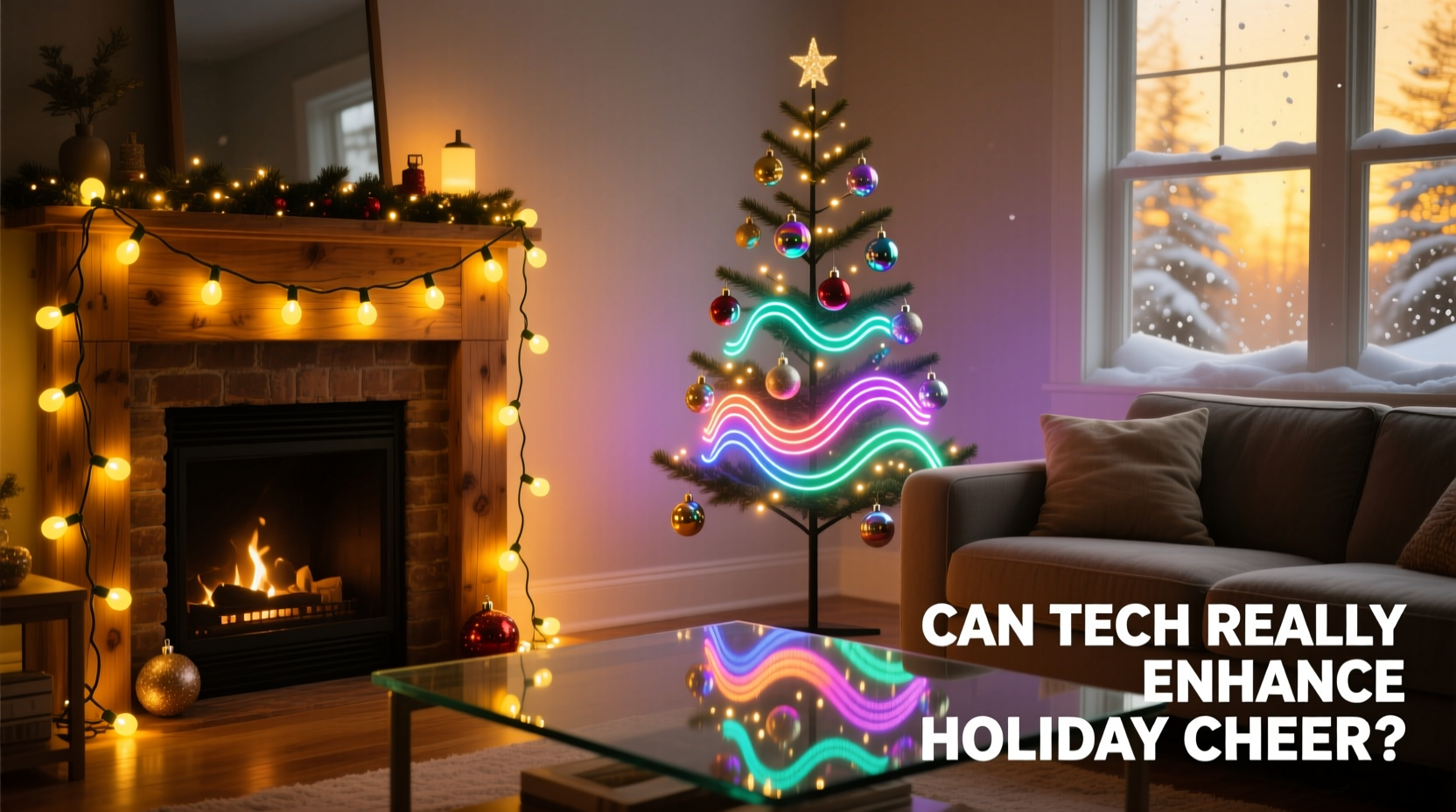
“Smart” in this context refers to lights that connect to a local network (Wi-Fi or Bluetooth) and integrate with a companion app or voice assistant ecosystem. Unlike basic incandescent or even non-smart LED strings—where functionality stops at on/off or simple blink modes—smart lights embed microcontrollers, wireless radios, and individually addressable LEDs (often WS2812B or similar chips). Each bulb can be controlled independently, enabling precise color shifts, dynamic patterns, and pixel-level animation.
Crucially, smart doesn’t mean universally compatible. Interoperability varies widely: some brands work exclusively within their own app; others support Matter or Thread protocols for broader smart home integration. Most require a hub (like Philips Hue Bridge) or rely on direct Wi-Fi connectivity—both introducing potential points of failure during peak usage periods. And while many assume “smart = more energy-efficient,” the reality is nuanced: a 50-bulb smart string may draw 6–8 watts when idle in standby mode, whereas a comparable non-smart LED string draws zero when off. That difference becomes meaningful across dozens of strings left powered year after year.
The Real-World Trade-Offs: Cost, Control, and Complexity
Price remains the most immediate differentiator. A 100-light basic LED string retails for $8–$15. A comparable smart string starts at $35 and climbs to $80+ for premium weatherproof models with built-in music sync. That’s not just a markup—it reflects added hardware (microcontrollers, antennas, power regulation), firmware development, cloud infrastructure, and ongoing security updates.
But cost extends beyond upfront dollars. Consider labor and longevity:
- Installation time: Basic lights require minimal setup—plug and drape. Smart lights demand configuration: downloading apps, naming devices, assigning zones, calibrating brightness, and troubleshooting connection drops.
- Maintenance overhead: Firmware updates may reset custom scenes. App redesigns sometimes deprecate older hardware. A 2023 study by the Consumer Technology Association found that 22% of smart light owners abandoned at least one string within two seasons due to inconsistent app performance or discontinued support.
- Lifespan variance: While both types use LED diodes rated for 25,000–50,000 hours, smart lights face additional stressors: thermal load from onboard electronics, voltage fluctuations during wireless transmission, and exposure to moisture through sealed-but-not-hermetic housings. In humid coastal regions, early capacitor failure in smart controllers is documented at nearly three times the rate of basic string transformers.
Yet control is where smart lights deliver undeniable value—not as novelties, but as tools for intentionality. With basic lights, “setting the mood” means choosing between steady white, warm white, or multicolor blink. With smart lights, you choose *when* the reds deepen at dusk, *how* the blues pulse softly during quiet family evenings, and *whether* the front porch glows warmly for guests arriving after dark—without ever touching a switch.
A Side-by-Side Comparison: Features That Matter in Practice
| Feature | Basic LED String Lights | Smart Christmas Lights |
|---|---|---|
| Initial Cost (per 100 bulbs) | $8–$15 | $35–$85+ |
| Power Consumption (active) | 4–6 watts | 6–12 watts (plus 0.5–2W standby) |
| Control Options | Manual switch or basic timer | App, voice (Alexa/Google/HomeKit), automation (sunrise/sunset triggers), music sync |
| Customization | Fixed color or pre-set blink pattern | Individual bulb color, speed, direction, effects (fire, rain, comet, gradient), scene libraries |
| Outdoor Durability | IP44 standard (splash resistant); common failure point is connector seals | IP65+ standard (jet water resistant); controller housing integrity is critical |
| Troubleshooting | Visual inspection, bulb tester, replace fuse or entire string | App diagnostics, firmware rollback, network channel adjustment, hub reboot |
Mini Case Study: The Miller Family’s Two-Season Experiment
The Millers live in Portland, Oregon—a city known for damp Novembers and frequent power fluctuations. In 2022, they installed 12 basic LED strings across their roofline, eaves, and tree. Setup took 90 minutes. They used a mechanical timer set to 4:30 p.m. to 11 p.m. daily. One string failed mid-season when rain seeped into a cracked connector; they replaced it with an identical model the next day.
In 2023, they upgraded to a 15-string smart system with music sync and geofencing. Setup consumed 7 hours over three evenings: configuring the hub, naming each zone (“Front Porch,” “Maple Tree Crown,” “Garage Eaves”), adjusting brightness per location, and building a “Winter Solstice” scene with slow amber-to-crimson transitions. On December 14, their Wi-Fi dropped during a storm. All lights went dark—not because of power loss, but because the hub lost cloud authentication. They restored function by resetting the hub and re-pairing devices, but not before receiving three concerned texts from neighbors.
Yet on Christmas Eve, something shifted. As carolers approached, the lights automatically brightened along the walkway. When the family gathered for cocoa, the living room window lights dimmed to a soft gold. And when their teenage daughter played piano, the tree lights pulsed gently in time with the melody—something no timer or manual switch could replicate. “It wasn’t about flash,” says Sarah Miller. “It was about the lights *responding*—like they were part of the moment, not just decoration.”
Expert Insight: Beyond Gimmicks, Toward Intentional Design
“Technology enhances holiday cheer only when it recedes into the background—when the focus stays on people, not pixels. Smart lights succeed not because they’re programmable, but because they let families reclaim time and attention. Automating the ‘when’ and ‘how bright’ means more presence during cookie decorating, fewer trips outside in the cold to adjust timers, and space to simply enjoy the glow.” — Dr. Lena Torres, Human-Computer Interaction Researcher, MIT Media Lab
Dr. Torres’ observation cuts to the core: the highest-value feature of smart lights isn’t rainbow explosions—it’s reliability layered with simplicity. The most praised systems today prioritize offline functionality (scenes stored locally on-device), intuitive drag-and-drop editors instead of coding interfaces, and physical fallback switches. These design choices acknowledge that holiday lighting serves emotional needs first—comfort, nostalgia, welcome—not technical benchmarks.
Your Practical Implementation Checklist
Before investing in smart lights, run through this actionable checklist:
- Evaluate your network infrastructure: Test Wi-Fi strength at each planned light location using a free app like WiFi Analyzer. If signal is weak (< -70 dBm), install a mesh node or consider Bluetooth-only options for smaller displays.
- Start small and modular: Begin with one smart string on your front door or mantle—not your entire roofline. Master scheduling and scene creation before scaling.
- Verify weatherproofing certifications: Look for IP65 (water jet resistant) or IP67 (immersion resistant) ratings—not just “outdoor use” marketing language.
- Check long-term support policy: Visit the manufacturer’s website and search for “end-of-life notice” or “firmware update history.” Brands that publish multi-year support roadmaps (e.g., Nanoleaf, Lifx) are lower-risk than those with no public documentation.
- Calculate true ROI: Estimate annual electricity cost: (watts ÷ 1000) × hours used × days × local kWh rate. For example: 10 strings × 8W × 7 hrs × 30 days × $0.14/kWh = ~$23.52/year. Compare against the $50+ premium per string.
FAQ: Addressing Common Concerns Head-On
Do smart lights increase cybersecurity risk?
Minimal—if configured correctly. Avoid default passwords, disable remote access unless needed, and segment smart lights onto a guest network separate from computers and phones. Most reputable brands now encrypt device-to-app traffic and auto-update firmware. The greater risk lies in neglecting updates altogether: a 2023 report by the IoT Security Foundation found that 68% of compromised holiday devices resulted from outdated firmware, not inherent vulnerabilities.
Can I mix smart and basic lights on the same circuit?
Yes—electrically, they’re compatible. But avoid plugging smart lights into the same outlet timer used for basic strings, as the timer’s power cycling will disrupt smart functionality. Use dedicated outlets or smart plugs *only* for basic strings, while smart lights remain on constant power with software-based scheduling.
Are smart lights harder to store and reuse?
Marginally. Their controllers and connectors are bulkier, requiring more careful coiling. However, most modern smart strings use tangle-resistant flat cables and include labeled storage bags. The bigger challenge is firmware fragmentation: a string updated in 2023 may not be recognized by the 2025 version of its app. Always archive firmware files and note model numbers before seasonal storage.
Conclusion: Tech as a Quiet Enabler, Not the Centerpiece
Smart Christmas lights don’t inherently generate cheer. Cheer arises from shared moments—the child’s gasp at the first twinkle, the neighbor’s wave as they pass under illuminated arches, the quiet pride in a tradition sustained across generations. Technology enhances that experience only when it operates invisibly: when lights brighten as footsteps approach, fade as bedtime nears, or shift hue to match the warmth of candlelight inside—not to dazzle, but to harmonize. Basic lights excel in simplicity, resilience, and immediacy. Smart lights shine brightest when they serve human rhythms, not technical specs. The most joyful displays aren’t the most complex—they’re the ones that feel alive, intentional, and effortlessly *there*.
If you’ve upgraded to smart lights, reflect on what changed beyond the spectacle. Did you spend less time adjusting timers and more time stringing popcorn? Did the ability to dim remotely extend evening conversations on the porch? Did syncing to a favorite carol deepen the emotional weight of a family tradition? Those subtle shifts—time reclaimed, attention refocused, moments amplified—are where technology truly earns its place in the season. Start small. Prioritize reliability over features. Let the lights support the joy—not compete with it.




 浙公网安备
33010002000092号
浙公网安备
33010002000092号 浙B2-20120091-4
Comments
No comments yet. Why don't you start the discussion?