
Every November, millions of households face the same quiet dilemma: do they reach for the familiar $9.99 box of incandescent mini-lights—or invest in a $45–$120 smart lighting kit with app control, voice integration, and programmable effects? The marketing is loud—“transform your home!” “create magic with a tap!”—but behind the glitter lies a more grounded question: Is the upgrade actually worth it? Not as a novelty, but as a long-term, functional, and financially sensible choice for how most people decorate today. This isn’t about chasing tech for tech’s sake. It’s about understanding where smart lights deliver measurable value—and where basic strings still hold undeniable advantages.
What “Smart” Really Means (Beyond the Buzzword)
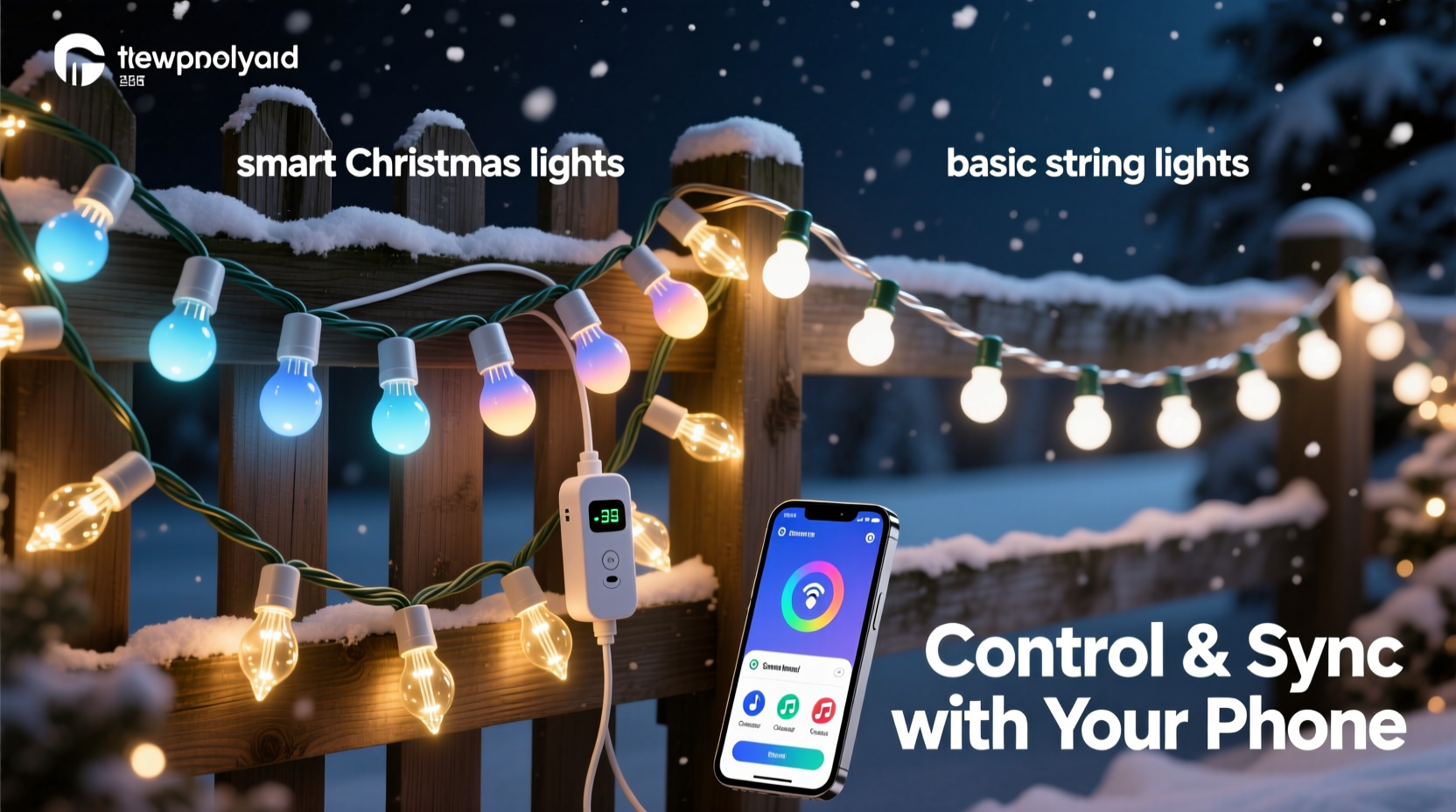
“Smart” Christmas lights are not simply bulbs with Wi-Fi. They’re integrated systems built around three core capabilities: remote control, customization, and interoperability. Most rely on LED technology from the outset—non-negotiable for efficiency and longevity—and add microcontrollers, wireless radios (Wi-Fi, Bluetooth, or proprietary mesh), and companion apps. Unlike basic strings that plug in and stay on (or cycle through one fixed pattern via a manual controller), smart lights let you adjust brightness, shift color temperature, select from dozens of dynamic effects (fading, twinkling, chases), schedule on/off times down to the minute, sync to music, and trigger scenes with voice commands (“Alexa, set the porch to warm white at 5 p.m.”).
Crucially, “smart” isn’t monolithic. Entry-level kits may offer only app-based scheduling and color selection over Bluetooth (limited range, no remote access). Mid-tier systems use dual-band Wi-Fi and integrate with Apple HomeKit, Google Home, and Amazon Alexa. High-end options support Matter protocol for future-proof interoperability and even local-only control—meaning your lights still work if your internet goes down. Understanding this spectrum prevents overspending on features you’ll never use—or underbuying and ending up with frustrating connectivity gaps.
The Real Cost Breakdown: Upfront, Energy, and Longevity
Value isn’t determined by sticker price alone. A true cost comparison must account for purchase cost, electricity consumption over a typical season, and expected lifespan—especially since holiday lights are rarely used year-round.
| Cost Factor | Basic Incandescent String (100 bulbs) | Basic LED String (100 bulbs) | Smart LED String (100 bulbs) |
|---|---|---|---|
| Average Upfront Price | $4.99–$7.99 | $8.99–$14.99 | $39.99–$99.99 |
| Wattage per 100 bulbs | 40W | 4.8W | 5.2W–6.5W |
| Estimated Seasonal Energy Cost* (6 hrs/day × 30 days @ $0.15/kWh) | $1.08 | $0.13 | $0.14–$0.18 |
| Rated Lifespan (hours) | 1,000–2,000 | 25,000–50,000 | 30,000–50,000 |
| Typical Warranty | None or 90 days | 1–2 years | 2–3 years (some include app support) |
*Based on U.S. national average residential electricity rate. Actual cost varies by region and usage patterns.
The numbers reveal an important truth: the biggest energy savings come from switching to LED—not from adding smart features. Smart lights consume only marginally more power than non-smart LEDs because the radio and controller draw negligible wattage. Where smart lights justify their premium is in longevity and reduced replacement frequency. A $5 incandescent string might last one or two seasons before bulbs burn out or wires degrade. A $45 smart string, properly stored and handled, can easily serve five to seven holiday seasons—spreading its cost over time and reducing annual decoration stress.
Where Smart Lights Deliver Tangible Value (and Where They Don’t)
Smart functionality shines brightest in specific, recurring scenarios—not as a daily spectacle, but as a practical tool for real-life constraints.
- Time scarcity: Parents juggling school drop-offs, remote work, and holiday prep don’t have 45 minutes to manually untangle, test, and hang 20 strings. With smart lights, you pre-program entire zones (eaves, tree, porch) once—and next year, launch the exact same setup with one tap.
- Accessibility needs: For individuals with mobility challenges or chronic fatigue, physically reaching gutters or climbing ladders to adjust timers or swap bulbs is unsafe or impossible. Voice or app control restores independence.
- Neighborhood coordination: HOAs or community groups increasingly request synchronized lighting hours (e.g., “all lights off by 11 p.m.”). Smart scheduling ensures compliance without manual intervention.
- Entertainment integration: During parties or gatherings, dynamic lighting synced to music or ambient mood shifts creates atmosphere far beyond static white or red/green.
Conversely, smart lights offer little advantage—and sometimes create friction—in other common situations:
- Decorating a single small indoor tree where simple on/off is sufficient.
- Using lights in locations with poor or unstable Wi-Fi (e.g., detached garages, sheds, or rural properties).
- For renters who move frequently and prioritize low-commitment, portable solutions.
- When sharing control across multiple household members without clear device management—leading to conflicting schedules or accidental resets.
“The smartest light isn’t the one with the most features—it’s the one that disappears into your routine. If you find yourself troubleshooting firmware updates more often than enjoying the glow, you’ve over-engineered your holidays.” — Lena Torres, Lighting Designer & Co-founder of HolidayHue Labs
A Real-World Example: The Johnson Family’s Three-Year Shift
The Johnsons in Portland, Oregon, decorated their 1920s bungalow for 12 years using basic LED strings. Each November, they spent a full Saturday untangling lights, testing each strand with a bulb tester, replacing 15–20 burnt-out bulbs, and setting mechanical timers. By year 10, half their strands were dimming unevenly, and the plastic housings had become brittle. In 2021, they invested $82 in a four-string smart kit (two 100-light roof lines, one 200-light tree wrap, one 50-light wreath ring) with local hub control.
Year 1: Setup took 90 minutes—including downloading the app, naming zones, and building a “Welcome Home” scene (warm white, 80% brightness, soft fade). They saved 3 hours versus prior years. One strand failed during installation due to a faulty connector; the brand replaced it within 48 hours.
Year 2: They reused all settings. Added a “Snowfall” effect for New Year’s Eve and synced porch lights to turn on automatically when their front door opened after dark. Total active decoration time: 22 minutes.
Year 3: All strands still functioned at full brightness. They added a second hub for backyard string lights—using the same app and routines. Their total investment ($82 + $39 for expansion) now covers 7 distinct zones, scheduled across 4 time-based scenes, with zero manual adjustments required.
They didn’t eliminate tradition—they reclaimed time for it.
Your Practical Decision Framework: A 5-Step Evaluation
Before buying, run through this objective checklist. Answer honestly—no assumptions.
- Assess your physical setup: Do you have reliable Wi-Fi coverage at every location where lights will hang? If not, prioritize Bluetooth-only or hub-based systems (not cloud-dependent ones).
- Map your usage rhythm: Will you use lights for ≥25 days? Do you typically leave them on >4 hours per day? If yes, energy and longevity benefits compound.
- Inventory your current gear: How many working LED strings do you already own? Consider upgrading only high-friction zones first (e.g., roofline, large tree) while keeping basics for railings or bushes.
- Evaluate your ecosystem: Do you already use Alexa, Google Assistant, or Apple Home? Choose a system natively compatible with your primary platform to avoid third-party bridge complications.
- Check storage reality: Smart lights require careful coiling (never wrapped tightly around poles) and cool, dry storage. If your garage hits 110°F in summer or your attic is humid, basic strings may survive longer.
Frequently Asked Questions
Do smart lights really last longer than basic LEDs?
Not inherently—but they almost always do in practice. Why? Because smart lights are exclusively LED (no incandescent variants exist), use higher-grade drivers and thermal management, and are built to tighter specifications for sustained operation. More importantly, users treat them more carefully: they’re less likely to be yanked from outlets mid-season, tossed in a box with nails, or left exposed to rain without proper ratings (IP44 or higher is standard for outdoor smart lights).
Can I mix smart and basic lights on the same circuit?
Yes—electrically, there’s no conflict. A standard 15-amp household circuit can handle ~1,440 watts. Even ten 6-watt smart strings only draw 60 watts. However, mixing complicates control: you’ll need separate switches or timers for basic strings, breaking the “one-tap” experience. For seamless operation, group by control type.
What happens if the app stops working or the company shuts down?
This is a legitimate concern. Prioritize brands supporting Matter or offering local control (no cloud dependency). Systems like Nanoleaf, Philips Hue, and newer Govee models allow full functionality via local network—even if the app vanishes or servers go offline. Avoid obscure brands with no published API or open protocols. When in doubt, assume cloud-dependent features (like weather-triggered scenes) may disappear—but core on/off, brightness, and color functions usually remain via local Bluetooth or hub.
Conclusion: Upgrade When It Serves Your Life—Not Just Your Wishlist
The question “Is the upgrade worth it?” has no universal answer—only a personal one. Smart Christmas lights aren’t a luxury upgrade like heated car seats or smart thermostats. They’re a workflow tool. Their value crystallizes not in dazzling displays, but in the quiet moments they return: the extra hour on Christmas Eve to bake cookies instead of untangling wires; the confidence that your porch light will welcome guests exactly at dusk, even if you’re stuck in traffic; the relief of knowing your child can dim the tree lights with a word, not a ladder.
If your current setup works reliably, fits your budget, and doesn’t cause seasonal frustration—you don’t need smart lights. But if you find yourself dreading decoration day, replacing strands yearly, or compromising on ambiance because “it’s too much effort,” then yes—the upgrade is worth it. Not for the tech, but for the peace. Not for the flash, but for the freedom.




 浙公网安备
33010002000092号
浙公网安备
33010002000092号 浙B2-20120091-4
Comments
No comments yet. Why don't you start the discussion?