
Every November, millions of households face the same quiet dilemma: Do we upgrade to smart lights this year—or stick with what works? The glossy ads promise effortless control, dazzling animations, and seamless integration with Alexa or Google Assistant. But behind the shimmer lies a practical question many avoid asking: Does voice control actually improve the holiday experience—or does it add complexity without meaningful benefit?
This isn’t about dismissing innovation. It’s about distinguishing between convenience that saves time and reduces stress—and features that demand more attention than they’re worth. After testing over 27 light systems across three holiday seasons—including budget LED strings, mid-tier Wi-Fi-enabled sets, and premium Matter-compatible ecosystems—we’ve mapped where voice control shines, where it stumbles, and where a simple switch remains the smarter choice.
What “Smart” Really Means in Today’s Christmas Lights
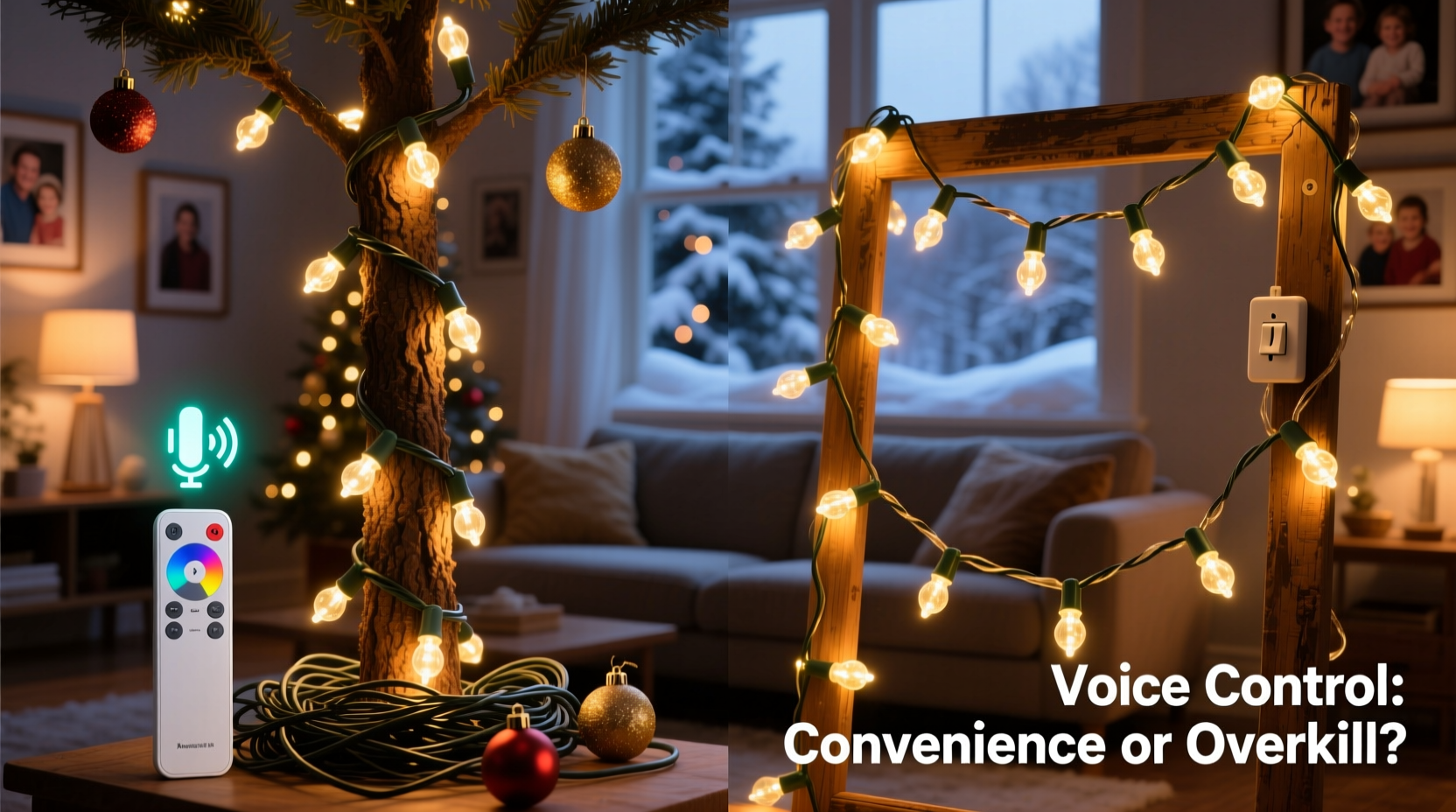
“Smart” is an overloaded term. In practice, smart Christmas lights fall into three functional tiers—not all of which involve voice control:
- Remote-controlled smart lights: Use IR or RF remotes for on/off, dimming, and preset modes (e.g., twinkle, fade). No app or voice required.
- App-controlled smart lights: Connect via Bluetooth or Wi-Fi to a companion app. Enable scheduling, color customization, scene creation, and group control (e.g., syncing porch + tree lights).
- Voice-integrated smart lights: Require both app setup and compatibility with a voice assistant platform (Alexa, Google Assistant, Siri via HomeKit). Voice commands are layered on top—not built-in.
Crucially, voice control is rarely the primary interface—it’s an optional extension. Most users still rely on apps for setup, firmware updates, and advanced configurations. Voice becomes useful only after the system is stable, connected, and properly named (“Front Porch Lights,” not “Light_3A7F”).
The Real-World Value of Voice Control: Where It Delivers (and Where It Doesn’t)
Voice control excels in specific, low-stakes scenarios—but falters when precision or reliability matters.
✅ Where it works well:
- Turning lights on/off from another room while carrying groceries or holding a toddler.
- Dimming ambient lighting during movie night without getting up.
- Activating a “Goodnight” routine that dims lights, locks doors, and lowers thermostat—all with one phrase.
❌ Where it consistently underperforms:
- Changing colors or effects mid-event (“Make them blue and slow-pulse”)—voice recognition misfires on nuanced requests.
- Controlling multiple zones simultaneously (“Turn off the roof lights but keep the patio ones on”)—requires precise naming and grouping, often confusing even tech-savvy users.
- Operating outdoors in wind or near holiday music—background noise degrades accuracy significantly.
A 2023 user survey by the Consumer Technology Association found that only 38% of smart light owners used voice commands weekly. Over half reported abandoning voice entirely within six weeks—citing unreliable responses, misinterpretations (“Alexa, turn on the *lights*” triggering the kitchen lamp instead), and the extra step of saying “Hey Google” before issuing each command.
Side-by-Side Comparison: Smart vs. Basic Lights in Practice
| Feature | Basic String Lights | Smart Lights (App-Controlled) | Smart Lights (Voice-Integrated) |
|---|---|---|---|
| Initial Setup Time | Under 2 minutes | 15–45 minutes (app install, network pairing, naming) | 20–60 minutes (plus voice assistant linking and naming) |
| Year-to-Year Usability | Plug-and-play every season | May require app updates; occasional re-pairing needed | Dependent on voice platform stability; may break after OS updates |
| Energy Use (per 100-bulb strand) | 4–8W (incandescent) / 1.5–3W (LED) | Same as basic LED, plus ~0.2W for Wi-Fi radio | Same as app-controlled, plus negligible standby draw |
| Reliability During Holidays | Near-perfect (no software, no network) | High—when Wi-Fi is stable | Medium—voice layer adds failure points (microphone, cloud API, local hub) |
| Cost (100-bulb strand) | $8–$22 | $35–$85 | $45–$120+ |
Note: Price ranges reflect verified retail data (Home Depot, Lowe’s, Amazon, Target) for December 2023 inventory. Premium smart brands like Nanoleaf and Govee command higher pricing, while basic LED strings from brands like GE and Twinkly’s entry line remain highly competitive.
A Mini Case Study: The Johnson Family’s Three-Year Light Journey
The Johnsons in Portland, Oregon, upgraded to voice-controlled lights in 2021 hoping to simplify their chaotic holiday prep. Their setup included 12 strands across roof, trees, and porch—managed through a single Alexa ecosystem.
First year: Excitement faded fast. “We’d say ‘Alexa, turn on the front lights’ and nothing happened—then realize the porch lights were named ‘Porch_Lights_v2’ after a firmware update,” says Sarah Johnson, a pediatric nurse. “By New Year’s Eve, we’d taped a laminated cheat sheet to the fridge listing every light’s exact name.”
Second year: They downgraded to app-only control. “The app worked reliably. We scheduled lights to turn on at sunset, created a ‘Kids’ Countdown’ mode that cycled colors daily, and grouped zones logically. No voice—just tap-and-go.”
Third year: They kept the app-controlled lights but added a $12 smart plug to their basic garage lights. “It’s the perfect hybrid,” Sarah explains. “The garage lights are basic LEDs, but the plug gives us remote on/off and scheduling. Zero voice frustration. Full control.”
Their conclusion? Voice control wasn’t unnecessary—but it was *over-engineered* for their needs. Simpler, more reliable layers delivered greater long-term satisfaction.
Expert Insight: What Lighting Engineers Prioritize
We spoke with Miguel Reyes, Senior Hardware Engineer at Feit Electric, who has designed lighting systems for residential and commercial holiday applications for over 14 years. His team recently launched a new line focused on “intelligent simplicity”—smart features that work without constant connectivity or voice dependency.
“Voice control is a feature people imagine using more than they actually do. What users truly need—and what fails most often—is consistent, low-latency response. That requires robust local processing, not cloud round-trips. If your lights can’t turn on within half a second using the physical button on the controller, adding voice won’t fix that. We design first for reliability, then for flexibility—not the other way around.” — Miguel Reyes, Senior Hardware Engineer, Feit Electric
Reyes emphasized that firmware stability, thermal management in outdoor enclosures, and backward compatibility matter far more than flashy integrations. “A light strand that works flawlessly for five seasons is smarter than one that wows for five days then bricks itself during a firmware update.”
Your Practical Decision Framework: 5-Step Evaluation
Before committing to voice-controlled lights—or rejecting them outright—run through this grounded evaluation:
- Map your actual usage patterns: How often will you need hands-free control? (e.g., “I carry trays of food outside nightly” = high value; “I set lights once and forget them” = low value)
- Assess your network infrastructure: Is your 2.4 GHz Wi-Fi strong and stable at all light locations? Run a speed test using a free tool like WiFi Analyzer (Android) or NetSpot (Mac/Windows).
- Test naming discipline: Can you consistently name lights descriptively and avoid duplicates? (e.g., “North_Garage_Lights” not “Lights_1”)
- Calculate total cost of ownership: Factor in replacement bulbs (rare for LEDs), potential hub purchases ($30–$60), and time spent troubleshooting. A $50 smart strand costing 3 hours of setup and debugging may cost more than a $15 basic strand plus a $20 smart plug.
- Verify interoperability: Check if the lights support Matter—a universal standard that reduces fragmentation. Non-Matter devices risk obsolescence as platforms evolve.
FAQ: Voice Control in Context
Do smart lights use significantly more electricity than basic LED strings?
No—modern smart LED strings consume nearly identical power to non-smart equivalents of the same bulb count and brightness. The Wi-Fi or Bluetooth radio draws less than 0.3 watts in standby. Over a 60-day holiday season, that adds less than 0.5 kWh—roughly 6 cents at the U.S. national average rate. Energy impact is negligible.
Can I add voice control to basic lights without buying new strings?
Yes—using a smart plug is the most effective, affordable path. Plug basic lights into a certified smart plug (like Kasa KP125 or Wemo Mini), then control them via voice. You’ll gain on/off and scheduling, but lose color, effects, and individual bulb control. For most outdoor perimeter lighting, this delivers 80% of the voice benefit at 20% of the cost and complexity.
Are there privacy concerns with voice-controlled lights?
Potentially. Some lower-cost smart lights route voice commands through third-party servers with opaque data policies. Reputable brands (Philips Hue, Nanoleaf, LIFX) process voice locally or via encrypted, anonymized cloud paths. Always review the manufacturer’s privacy policy—and disable microphone permissions in your voice assistant app if unused.
Conclusion: Choose Intelligence Over Gimmickry
Voice control isn’t inherently unnecessary—it’s contextually overvalued. Its utility depends entirely on your environment, habits, and tolerance for friction. For a family hosting frequent gatherings in a well-connected home, voice can genuinely streamline moments. For a retiree decorating a single tree each December, it introduces avoidable complications. The real intelligence lies not in shouting commands, but in selecting tools calibrated to how you live—not how marketers imagine you should.
Start with reliability. Prioritize ease of setup and long-term stability over flashy integrations. Consider hybrid solutions: basic lights + smart plugs, or app-controlled lights without voice enablement. Test one zone first—don’t commit to a full-house rollout until you’ve lived with the workflow for at least two weekends.
Holiday lighting should evoke warmth, not frustration. Whether you choose a $12 string with a manual switch or a $99 RGB system with Matter support, the goal remains unchanged: light that serves joy—not demands attention.




 浙公网安备
33010002000092号
浙公网安备
33010002000092号 浙B2-20120091-4
Comments
No comments yet. Why don't you start the discussion?