
Every holiday season, millions of homes light up with festive cheer. For decades, the ritual has remained largely unchanged: dragging boxes from the attic, untangling wires, climbing ladders, and plugging in strings one by one. But a new wave of smart lighting technology is changing that—offering voice control, scheduling, color customization, and remote access. The question isn’t whether smart lights look impressive; it’s whether they genuinely make life easier than traditional manual string lights.
The answer depends on more than just convenience. It’s about time saved, safety improved, energy used, and even the joy of the experience. Let’s break down the real differences between smart and manual Christmas lights—and explore whether voice control truly simplifies your decorating routine.
How Smart Lights Work: Beyond On and Off
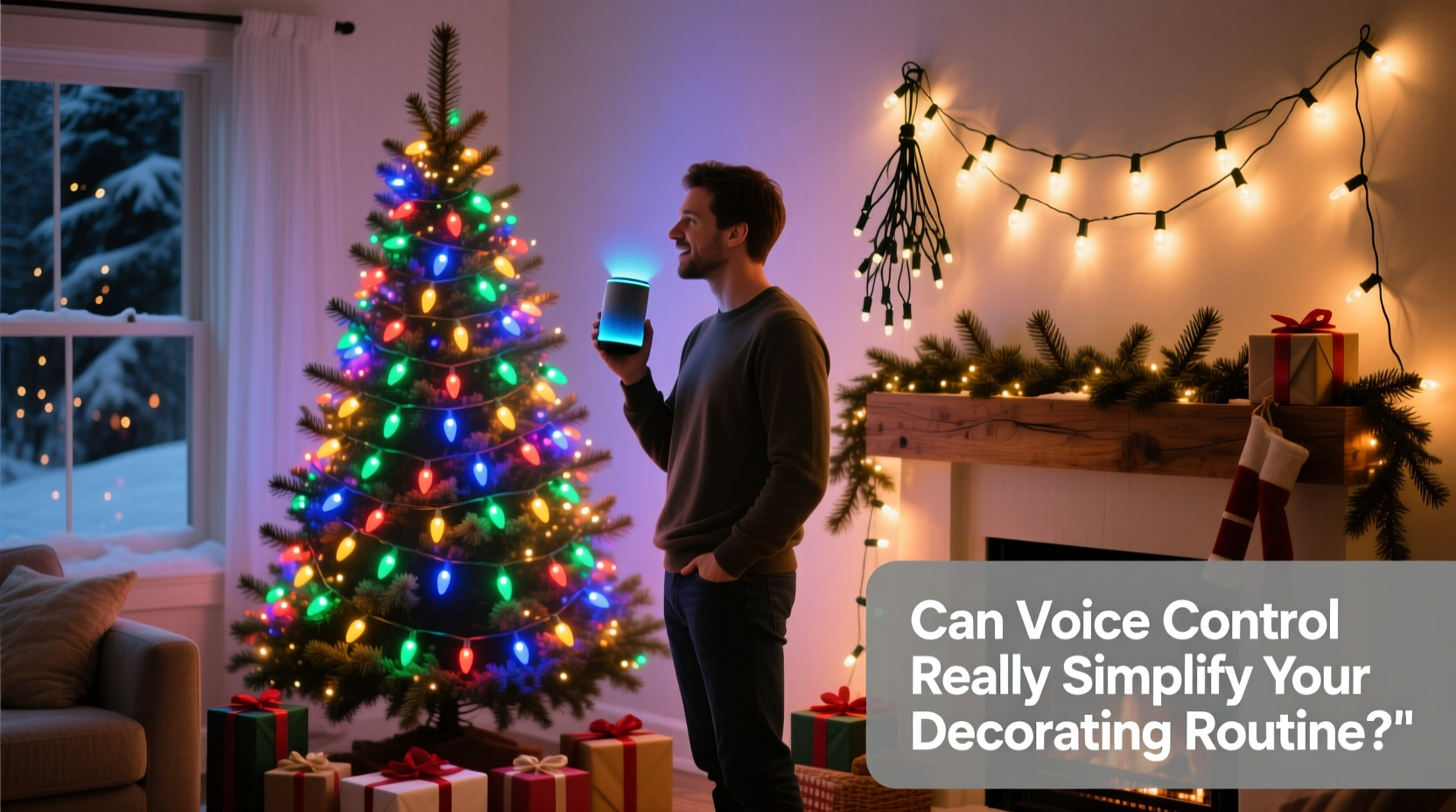
Smart Christmas lights are Wi-Fi or Bluetooth-enabled LED strings that connect to smartphone apps and voice assistants like Amazon Alexa, Google Assistant, and Apple HomeKit. Unlike traditional lights that only respond to a physical switch or timer, smart lights offer granular control:
- Change colors with a tap or voice command
- Set schedules for automatic on/off times
- Create dynamic effects (twinkling, fading, chasing)
- Sync lights to music or seasonal events
- Control them remotely—even when you're away from home
These features rely on small built-in controllers within the light string or an external hub. Once set up, users manage everything through companion apps like Philips Hue, LIFX, or Govee, which allow for grouping, scene creation, and integration with broader smart home systems.
“Smart lighting transforms holiday decoration from a chore into an interactive experience. Families can now personalize ambiance without leaving the couch.” — David Lin, Smart Home Product Designer at Nestwell Labs
Manual String Lights: Simplicity with Limitations
Traditional string lights have been the backbone of holiday decor for generations. They’re typically incandescent or basic LED bulbs wired together in fixed configurations. Plug them in, turn them on, and enjoy the glow—no app required.
Their appeal lies in reliability and low cost. A standard 50-light string costs as little as $5–$10, making them accessible for large-scale displays. However, their functionality stops there. There's no dimming, no color shifting, and no automation beyond a mechanical timer.
Moreover, manual lights come with recurring hassles:
- Tangled wires requiring hours of prep
- Difficulty reaching outlets after installation
- No way to adjust brightness or timing remotely
- Risk of forgetting to turn them off, increasing fire hazard and energy bills
While dependable, manual lights demand effort every single year. And for those with mobility issues or tight schedules, that effort adds up quickly.
Comparing Setup, Control, and Daily Use
To understand the practical impact of smart vs. manual lights, consider three key phases: installation, daily operation, and takedown.
| Feature | Smart Christmas Lights | Manual String Lights |
|---|---|---|
| Initial Setup Time | Moderate (requires app pairing and network setup) | Fast (plug and play) |
| Installation Complexity | Higher (must ensure Wi-Fi signal reaches outdoor areas) | Low (only needs power source) |
| Daily Operation | Voice or app control; automated schedules | Manual switch or timer-based |
| Remote Access | Yes (turn on/off from anywhere) | No |
| Energy Efficiency | High (LEDs + scheduling reduce waste) | Variable (depends on bulb type and user discipline) |
| Safety | Higher (auto-shutoff reduces overheating risk) | Lower (relies on user memory) |
| Lifespan | 3–5 years (with firmware updates) | 2–4 years (if stored properly) |
| Cost per String | $20–$60 | $5–$15 |
The data shows a clear trade-off: higher upfront investment and setup complexity for long-term gains in control, safety, and efficiency. Voice control, in particular, becomes valuable during winter months when going outside to flip a switch is inconvenient or unsafe due to ice, snow, or darkness.
Can Voice Control Really Simplify Decorating?
Voice commands eliminate the need to locate switches, remember codes, or pull out phones. Saying “Hey Google, turn on the Christmas lights” takes less than five seconds—and can be done hands-free while cooking, watching TV, or helping children with homework.
But does this translate into meaningful time savings? Consider a typical household using six light strings across tree, porch, roofline, and yard. With manual lights, turning them all on requires either multiple switches or daisy-chained plugs controlled by one outlet. If that outlet is outdoors or hard to reach, each activation involves:
- Locating the correct switch or extension cord
- Walking to the outlet (possibly outside)
- Flipping the switch or plugging in
- Returning indoors
Over a month-long holiday season with nightly use, that’s nearly 10 hours of cumulative effort—especially if done twice per evening (on at dusk, off at bedtime).
With voice-controlled smart lights, the same action takes seconds and can be scheduled to happen automatically. You can also create scenes: “Holiday Mode” turns on all lights at 5 PM, dims them at 9 PM, and shuts them off at midnight—all without interaction.
“We used to argue about who forgot to turn off the porch lights. Now our kids say goodnight to the house, and Alexa handles the rest.” — Maria Tran, homeowner in Minneapolis
A Real Example: The Johnson Family Holiday Routine
The Johnsons live in a two-story suburban home with extensive exterior lighting. Every year, setting up 1,200 bulbs took two full weekends. After installing smart lights last season, they cut initial setup time by 40% thanks to app-guided diagnostics (the app identifies dead segments instantly). More importantly, daily use changed dramatically.
Instead of using a ladder to reach rooftop outlets, Mr. Johnson now says, “Alexa, start the holiday display,” from his armchair. His daughter controls color themes via tablet, cycling through red/green, icy blue, or rainbow modes for parties. When they went on vacation, they turned the lights on remotely to deter burglars.
At season’s end, they used the app’s “storage mode” reminder to unplug and pack lights systematically. Total labor reduction: approximately 18 hours over six weeks.
Step-by-Step: Transitioning from Manual to Smart Lights
Switching doesn’t require replacing every string at once. Here’s how to integrate smart lights gradually:
- Assess Your Display: Identify high-impact areas where automation adds value (e.g., hard-to-reach rooflines or frequently adjusted indoor trees).
- Purchase Compatible Strings: Choose lights that work with your existing ecosystem (Alexa, Google Home, etc.). Look for IP65+ ratings for outdoor durability.
- Test Connectivity: Ensure your Wi-Fi extends to installation zones. Use mesh extenders if needed.
- Install and Pair: Hang lights first, then connect to power and follow app instructions to sync devices.
- Create Routines: Set daily schedules and voice commands. Example: “Good Morning” turns off lights; “Holiday Evening” activates warm white twinkling.
- Integrate Gradually: Replace one or two manual strings per year until fully upgraded.
This phased approach spreads cost and learning over time while delivering incremental benefits.
Common Concerns and Misconceptions
Despite their advantages, smart lights face skepticism. Let’s address common concerns:
- “They’re too expensive.” While pricier upfront, smart LEDs last longer and save energy. Over three seasons, the total cost often matches or beats repeated purchases of cheaper manual sets.
- “They’re complicated to set up.” Modern apps guide users step-by-step. Most brands offer video tutorials and customer support.
- “What if my Wi-Fi goes down?” Many smart lights retain basic functionality via physical switches. Some even support Bluetooth fallback.
- “Do I need a hub?” Not always. Standalone Wi-Fi models (like Govee or TP-Link Kasa) connect directly to your router.
Checklist: Is It Time to Upgrade to Smart Christmas Lights?
Use this checklist to decide if smart lights are right for your home:
- ☐ Do you decorate annually with multiple light strings?
- ☐ Are some of your displays in hard-to-reach locations?
- ☐ Have you forgotten to turn off lights overnight?
- ☐ Do you want customizable colors or effects?
- ☐ Are you already using a smart speaker (Alexa, Google, Siri)?
- ☐ Would remote control add value (e.g., vacation monitoring)?
- ☐ Are you willing to invest $100–$300 for long-term convenience?
If you answered “yes” to three or more, upgrading makes practical sense.
Frequently Asked Questions
Can I mix smart and manual lights?
Yes. Many households use smart lights for primary displays and manual ones for accents. Just keep them on separate circuits to avoid interference.
Are smart Christmas lights safe outdoors?
Most are designed for outdoor use with weather-resistant casings (look for IP65 or higher). Always check manufacturer guidelines and avoid submerging any part.
Do smart lights increase my electricity bill?
No—they typically use 70–80% less energy than incandescent strings. Combined with auto-shutoff features, they often reduce overall consumption.
Conclusion: Convenience Meets Tradition
Smart Christmas lights aren’t just flashy gadgets—they represent a shift toward smarter, safer, and more sustainable holiday traditions. Voice control may seem like a small perk, but its cumulative effect is significant: fewer trips outside in freezing weather, reduced fire risks, and more time spent enjoying the season rather than managing it.
For busy families, aging homeowners, or anyone seeking a simpler way to celebrate, the upgrade pays for itself in peace of mind and saved hours. You don’t have to abandon tradition to embrace innovation. Start small—replace one string, try a voice command, automate a schedule. Experience firsthand how modern tech can enhance, not replace, the magic of the holidays.




 浙公网安备
33010002000092号
浙公网安备
33010002000092号 浙B2-20120091-4
Comments
No comments yet. Why don't you start the discussion?