
The holiday season brings with it a timeless tradition: decorating homes with twinkling lights that evoke warmth, nostalgia, and celebration. For decades, traditional string lights have illuminated porches, trees, and rooftops. But in recent years, smart Christmas lights have emerged as a modern alternative—offering app control, color customization, and automation. With higher price tags and new technology, many homeowners wonder: is upgrading to smart lights truly worth it?
This guide dives into the practical differences between smart and traditional Christmas lights, examining performance, cost, ease of use, and long-term value. Whether you're a minimalist decorator or a full-blown holiday enthusiast, understanding these distinctions can help you make an informed decision that enhances your seasonal display without overspending.
Understanding the Core Differences
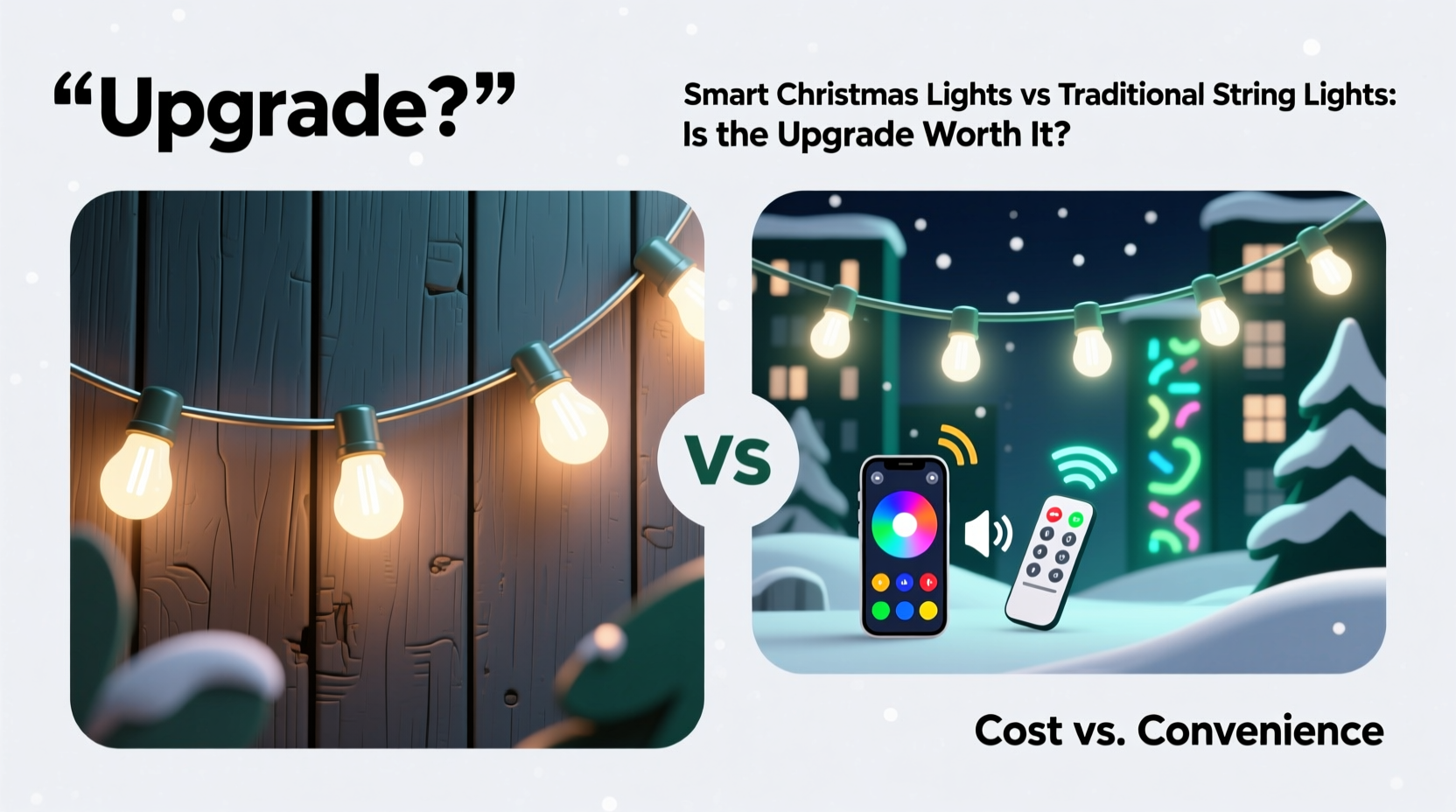
At first glance, smart and traditional Christmas lights may appear identical. Both come in strands, connect via plugs, and emit light. However, their underlying technology, functionality, and user experience diverge significantly.
- Traditional string lights are passive lighting systems. Once plugged in, they either stay on continuously or cycle through preset patterns (like twinkle or fade) if equipped with a controller. They require manual setup and physical access to turn on or off.
- Smart Christmas lights, by contrast, connect to your home Wi-Fi or Bluetooth network and are controlled via smartphone apps, voice assistants (like Alexa or Google Assistant), or automated schedules. Many allow you to adjust brightness, change colors, create dynamic effects, and sync with music—all remotely.
The shift from manual to digital control opens up new creative possibilities, but it also introduces complexity. While traditional lights are plug-and-play, smart versions often require initial setup involving apps, firmware updates, and network pairing.
Comparing Key Features: A Practical Breakdown
To determine whether smart lights justify their premium cost, let’s compare them across five critical dimensions: control options, energy efficiency, durability, installation effort, and lifespan.
| Feature | Traditional String Lights | Smart Christmas Lights |
|---|---|---|
| Control Method | Manual switch or basic timer | App, voice commands, automation, geofencing |
| Color Options | Solid color or multicolor fixed sets | Millions of colors, customizable per bulb (on RGB models) |
| Energy Use | Moderate to high (especially incandescent) | Lower (LED-based); some offer usage tracking |
| Installation Complexity | Simple plug-in; minimal setup | Requires app setup, network pairing, labeling (for multi-zone setups) |
| Lifespan | 1,000–3,000 hours (incandescent); up to 50,000 (LED) | Typically 25,000–50,000 hours (all LED) |
| Weather Resistance | Varies; many are outdoor-rated | Most are IP44 or higher; check manufacturer specs |
| Price Range (per 50-light strand) | $5–$15 | $20–$50+ |
While smart lights lead in customization and remote management, traditional sets win on simplicity and upfront affordability. The real value of smart lighting lies not in replacing every strand, but in strategic application—such as accent lighting, focal displays, or synchronized animations.
When Smart Lights Make the Most Sense
Upgrading isn't always about replacing everything. In many cases, integrating smart lights into select areas delivers maximum impact without overhauling your entire decor system.
Consider using smart lights if:
- You frequently change your light displays and want to experiment with themes (e.g., red/green for Christmas, blue/silver for New Year’s).
- You travel during the holidays and want to schedule lights to turn on/off automatically for security and ambiance.
- You enjoy syncing lights with music or creating choreographed sequences for neighborhood shows.
- You want to reduce energy consumption by automating shut-off times or dimming during low-traffic hours.
- You manage multiple zones (front yard, back porch, tree) and prefer centralized control instead of hunting for individual timers.
“Smart lighting transforms holiday decorating from static to dynamic. It’s not just about being flashy—it’s about personalization and convenience.” — Daniel Reyes, Smart Home Lighting Designer
A Real Example: The Neighborhood Light Show Upgrade
Take the case of Maria Thompson, a homeowner in Portland, Oregon, who maintained a modest outdoor display for years using traditional mini-lights. Her setup included two roofline strands, a tree wrap, and a single animated reindeer. Each year, she spent 30–45 minutes adjusting timers and manually turning lights on at dusk.
In 2022, she invested $120 in three strands of smart RGB LED lights for her roofline and paired them with a smart plug for her existing decorations. Using a free app, she programmed her lights to:
- Turn on at sunset and off at 10 PM.
- Shift from warm white to festive red/green on December 1.
- Activate a “party mode” with pulsing gold and silver for New Year’s Eve.
- Sync with holiday playlists during weekend gatherings.
Within two weeks, neighbors noticed the enhanced display. More importantly, Maria saved time and energy—no more daily adjustments. She now controls everything from her phone, even when visiting family out of state. “It paid for itself in convenience,” she said. “I spend less time managing lights and more time enjoying them.”
Step-by-Step: How to Transition Gradually to Smart Lights
You don’t need to replace all your lights at once. A phased approach allows you to test smart technology without financial risk. Follow this timeline to integrate smart lighting wisely.
- Assess Your Current Setup (September–October)
Inventory your existing strands. Identify which ones are still functional and where visual upgrades would matter most (e.g., front-facing areas). - Pick One Zone to Upgrade (Early October)
Choose a small, high-visibility area—like your porch railing or entryway tree—to pilot smart lights. Buy one or two quality strands from reputable brands (e.g., Philips Hue, Govee, or Twinkly). - Test Connectivity and App Setup (Mid-October)
Install the companion app, pair the lights, and ensure stable Wi-Fi or Bluetooth range. Test color changes, scheduling, and voice commands. - Create Automation Rules (Late October)
Set up sunrise/sunset triggers, weekly schedules, and special event modes (e.g., Thanksgiving dinner lighting). Use geofencing if available to turn lights on as you approach home. - Evaluate and Expand (Post-Holiday Review)
After the season, reflect: Did the smart lights enhance your experience? Were they reliable? If yes, plan to expand next year—perhaps adding smart icicle lights or path markers.
Common Pitfalls to Avoid
Despite their benefits, smart Christmas lights come with potential drawbacks. Awareness helps prevent frustration.
- Overestimating Wi-Fi coverage: Outdoor installations far from your router may drop connection. Use Wi-Fi extenders or opt for Bluetooth models if controlling from a nearby device is sufficient.
- Ignoring compatibility: Not all smart lights work with Alexa, Google, or Apple HomeKit. Check integration support before buying.
- Skipping surge protection: Smart electronics are more sensitive than traditional bulbs. Plug them into surge-protected outlets to prevent damage from power spikes.
- Buying cheap knockoffs: Low-cost smart lights often lack firmware updates, responsive customer support, or accurate color rendering. Stick to known brands with strong reviews.
- Underestimating storage needs: Smart light controllers and end caps can be fragile. Store them separately in labeled containers to avoid crushing during off-seasons.
Cost Analysis: Short-Term Spend vs Long-Term Value
Smart lights cost 2–4x more per strand than traditional sets. But long-term savings emerge through durability and efficiency.
Consider this scenario:
- You buy five 50-light strands annually for $10 each = $50/year.
- Traditional incandescent strands last ~2 seasons due to burnout and weather damage.
- Smart LED strands cost $35 each but last 5+ years with proper care.
Over five years:
- Traditional lights: 13 sets needed × $10 = $130
- Smart lights: 5 sets × $35 = $175 (one-time purchase)
While the smart option costs more upfront, it offers greater functionality, lower energy use (~80% less than incandescent), and reduced replacement frequency. Plus, features like scheduling and remote control add intangible value in convenience and peace of mind.
FAQ: Answering Common Questions
Can I mix smart and traditional lights on the same display?
Yes, absolutely. Use smart lights for key areas and control traditional ones via smart plugs. This hybrid method gives you flexibility without full replacement.
Do smart Christmas lights work without Wi-Fi?
Basic functions (like turning on) may work locally via Bluetooth, but full features—remote access, automation, voice control—require a stable internet connection. Some models store routines locally and will run schedules even if Wi-Fi drops temporarily.
Are smart lights harder to store?
They require slightly more care. Protect the controller box and connectors from moisture and pressure. Use foam-lined bins or spools to prevent kinks that could damage internal wiring.
Checklist: Is It Time to Upgrade?
Use this checklist to decide whether smart Christmas lights are right for your home:
- ☐ I want to customize colors without buying multiple sets
- ☐ I’m tired of adjusting timers manually each year
- ☐ I host holiday gatherings and want dynamic lighting effects
- ☐ I travel during December and want lights to run automatically
- ☐ My current lights are aging and need replacement soon
- ☐ I have reliable outdoor Wi-Fi or am willing to extend coverage
- ☐ I’m open to learning a new app or system for long-term gains
If you checked four or more, the upgrade is likely worth it.
Final Thoughts: Balancing Tradition and Innovation
Holiday lighting has always been about emotion—creating moments of joy, memory, and connection. Traditional string lights excel at delivering that classic glow, evoking childhood memories and timeless charm. There’s undeniable beauty in simplicity.
Yet smart Christmas lights aren’t meant to erase tradition—they’re designed to expand it. They offer precision, creativity, and ease that complement rather than replace the familiar. You can keep your heirloom strands on the tree while using smart lights to animate your roofline. You can maintain a cozy indoor ambiance while programming outdoor displays to welcome guests.
The question isn’t whether smart lights are “better” overall, but whether their advantages align with your lifestyle and goals. For those seeking convenience, customization, and long-term reliability, the upgrade often pays off—both financially and experientially.




 浙公网安备
33010002000092号
浙公网安备
33010002000092号 浙B2-20120091-4
Comments
No comments yet. Why don't you start the discussion?