
The warm glow of Christmas lights has long been a hallmark of the holiday season. For decades, families have draped strands of incandescent bulbs across trees, rooftops, and porches, creating nostalgic displays passed down through generations. But in recent years, a quiet revolution has been unfolding—one powered by microchips, Wi-Fi signals, and smartphone apps. Programmable LED Christmas lights are rapidly gaining ground, challenging the dominance of traditional strings. While classic lights still hold emotional appeal, smart lighting technology is reshaping how we decorate, offering unprecedented control, energy efficiency, and creative potential.
This shift isn’t just about brightness or color—it reflects broader trends in home automation, sustainability, and digital personalization. As more consumers embrace connected devices, it’s natural that even seasonal decorations would evolve. But are smart lights truly superior? Can they coexist with tradition? And most importantly, are they here to stay?
The Evolution of Holiday Lighting: From Edison to Alexa
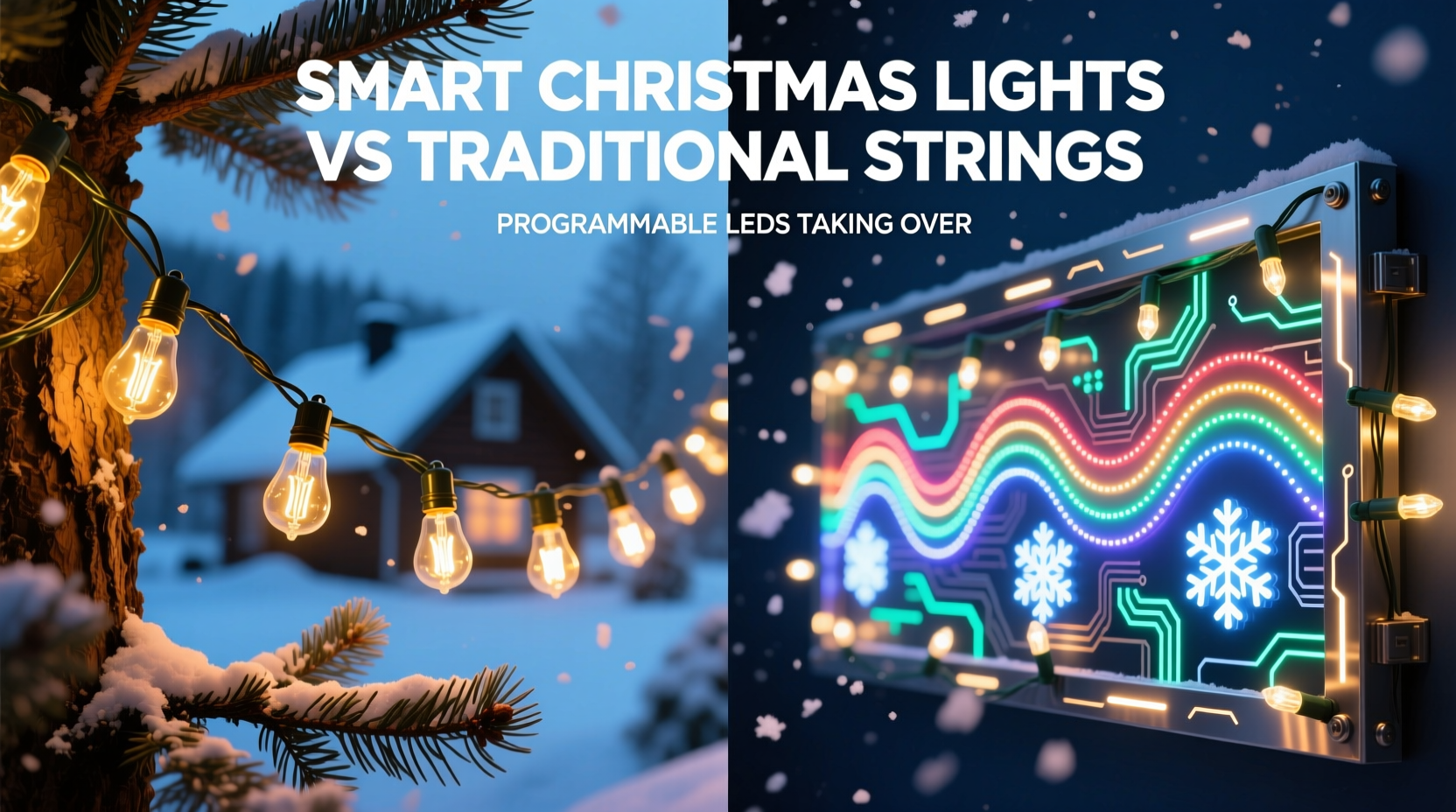
Christmas lights trace their origins back to 1882, when Edward H. Johnson, an associate of Thomas Edison, hand-wired 80 red, white, and blue bulbs and wrapped them around a tree. At the time, electric lights were a luxury—costing upwards of $300 in today’s money for a single set. Over the next century, mass production made lights affordable and accessible, with incandescent mini-lights becoming the standard by the 1970s.
These traditional strings relied on simple circuitry: alternating current flowing through thin filaments to produce light and heat. While effective, they were fragile, power-hungry, and limited in functionality. A string outage often meant hunting for a single faulty bulb—a ritual familiar to anyone who’s spent hours troubleshooting before a holiday gathering.
The real turning point came with the widespread adoption of LED (light-emitting diode) technology in the early 2000s. LEDs consumed up to 90% less energy, lasted 25 times longer, and generated minimal heat—making them safer and more durable. Initially, LED strings mimicked traditional designs, offering only static colors or basic chasing effects. But as semiconductor costs dropped and wireless connectivity advanced, manufacturers began embedding microcontrollers into individual bulbs.
Today, many smart Christmas lights support protocols like Wi-Fi, Bluetooth, or Zigbee, allowing users to control brightness, color, patterns, and timing via smartphone apps or voice assistants. Brands like Philips Hue, Govee, Twinkly, and LIFX now dominate the premium segment, while budget-friendly options from Amazon and GE expand accessibility.
Smart vs. Traditional: A Practical Comparison
To understand whether smart lights are truly overtaking traditional strings, it helps to compare them across key criteria. The following table outlines the differences in cost, energy use, durability, setup complexity, and customization.
| Feature | Traditional Incandescent Strings | Smart Programmable LEDs |
|---|---|---|
| Energy Consumption | High (40–100W per 100 bulbs) | Low (2–6W per 100 bulbs) |
| Lifespan | 1,000–2,000 hours | 25,000–50,000 hours |
| Initial Cost | $5–$15 per 100-light strand | $25–$80 per strand |
| Customization | Limited (on/off, blink modes) | Full RGB control, animations, music sync |
| Setup & Control | Plug-and-play; manual switches | App-based setup, voice control, scheduling |
| Weather Resistance | Varies; often not sealed | Most rated IP65 or higher |
The data shows a clear technological advantage for smart LEDs. Their energy efficiency alone makes them appealing, especially for large outdoor displays that run for weeks. A homeowner using 10 strands of traditional lights could spend over $50 in electricity during the season, while the same display with smart LEDs might cost under $5. Over time, these savings help offset the higher upfront price.
Why Smart Lights Are Gaining Momentum
Beyond efficiency, several factors are accelerating the adoption of programmable LEDs:
- Personalization at scale: Users can design custom light shows that sync with music, change based on holidays, or respond to weather conditions. Some systems even allow mapping lights to architectural features for immersive effects.
- Integration with smart homes: Lights can be controlled alongside thermostats, security cameras, and doorbells. A single “Goodnight” routine might turn off lights, lock doors, and adjust the temperature.
- Scheduling and automation: Displays can turn on at sunset and off at midnight without manual intervention, improving safety and convenience.
- Durability and reliability: With no filaments to burn out and better sealing against moisture, smart LEDs are less prone to failure.
- Community sharing: Apps like Twinkly let users share light sequences online, fostering a creative ecosystem where homeowners download festive animations created by others.
“Smart lighting is transforming holiday decor from passive decoration to interactive storytelling. People aren’t just illuminating their homes—they’re expressing identity.” — Daniel Park, Home Automation Analyst at TechLiving Labs
Real-World Example: A Suburban Transformation
Consider the case of the Martinez family in Portland, Oregon. For 15 years, they used the same red-and-green incandescent strings on their roofline and tree. Setup took two evenings, and troubleshooting was a recurring headache—especially after rainy winters damaged connections.
In 2022, they switched to a Govee Wi-Fi LED system with 500 programmable bulbs. Using the app, they designed a snowfall animation that cascaded down the eaves and synchronized with holiday playlists. They scheduled the display to activate only between 5 PM and 10 PM, reducing energy use and light pollution. Neighbors began stopping by—not just to admire the lights, but to ask about the technology.
By 2023, three other homes on their block had adopted smart systems. One resident even created a neighborhood light show coordinated via shared app settings. What started as a personal upgrade evolved into a community experience, enabled entirely by programmable LEDs.
Challenges and Limitations of Smart Lighting
Despite their advantages, smart Christmas lights are not without drawbacks:
- Higher initial cost: A full smart setup can cost hundreds of dollars, compared to under $50 for a traditional display.
- Technical complexity: Older users may struggle with app navigation, firmware updates, or Wi-Fi pairing.
- Dependence on infrastructure: Power outages, router failures, or app downtime can disable entire displays.
- Compatibility issues: Not all brands work with Alexa, Google Assistant, or Apple HomeKit, limiting integration options.
- E-waste concerns: While long-lasting, smart lights contain circuit boards and batteries that complicate recycling.
Additionally, some purists argue that smart lights lack the warmth and simplicity of incandescents. The soft flicker of old-school bulbs evokes childhood memories in a way that pixel-perfect digital animations cannot replicate. There’s also a growing counter-movement favoring minimalist, low-tech decor—particularly among those seeking to reduce screen time during the holidays.
Step-by-Step Guide to Transitioning to Smart Lights
Moving from traditional to smart lighting doesn’t have to happen overnight. Follow this practical timeline to make the switch smoothly:
- Assess your current setup: Inventory existing strands, note lengths, and identify areas most visible to neighbors or pedestrians.
- Define your goals: Do you want energy savings, animated effects, voice control, or all three? Prioritize features to guide purchasing decisions.
- Start small: Purchase one or two smart strands compatible with your preferred ecosystem (e.g., Alexa or HomeKit). Test range, brightness, and app stability.
- Map your layout: Use painter’s tape or string to simulate placement. Many apps offer grid tools to visualize pixel-level animations.
- Install and sync: Mount lights securely, connect to power, and pair with your network. Update firmware if prompted.
- Design your display: Experiment with preset themes or create custom sequences. Add music synchronization for special occasions.
- Schedule and automate: Set daily on/off times, link to sunrise/sunset, or trigger activation via motion sensors or doorbell rings.
- Expand gradually: Replace traditional strings over multiple seasons as budget allows, maintaining consistent voltage and color temperature.
Checklist: Choosing the Right Smart Lights
Before buying, ensure your selection meets these criteria:
- ✅ Compatible with your voice assistant (Alexa, Google, Siri)
- ✅ Supports 2.4 GHz Wi-Fi (most don’t work on 5 GHz)
- ✅ Has an IP rating of at least IP65 for outdoor use
- ✅ Offers independent bulb control (not just zone-based)
- ✅ Includes extension cords or power adapters if needed
- ✅ Allows offline operation (in case internet fails)
- ✅ Provides a mobile app with intuitive interface and frequent updates
Frequently Asked Questions
Can I mix smart and traditional lights on the same circuit?
Yes, but avoid connecting them in series. Use separate outlets or power strips to prevent voltage drops that could damage sensitive electronics in smart strands.
Do smart Christmas lights work without Wi-Fi?
Most retain basic functions like on/off and preloaded patterns when disconnected, but lose remote control, scheduling, and app customization. Check product specs for local control options.
Are smart lights safe for children and pets?
Yes—and often safer than traditional strings. LEDs operate at low voltage and generate little heat, reducing fire and burn risks. However, keep control boxes and cords out of reach to prevent chewing or tampering.
Conclusion: The Future Is Bright—But Tradition Still Glows
Programmable LED Christmas lights are undeniably transforming holiday decorating. Their energy efficiency, customization, and integration capabilities offer compelling benefits that align with modern lifestyles. For tech-savvy households, event planners, and communities looking to create memorable experiences, smart lights are not just an option—they’re becoming the standard.
Yet, traditional strings retain cultural and emotional significance. Their simplicity, affordability, and timeless charm ensure they won’t vanish entirely. Instead, the future likely holds coexistence: smart lights handling dynamic, large-scale displays, while classic designs preserve intimacy and heritage in smaller settings.
Whether you choose to go fully digital or maintain a blend, the goal remains the same—to spread joy, warmth, and connection during the holidays. Technology enhances that mission, but it doesn’t replace the human spirit behind the lights.




 浙公网安备
33010002000092号
浙公网安备
33010002000092号 浙B2-20120091-4
Comments
No comments yet. Why don't you start the discussion?