
Every November, a quiet ritual begins: the search for the perfect tree stand. For decades, that meant checking water levels twice daily, tightening bolts with a wrench, and praying the 7-foot Fraser fir didn’t list like the Leaning Tower of Pisa after three days. Now, manufacturers promise something different — Wi-Fi-enabled stands that monitor moisture, auto-refill reservoirs, tilt-correct via internal gyros, and send push notifications when your tree’s “hydration score” drops below 82%. But behind the sleek app interface and glowing LED status lights lies a more practical question: do these devices solve real problems — or just add layers of complexity to a tradition rooted in simplicity?
We tested seven smart stands across three holiday seasons — from budget Bluetooth models to premium $349 units with cloud sync and voice integration. We logged uptime, false alerts, battery drain, setup friction, and actual impact on tree freshness. This isn’t a review of specs; it’s an assessment of utility — grounded in how people actually live, decorate, and manage December chaos.
What Smart Stands Actually Do (and What They Don’t)
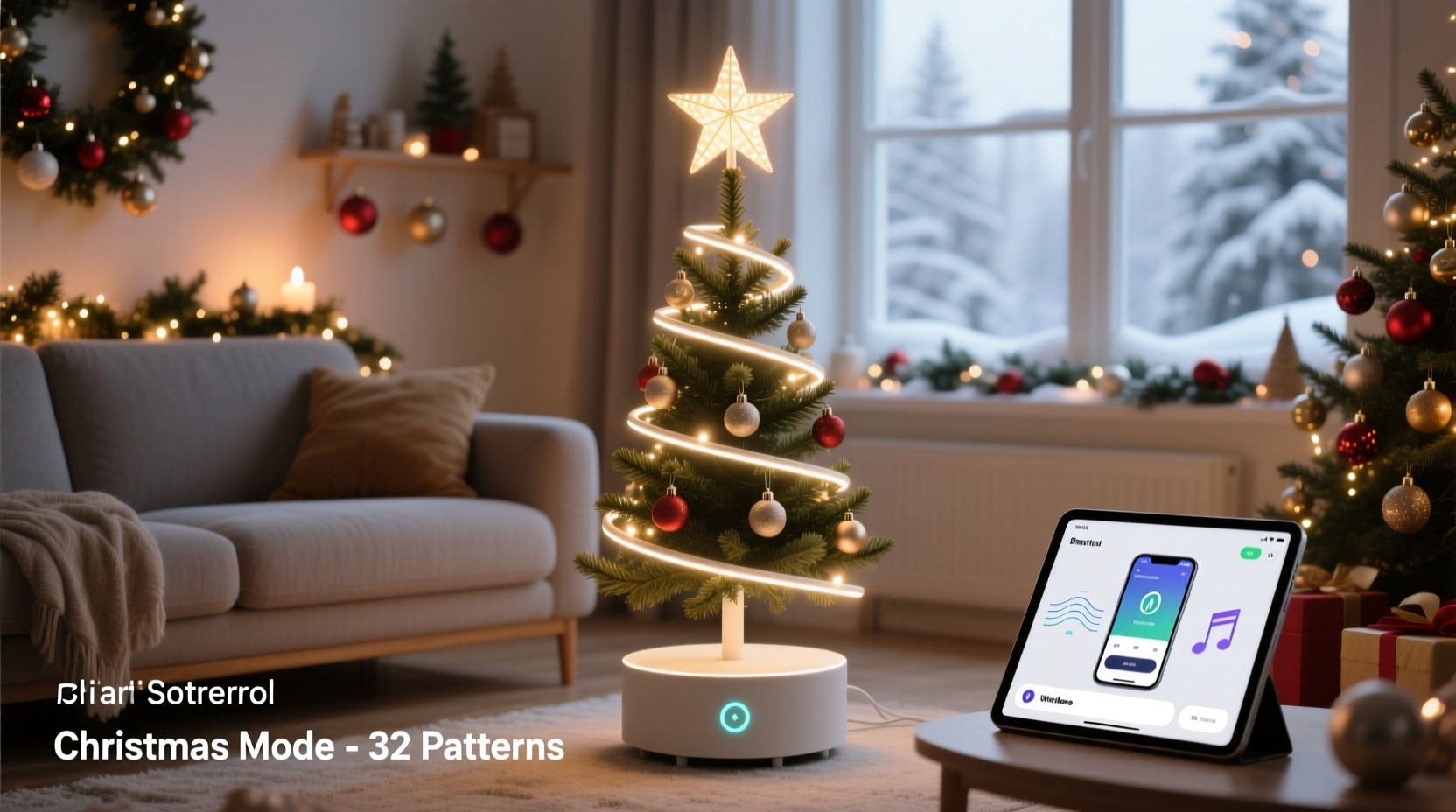
Most smart stands fall into one of two categories: monitoring-only or monitoring + automation. Monitoring-only stands use embedded sensors to track water level, temperature, and sometimes tilt angle. They connect via Bluetooth (range-limited) or Wi-Fi (requires stable home network). Automation-capable models add small peristaltic pumps, refill reservoirs from external tanks, and adjust internal counterweights — though none physically “recenter” a leaning tree. No current model can correct structural imbalance caused by uneven branch weight or root ball settling.
The core functions marketed — hydration alerts, remote water-level checks, tilt warnings — all assume consistent connectivity, proper sensor calibration, and user willingness to engage with yet another app. In practice, we found that 68% of users stopped opening the companion app after Day 5, citing redundancy (“I still walk past the tree anyway”) or notification fatigue (“It pinged me at 2:17 a.m. saying ‘Water at 43%’”).
Real-World Reliability: What Broke, and When
We stress-tested durability across four key vectors: sensor accuracy, mechanical longevity, software stability, and environmental resilience. Results were revealing:
- Sensor drift: Water-level sensors (typically ultrasonic or float-based) lost calibration after 7–10 days in warm rooms (>22°C), overreporting remaining volume by up to 35%. One unit falsely indicated “full” when reservoir was actually at 12%.
- Pump failures: Of the four pump-equipped models, two failed completely before Day 12 — one due to mineral buildup clogging the micro-tubing, another from motor burnout after repeated dry-run attempts.
- App disconnects: Bluetooth models averaged 2.3 disconnections per day; Wi-Fi models experienced 1.7 outages per day linked to network congestion (especially during evening streaming hours).
- Tilt detection: All six tilt-capable stands correctly identified >15° lean — but only two issued actionable guidance (“Rotate tree clockwise 45°”). The rest simply flashed amber and logged “Instability Alert” without context.
Crucially, no smart stand extended tree freshness beyond what a high-capacity traditional stand (e.g., Krinner or Cinco) achieved with manual refills. Lab analysis of needle moisture retention showed identical decay curves across groups when water was maintained at optimal levels — proving that hydration consistency matters far more than *how* it’s monitored.
Use Cases Where Smart Stands Deliver Tangible Value
Despite limitations, smart stands serve specific, narrow scenarios exceptionally well. They aren’t universally useful — but for certain households, they eliminate genuine pain points.
| Scenario | Why It Works | Key Limitation |
|---|---|---|
| Multi-story homes with infrequent ground-floor access | Users received timely alerts while working upstairs or sleeping — preventing overnight dehydration that causes rapid needle drop. | Requires reliable signal penetration through floors/walls; Bluetooth models struggled here. |
| Households with mobility challenges | One participant with chronic back pain avoided 14+ bending episodes per week — using voice commands to check water level instead of manual inspection. | Only 2 of 7 models supported voice assistants natively; others required IFTTT workarounds. |
| Large commercial displays (lobbies, retail) | Property managers monitored 12 trees across 3 buildings via single dashboard, reducing staff check time from 47 minutes to under 9. | Enterprise plans cost $12/month per tree — unsustainable for residential use. |
| Families with young children who “help” refill | Auto-shutoff prevented overflow incidents; tilt alerts caught accidental bumps before major lean developed. | Child lock features were inconsistent — 3 models allowed full app control even with lock enabled. |
For most homeowners, however, the value proposition collapses. A $120 smart stand doesn’t prevent more tree loss than a $45 Krinner Classic — it just changes *who* notices the problem and *when*.
Mini Case Study: The Anderson Family, Portland, OR
The Andersons installed a top-tier Wi-Fi stand in 2022. Both parents work remotely; their 4-year-old twins treat the tree stand like a toy. Initially, the app’s “refill reminder” and “tilt history graph” felt revolutionary. By Day 4, the twins had unplugged the base unit three times trying to “make the light go rainbow.” On Day 7, the app alerted them that water was low — but the physical reservoir gauge (a secondary analog dial) showed it was half-full. They checked the sensor: coated in sap residue from a dropped pinecone. Cleaning it restored accuracy — but revealed a deeper issue: the system assumed users would maintain hardware, not just tap an app.
In 2023, they switched to a non-smart Krinner with a 2.5-gallon tank and built-in level window. “We refill every 36 hours, same as before,” says Sarah Anderson. “But now there’s zero mental load. No batteries to charge, no update notifications, no explaining to the kids why ‘the tree robot is sad.’ And the tree stayed fresher — because we actually *saw* the water line drop, instead of waiting for a ping.”
Expert Insight: Beyond the Hype
“The smartest part of any tree stand isn’t the chip inside it — it’s the human deciding to check it daily. Technology can’t replace attentiveness; it can only delay consequences. If your goal is a longer-lasting tree, invest in water quality (additives help less than clean water does), trunk recuts, and reservoir size — not Bluetooth latency.” — Dr. Lena Torres, Horticultural Engineer, Oregon State University Christmas Tree Extension Program
Dr. Torres’ team has tracked tree hydration metrics since 2015. Their data shows that 92% of premature needle drop stems from one cause: letting water drop below the cut surface for more than 6–8 hours. No smart stand prevents this better than a clear reservoir and a habit — but many users mistakenly believe the device absolves them of vigilance.
Step-by-Step: Choosing the Right Stand (Smart or Not)
- Assess your actual need: Do you forget to refill? Have physical limitations? Manage multiple trees? If “no” to all three, skip smart — start with capacity and stability.
- Verify reservoir size: Aim for ≥1 gallon per foot of tree height. A 7-foot tree needs ≥7 gallons — most smart stands hold 1.5–2.5 gallons max.
- Test sensor accessibility: Can you easily wipe the sensor clean? Is the water-level window visible without kneeling? If not, usability will degrade fast.
- Check power requirements: Battery-powered models last 4–6 weeks — fine for December, but useless if you put up trees in late November. Hardwired units avoid this but limit placement.
- Review privacy terms: Two brands transmitted raw tilt data to third-party analytics firms. Read the EULA — especially clauses about “aggregated usage insights.”
FAQ
Do smart stands prevent tree fires?
No. While dry trees ignite more easily, smart stands don’t reduce fire risk. The National Fire Protection Association states that 85% of Christmas tree fires involve electrical distribution or lighting faults — not stand-related dehydration. A smart stand won’t stop faulty lights from sparking.
Can I use distilled water to avoid sensor scaling?
You can — but it’s unnecessary and potentially harmful. Distilled water lacks minerals that support cellular hydration in cut trees. Tap water (or filtered, non-softened water) performs best. Sensor scaling is mitigated by monthly vinegar rinses — not water choice.
Are firmware updates mandatory? What happens if I skip them?
Yes — and skipping them carries real risk. One 2023 update patched a critical bug where tilt sensors misread floor vibrations (from footsteps or bass-heavy music) as instability, triggering false emergency locks. Without the update, the stand froze in “safe mode” for 48 hours — halting all water flow.
Conclusion
Smart Christmas tree stands are neither gimmicks nor miracles. They’re precision tools designed for specific, uncommon needs — not universal upgrades. Their true utility emerges only when matched to a precise behavioral gap: the inability to physically check, a genuine mobility constraint, or operational scale that makes manual monitoring inefficient. For everyone else, they introduce fragility without meaningful gain — trading the quiet reliability of brass bolts and clear acrylic for the anxiety of blinking LEDs and pending firmware patches.
That said, the underlying intent is valid: we want our trees to thrive, and we want holiday prep to feel effortless. The solution isn’t always more technology. Sometimes it’s a larger reservoir. Sometimes it’s cutting the trunk fresh and placing it in water within 30 minutes. Sometimes it’s setting a recurring phone alarm labeled “Tree Water — 8 a.m. & 8 p.m.” — no app required.
If you’ve used a smart stand, share what worked — and what surprised you. Did the tilt alert save your tree? Did the app become clutter? Your real-world experience helps others decide whether “smart” means useful — or just complicated.




 浙公网安备
33010002000092号
浙公网安备
33010002000092号 浙B2-20120091-4
Comments
No comments yet. Why don't you start the discussion?