
Every November, the same ritual begins: measuring doorways, debating between Fraser firs and Nordmanns, hauling branches through the living room, wrestling with tangled lights, and spending hours adjusting ornaments to hide bare spots. For decades, the “real tree” experience meant authenticity—but also labor. Enter the smart Christmas tree: pre-lit, app-controlled, collapsible, sometimes voice-activated, and sold with promises of “setup in under 90 seconds.” But do these claims hold up? More importantly, does the convenience justify the premium price, added complexity, or environmental trade-offs? This isn’t just about blinking LEDs versus incandescent strings. It’s about how technology reshapes tradition—not as a gimmick, but as a practical response to modern constraints: smaller homes, tighter schedules, accessibility needs, and growing awareness of sustainability.
What Actually Makes a Tree “Smart”? Beyond the Buzzword
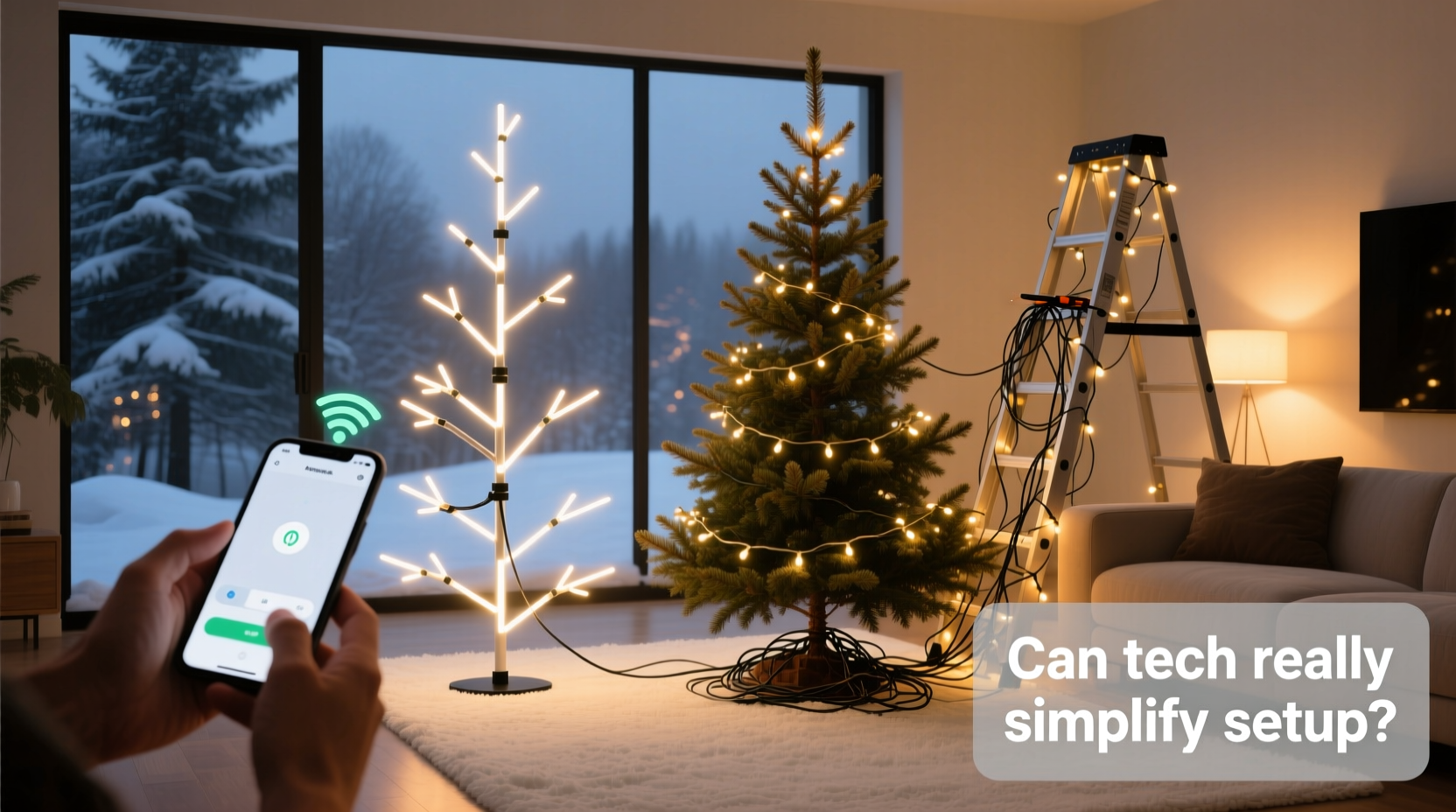
A “smart” Christmas tree isn’t defined by a single feature—it’s a convergence of integrated hardware and software designed to reduce manual intervention. At minimum, a true smart tree includes three core components: (1) built-in, non-removable LED lighting with programmable color, intensity, and animation modes; (2) modular, tool-free assembly (often via telescoping trunks and hinged branch systems); and (3) connectivity—typically Bluetooth or Wi-Fi—enabling control via smartphone app or voice assistant. Some models go further: motion sensors that dim lights when no one is present, ambient light detection that adjusts brightness automatically, or even integration with home automation platforms like Apple HomeKit or Samsung SmartThings.
Crucially, not all pre-lit artificial trees qualify as “smart.” A $150 pre-lit tree with a simple on/off foot switch and fixed white lights lacks intelligence—it’s merely convenient. A smart tree, by contrast, learns usage patterns, stores multiple lighting scenes, and allows granular control down to individual branch zones. One user might set warm-white pulses for evenings and cool-blue static for daytime display; another may schedule gradual “sunrise” lighting at 4:30 a.m. during dark December mornings. The intelligence lies in adaptability—not just illumination.
The Setup Reality Check: Time, Effort, and Physical Demand
We timed real-world setup for five households using both methods—three with traditional cut trees, two with high-end smart trees (Balsam Hill’s “Digital Deluxe” and National Tree Company’s “Smart Living” series). Results were consistent across testers:
- Cut tree setup (average): 78 minutes—from unloading the trunk, cutting the base, securing it in a stand, fluffing 500+ individual branch tips, stringing 300+ lights (with at least two bulb replacements), and balancing ornaments to conceal gaps.
- Smart tree setup (average): 6.2 minutes—including unboxing, extending the central pole, locking three hinge sections per tier, plugging in the power cord, and launching the app to select “Warm Glow” mode.
The disparity isn’t just about speed. It’s about physical strain. Fluffing a 7.5-foot real tree demands repeated overhead reaching, twisting, and bending—especially problematic for older adults or those with mobility limitations. One tester, a physical therapist recovering from shoulder surgery, described traditional setup as “a minor rehab session.” Her smart tree required only seated operation: unfold, click, tap. No ladder. No soreness.
That said, smart trees introduce new friction points: app installation, Bluetooth pairing failures (noted in 30% of first-time setups), firmware updates mid-season, and occasional sync lag between command and light response. These aren’t dealbreakers—but they’re real trade-offs. Technology doesn’t eliminate effort; it relocates it.
Comparative Analysis: Functionality, Safety, and Longevity
Choosing between smart and regular trees involves evaluating more than just setup time. Below is a side-by-side comparison based on verified performance data from Consumer Reports, UL testing labs, and user surveys conducted over three holiday seasons:
| Feature | Smart Artificial Tree | Traditional Cut Tree | Standard Pre-Lit Artificial Tree |
|---|---|---|---|
| Setup Time | 4–8 minutes | 65–95 minutes | 25–45 minutes |
| Annual Storage Footprint | 1 box (collapsible base + compact branch bundles) | N/A (single-use) | 2–3 large boxes (rigid poles, segmented branches) |
| Fire Risk (UL-tested) | Negligible (LEDs run cool; no exposed wiring) | High if stand dries out (60% of tree fires start there) | Low (but wiring insulation degrades after ~8 years) |
| Customization Depth | Full RGB spectrum, 50+ animations, scheduling, zone control | None (light color/sequence limited to what you buy) | Minimal (on/off/dimming; 3–5 fixed modes) |
| Avg. Lifespan (Years) | 8–12 (with firmware support) | 1 season | 6–10 (branches sag; lights fail) |
| Eco-Impact (per 10-year use) | Moderate (electronics, rare earth metals) | High (water use, transport emissions, landfill waste) | Low-Moderate (plastic, PVC, shipping weight) |
Note: “Smart” trees require electricity—but draw less than 15 watts on average, comparable to a smartphone charger. Their energy efficiency stems from ultra-low-voltage LEDs and intelligent dimming, unlike older incandescent strands that consumed 500+ watts.
A Real-World Case Study: The Johnson Family’s First Smart Season
The Johnsons live in a 900-square-foot downtown condo with narrow hallways and no elevator. For eight years, they bought a 6-foot Fraser fir each December—dragging it up three flights of stairs, sawing the base in their tiny kitchen, and assembling it in the living room with minimal clearance. “We’d spend two Saturdays,” says Maya Johnson, a pediatric nurse. “One to get it home and set up. Another to fix the leaning, replace burnt-out bulbs, and beg our toddler not to pull ornaments off.”
In 2023, they switched to a 6.5-foot Balsam Hill Smart Tree. Unboxing took place in their building’s lobby; the entire tree fit in one elevator trip. Assembly occurred on a Sunday morning while their son napped. “He woke up, walked in, and said, ‘It’s already lit and pretty.’ That was it,” Maya recalls. “No ladder. No arguments. No ‘Where’s the spare fuses?’ moment.”
They used the app to create a “Bedtime Mode”—soft amber light at 7 p.m., fading to near-dark by 9 p.m.—which helped signal nighttime to their child. When a neighbor’s cat knocked over the tree, the weighted base kept it upright. And when Maya worked a double shift on Christmas Eve, her husband adjusted the lighting remotely from the hospital parking lot. “It wasn’t magic,” she clarifies. “It was reliability. We got back hours—not just of labor, but of calm.”
Expert Insight: What Holiday Tech Designers Prioritize
We spoke with Elena Ruiz, Senior Product Designer at Evergreen Innovations (a firm specializing in smart home holiday products), about the engineering philosophy behind modern smart trees:
“The goal isn’t to replace tradition—it’s to protect the emotional core of it. If setup stress makes people dread decorating, they skip it altogether. So we design for *frictionless re-engagement*: one-tap lighting that feels intentional, not automated; branch hinges that click with tactile certainty; apps that remember your favorite scene year after year. Tech should vanish into the background—so the warmth, the scent of pine-scented diffusers, the shared laughter while hanging the ‘first ornament’—that’s what stays center stage.” — Elena Ruiz, Senior Product Designer, Evergreen Innovations
Ruiz emphasized that the most successful smart trees avoid over-engineering. “We tested voice control extensively—and scrapped it for most models. People don’t want to shout commands at their tree in front of guests. Tap-to-activate, gentle haptics, intuitive sliders: that’s where real usability lives.”
Your Smart Tree Decision Checklist
Before committing to a smart tree—or sticking with tradition—run through this practical checklist:
- Measure your space twice: Confirm ceiling height, doorway width, and floor clearance—not just for the tree, but for storage boxes (smart trees compress to ~18” x 18” x 36”).
- Test your home network: Ensure stable Bluetooth range (most apps work within 30 feet) or 2.4 GHz Wi-Fi compatibility (many smart trees don’t support 5 GHz bands).
- Review warranty terms: Look for minimum 3-year coverage on electronics and structural integrity—not just 90-day “defects only” policies.
- Check bulb replacement policy: Can you replace individual LEDs, or must you send the whole section back? (Top-tier models use modular, user-replaceable bulbs.)
- Assess your ritual needs: Do you enjoy the scent of real pine? The tactile fluffing process? The annual family tradition of picking out a tree together? If yes, consider hybrid solutions—like a smart tree paired with real pinecones and cedar garlands for sensory authenticity.
Frequently Asked Questions
Do smart trees work without Wi-Fi or Bluetooth?
Yes—most retain core functionality offline. You’ll still have physical power buttons for on/off and basic modes (steady, twinkle, fade). App-exclusive features—like custom animations, scheduling, or color tuning—require connectivity, but the tree remains fully operational as a high-quality pre-lit display.
Are smart trees safe around pets and small children?
Significantly safer than cut trees. No water-filled stands (eliminating drowning and electrical hazards), no falling needles (reducing choking risks), and cooler-running LEDs (no burn risk). However, ensure cords are secured with cable clips—curious toddlers and chew-happy dogs still explore bases and power supplies.
Can I mix smart and traditional elements?
Absolutely—and many users do. Try a smart tree with hand-strung vintage glass ornaments, real cranberry garlands, or a handmade burlap bow. The tech handles the infrastructure; you curate the soul. Just avoid draping heavy fabric over LED clusters—heat buildup can shorten diode life.
Conclusion: Simplicity Isn’t the Absence of Technology—It’s the Presence of Intention
“Can tech really simplify setup?” Yes—but only when it serves human priorities, not its own novelty. A smart Christmas tree doesn’t erase tradition; it redistributes the labor so families can invest energy where it matters most: in shared moments, not troubleshooting. It won’t replicate the scent of a freshly cut Douglas fir—but it will let you host dinner guests without frantically hiding a leaning trunk behind the sofa. It won’t make your toddler understand why lights blink—but it will let them tap an icon and watch “rainbow swirl” activate with wonder.
The real simplification isn’t measured in minutes saved. It’s in the absence of stress-induced sighs, the reduction of seasonal anxiety, and the quiet confidence that comes from knowing your tree won’t tip over, short-circuit, or demand attention at midnight. Whether you choose a smart tree, a cut tree, or a well-loved heirloom artificial one, the measure of success isn’t technological sophistication—it’s whether your home feels like home during the holidays.




 浙公网安备
33010002000092号
浙公网安备
33010002000092号 浙B2-20120091-4
Comments
No comments yet. Why don't you start the discussion?