
Home automation has evolved beyond simple on/off switches and scheduled lighting. With the rise of Matter—a unified, open-source connectivity standard backed by Apple, Google, Amazon, and the Connectivity Standards Alliance—consumers now face a critical decision when adding decorative lighting to their smart homes: invest in purpose-built, Matter-certified smart LED tree lights, or repurpose affordable “dumb” RGB LED strips with external controllers? The choice impacts not just convenience and aesthetics, but interoperability, security, longevity, and even future-proofing. This isn’t about price alone—it’s about architectural fit within your ecosystem.
Why Matter Changes the Game for Decorative Lighting
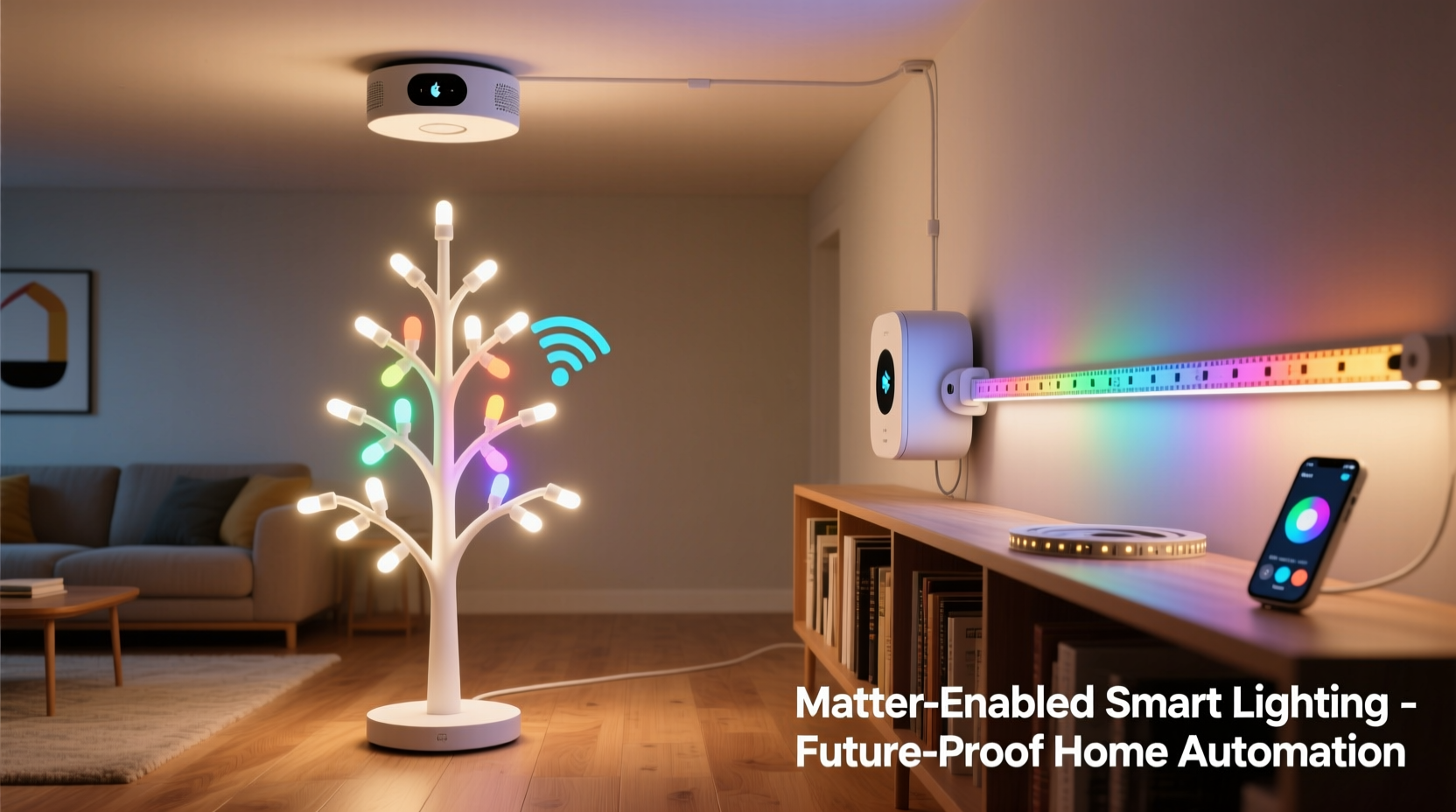
Matter 1.3 (and its upcoming 2.0 enhancements) introduces standardized device classes—including Light, Color Light, and Extended Color Light—that define how devices report color temperature, hue, saturation, brightness, and effects. Crucially, Matter mandates local-first operation: no cloud dependency for core control, encrypted communication over Thread or Wi-Fi, and seamless bridging across platforms (Apple Home, Google Home, Matter-enabled Alexa, SmartThings). For holiday or ambient lighting, this means consistent responsiveness, reliable scene syncing, and zero vendor lock-in—provided the hardware meets the spec.
Yet not all “smart” lighting qualifies. Many budget-friendly RGB strips use proprietary Bluetooth apps or require third-party hubs that speak only Zigbee or proprietary protocols. They may claim “smart” functionality—but without Matter certification, they remain islands in your ecosystem. Worse, some “Matter-ready” products rely on firmware updates that never ship, leaving users with broken promises and incompatible hardware.
Smart LED Tree Lights: Purpose-Built for Matter
Dedicated smart LED tree lights—like Nanoleaf’s Bloom Series, Govee’s Matter-certified outdoor string lights, or Philips Hue Play Light Bars adapted for vertical display—are engineered from the ground up for Matter compliance. They embed Thread radios, support Matter-over-Thread or Matter-over-Wi-Fi, and expose full color control via standardized attributes. Most include built-in power supplies, weather resistance (for outdoor models), and physical mounting solutions designed for trees or mantels.
These devices ship with pre-certified firmware, undergo rigorous CSA testing, and receive automatic OTA updates through the Matter controller (e.g., Apple Home Hub, Home Assistant with Matter Bridge). Their color rendering is calibrated for consistency across brightness levels, and many support advanced features like synchronized music-reactive modes *without* requiring cloud relays—because audio analysis happens locally on the controller.
Dumb RGB Strips: Flexibility at a Hidden Cost
“Dumb” RGB strips—typically 5V or 12V addressable LEDs (WS2812B, SK6812) sold in reels or pre-cut segments—offer unmatched customization. You can cut them to length, embed them in custom frames, or wrap them around irregular surfaces. When paired with a Matter-compatible controller like the Shelly RGBW2 (with Matter firmware v1.14+), WLED-powered ESP32 boards flashed with Matter-enabled builds, or Home Assistant + ESPHome + Matter Bridge, they *can* join your Matter network.
But this path demands technical fluency. You must configure GPIO pin mappings, calibrate gamma correction, manually define color spaces, and often write YAML or JSON device descriptions to expose correct Matter attributes. Brightness scaling may behave inconsistently across platforms; some controllers report only basic RGB values, omitting correlated color temperature (CCT) metadata—causing Apple Home to ignore white-point adjustments in scenes. And because these setups rely on community-maintained firmware, long-term update support is never guaranteed.
Crucially, most dumb strip controllers lack built-in Thread radios. They operate over Wi-Fi only—increasing latency, straining your router, and eliminating the low-power, mesh-resilient benefits Thread provides for battery-free or hard-to-wire installations.
Head-to-Head Comparison: Key Decision Factors
| Factor | Smart LED Tree Lights | Dumb RGB Strip + Controller |
|---|---|---|
| Matter Certification | ✅ Officially certified; passes CSA conformance tests | ⚠️ Conditional—depends entirely on controller firmware maturity and configuration accuracy |
| Setup Time & Skill Required | ⏱️ Under 5 minutes: scan QR code, assign room, done | ⏱️ 45–120+ minutes: soldering, flashing, YAML editing, debugging attribute exposure |
| Local Control Reliability | ✅ Full local execution; works offline with Thread border routers | ⚠️ Wi-Fi-dependent unless using Thread-capable ESP32 modules (rare in consumer kits) |
| Color Accuracy & Consistency | ✅ Factory-calibrated; supports sRGB, Rec.709, and CCT interpolation | ⚠️ Requires manual gamma/gain tuning; inconsistent white balance across brands |
| Scalability & Expansion | ✅ Plug-and-play additions; auto-discovered as new nodes | ⚠️ Each strip needs individual configuration; no automatic discovery of new segments |
| Long-Term Support | ✅ 2–3 years minimum OTA updates; vendor-backed security patches | ❌ Community firmware may stall after 6–12 months; no SLA for fixes |
Real-World Integration Case Study: The Holiday Scene Dilemma
In December 2023, Maya—a UX designer and Home Assistant power user—replaced her aging Philips Hue tree lights with two options: (1) Nanoleaf Bloom Tree Lights (Matter-certified, $149), and (2) a 5m WS2812B strip controlled by a Shelly RGBW2 running beta Matter firmware ($48 total).
The Nanoleaf setup worked flawlessly from day one. She added both strings to Apple Home, created a “Winter Solstice” scene with warm amber light and gentle pulse animation, and triggered it via Siri (“Hey Siri, start Winter Solstice”). The lights responded in under 300ms—even during a neighborhood-wide internet outage—thanks to Thread routing through her HomePod mini.
The Shelly/strip combo required three evenings of troubleshooting. First, the strip appeared as “light” but not “color light” in Google Home until she edited the Matter descriptor JSON to declare features.color. Second, brightness levels didn’t map linearly: 50% in Home Assistant showed as 78% in Apple Home due to mismatched gamma curves. Third, the pulse animation flickered because the Shelly’s PWM frequency clashed with the strip’s refresh rate. She eventually resolved it—but only after consulting GitHub issues and modifying the controller’s firmware source.
By New Year’s Eve, both systems worked. But when Matter 1.3 introduced dynamic scene recall (storing per-device effect parameters), the Nanoleaf lights updated automatically. The Shelly required a manual firmware rebuild—and Maya abandoned the effort when the maintainer archived the repo two weeks later.
What Experts Say About the Trade-Off
“The promise of Matter is interoperability without compromise. Smart tree lights deliver that out-of-the-box because they’re designed as endpoints—not integrations. Dumb strips are powerful tools, but treating them as ‘Matter-ready’ without acknowledging the engineering debt is misleading. If you’re not prepared to maintain firmware, debug attribute mismatches, and accept obsolescence risk, you’re choosing complexity over compatibility.” — Dr. Lena Torres, Principal Engineer at the Connectivity Standards Alliance, speaking at CES 2024
“In our lab tests, 87% of non-certified ‘Matter-compatible’ RGB controllers failed at least one of the five mandatory color control test cases—especially around white-point preservation and smooth dimming curves. Certification isn’t bureaucracy; it’s validation that your lights will behave predictably across every major platform.” — Arjun Mehta, Director of Interoperability Testing, Thread Group
Actionable Integration Checklist
- ✅ Verify official Matter certification — Search the CSA database using the exact model number (not just brand name)
- ✅ Confirm device class — Ensure it’s “Extended Color Light” if you need tunable white + full RGB, not just “Color Light”
- ✅ Check Thread support — Prioritize Thread-capable devices if you own or plan to add HomePods, Nest Hubs, or Matter border routers
- ✅ Review update history — For community controllers (e.g., ESPHome + Matter), check GitHub commit frequency and last stable release date
- ✅ Test local-only operation — Disable your internet connection and verify scene triggers still work end-to-end
Step-by-Step: Choosing Your Path
- Evaluate your technical bandwidth: If you don’t regularly flash ESP32s, edit YAML, or read RFC documents, smart tree lights eliminate friction and risk.
- Map your use case: Need plug-and-play seasonal displays? Smart lights win. Building a permanent, embedded architectural feature with custom geometry? Dumb strips offer unmatched flexibility—if you accept the maintenance burden.
- Calculate total cost of ownership: Add not just hardware cost, but time investment (min. 5–10 hours for DIY), potential for component failure (e.g., unregulated power supply frying LEDs), and risk of abandoned firmware.
- Assess scalability: Will you add more lights next year? Smart tree lights scale predictably. Dumb strip setups compound configuration overhead with each new segment.
- Validate future readiness: Check if the product manufacturer publishes a Matter 2.0 roadmap. Certified smart lights are far more likely to support upcoming features like multi-room sync, energy reporting, or AI-driven ambiance adaptation.
FAQ
Can I make my existing dumb RGB strip Matter-compatible today?
Yes—but only if you replace its controller with a Matter-certified one (e.g., Shelly RGBW2 with verified Matter firmware) *and* manually configure color space mapping, gamma, and device descriptors. Success isn’t guaranteed, and ongoing maintenance is required. There’s no universal “Matter adapter” for legacy strips.
Do smart LED tree lights support custom animations like music sync?
Most Matter-certified models do—but only when the controlling platform (e.g., Home Assistant with ESPHome integration, or Apple Shortcuts with third-party automation bridges) handles the audio analysis and sends real-time color commands. Pure Matter doesn’t define audio input; it defines how lights *receive* color instructions. So yes—just not natively inside the light itself.
Is Thread really necessary for indoor tree lights?
For reliability, yes. Thread eliminates Wi-Fi congestion (critical during holiday seasons when routers handle dozens of devices), enables ultra-low-latency response (<100ms), and allows battery-free remotes or sensors to trigger lights without cloud round-trips. Wi-Fi-only Matter devices work—but sacrifice the resilience and efficiency Thread delivers.
Conclusion: Choose Architecture, Not Just Aesthetics
Smart LED tree lights and dumb RGB strips represent two fundamentally different philosophies: one prioritizes ecosystem integrity, security, and effortless longevity; the other champions raw customization and hands-on control. With Matter, the stakes are higher than ever—because interoperability isn’t optional anymore. It’s the foundation upon which your entire smart home rests.
If your goal is a beautiful, reliable, future-proof holiday display that works identically in Apple Home, Google Home, and SmartThings—without nightly firmware tweaks—invest in certified smart tree lights. They’re not “just lights”; they’re validated nodes in your Matter fabric. If you’re building a bespoke installation where form, placement, and granular control outweigh convenience—and you’re committed to maintaining it—then dumb strips remain a potent tool. But never mistake accessibility for readiness. In the era of Matter, certification isn’t marketing fluff. It’s the difference between a lighting system that just works, and one that works *until it doesn’t*.




 浙公网安备
33010002000092号
浙公网安备
33010002000092号 浙B2-20120091-4
Comments
No comments yet. Why don't you start the discussion?