
In modern homes and workplaces, lighting plays a crucial role not only in visibility but also in mood regulation, productivity, and long-term well-being. Yet many people still rely on outdated methods—like fixed-time switches or manually turning lights on and off. As technology evolves, so do the options for intelligent lighting control. One of the most impactful advancements is the shift from static timers to dynamic, data-driven systems. This article explores the fundamental differences between a smart light scheduler that adapts to local sunset times and a traditional manual timer that operates independently of natural daylight cycles.
The contrast isn't just technical—it affects sleep quality, energy consumption, convenience, and even mental health. By understanding how each system works, you can make an informed decision about which approach best suits your lifestyle and environment.
How Lighting Impacts Daily Life
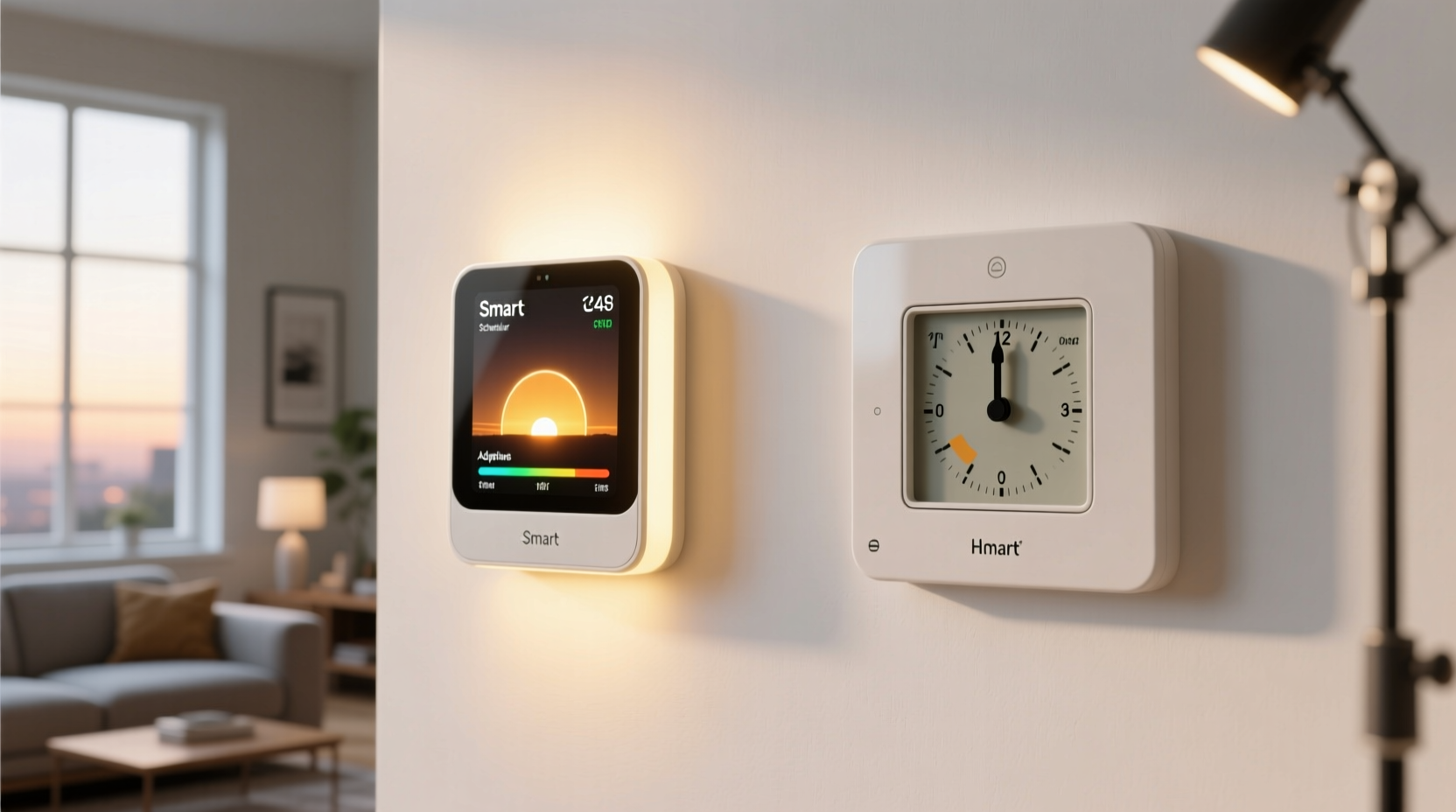
Lighting does more than illuminate spaces—it influences biological rhythms. The human body follows a circadian rhythm regulated largely by exposure to light and darkness. Morning light suppresses melatonin and promotes alertness, while dimmer evening lighting signals the brain to prepare for rest. Disruptions to this cycle, such as being exposed to bright artificial light late at night, can lead to insomnia, fatigue, and reduced cognitive performance.
Traditional lighting setups often ignore these biological cues. A lamp set to turn on at 6:00 PM every day may be appropriate in December when it's already dark outside, but in June, that same timing could mean flipping on bright overheads during golden hour—wasting energy and disrupting natural wind-down processes.
“Consistent alignment between indoor lighting and outdoor daylight patterns supports better sleep, improved focus, and lower stress.” — Dr. Lena Patel, Chronobiology Researcher, Stanford University
This misalignment is where smart lighting systems begin to outperform their manual counterparts. By integrating real-time geolocation and astronomical data, they adjust automatically to seasonal changes in sunrise and sunset—ensuring that your home’s lighting feels intuitive rather than arbitrary.
Manual Timers: Simplicity with Limitations
Manual timers have been around for decades. They’re inexpensive, easy to install, and require no internet connection. You program them once—say, “turn lights on at 6:00 PM, off at 11:00 PM”—and they repeat that schedule daily. For basic security applications (e.g., simulating occupancy while away), they work adequately.
However, their rigidity becomes a liability over time. Consider someone living in Seattle, where sunset varies from around 4:30 PM in December to nearly 9:00 PM in June. A fixed 6:00 PM lighting schedule means:
- Bright lights activating two hours after dark in winter—potentially leaving rooms unlit during early evening activities.
- Lights turning on three hours before sunset in summer—creating unnecessary glare and electricity use.
Over the course of a year, this inefficiency adds up. Not only in wasted kilowatt-hours, but also in diminished user experience. Residents must either reprogram timers seasonally (which most forget to do) or live with suboptimal lighting conditions.
Smart Light Schedulers: Adaptive Intelligence
A smart light scheduler leverages APIs that provide precise daily sunrise and sunset times based on your exact geographic location. These systems don’t just follow a calendar—they respond dynamically. When paired with dimmable LEDs and automation platforms like Apple HomeKit, Google Home, or Hubitat, they can:
- Gradually increase brightness in the morning as dawn approaches.
- Dim lights shortly after sunset to support melatonin production.
- Adjust weekend schedules differently from weekdays.
- Respond to unexpected events (e.g., power outages) by recalculating the next trigger point.
Some advanced implementations even incorporate twilight phases—civil, nautical, and astronomical dusk—to fine-tune ambiance transitions. For instance, landscape lighting might activate at civil twilight (~30 minutes after sunset), while bedroom lamps dim earlier to encourage relaxation.
These systems typically use Wi-Fi-connected hubs or cloud services to fetch updated solar data nightly. No user intervention is needed; the lights adapt seamlessly across seasons.
Real-World Example: The Johnson Family Home
The Johnsons installed Philips Hue lights throughout their house in early 2022. Initially, they used manual timers: living room lights on at 6:00 PM, bedrooms at 7:30 PM. By spring, family members complained of headaches from harsh lighting during extended daylight hours. Their teenage daughter struggled to fall asleep despite going to bed at 10:00 PM—her room lit brightly until then.
After switching to a smart routine powered by sunset tracking via Home Assistant, the changes were immediate. Lights now turn on 20 minutes after sunset, starting at low brightness (30%) and increasing gradually if activity is detected. Bedroom lighting fades to 10% by 9:00 PM unless overridden. Since the change, all three children report falling asleep faster, and monthly energy bills dropped by 14% due to reduced runtime.
Comparative Analysis: Key Differences
| Feature | Manual Timer | Smart Scheduler (Sunset-Based) |
|---|---|---|
| Sets On/Off Times | Fixed time (e.g., 6:00 PM) | Dynamic (e.g., 15 min after sunset) |
| Seasonal Adjustment | None – requires manual update | Automatic – updates daily |
| Energy Efficiency | Moderate – often runs unnecessarily | High – aligns with actual need |
| Circadian Support | Poor – may conflict with natural rhythm | Strong – mimics natural light progression |
| User Maintenance | Required quarterly | Nearly zero |
| Initial Setup Complexity | Low | Moderate (requires app setup) |
| Cost | $5–$15 per unit | $50+ (bulbs + hub/app) |
While upfront costs favor manual timers, long-term value tilts strongly toward smart systems. Energy savings, health benefits, and convenience compound over time, often offsetting initial investment within 12–18 months in households with multiple controlled zones.
Step-by-Step Guide to Implementing a Sunset-Based Lighting Schedule
Transitioning from fixed timers to adaptive lighting doesn’t require advanced technical skills. Follow this practical guide:
- Determine Your Goals: Decide whether you want ambient lighting, task lighting, or security-focused automation. Prioritize areas like living rooms, hallways, or bedrooms.
- Choose Compatible Hardware: Select smart bulbs or switches that support scheduling and integration with automation platforms (e.g., LIFX, Nanoleaf, or TP-Link Kasa).
- Select an Automation Platform: Use Apple Shortcuts (iOS), Google Home Routines, IFTTT, or open-source tools like Home Assistant for greater flexibility.
- Enable Location Services: Ensure your device or hub has accurate GPS coordinates enabled to calculate local sunrise/sunset times.
- Create Dynamic Triggers: In your app, set triggers like “At sunset + 10 minutes” instead of “At 6:00 PM.” Adjust brightness levels accordingly (e.g., 40% at onset, 80% during peak usage).
- Add Exceptions: Program overrides for vacations, movie nights, or guest visits to maintain usability.
- Test and Refine: Observe lighting behavior over one week. Tweak offsets (e.g., switch from “sunset + 15 min” to “civil twilight”) for optimal results.
Checklist: Upgrading to Adaptive Lighting
- ☐ Audit current lighting usage and identify high-impact zones
- ☐ Replace key fixtures with dimmable smart bulbs or switches
- ☐ Install and configure a central automation platform
- ☐ Grant location access and verify timezone accuracy
- ☐ Set rules based on sunset/sunrise with buffer periods
- ☐ Test system across different seasons or simulate date changes
- ☐ Educate household members on override procedures
- ☐ Monitor energy usage before and after implementation
Frequently Asked Questions
Can smart lighting systems work without internet?
Most require internet access to fetch updated sunset data and sync schedules. However, some local-processing platforms like Home Assistant or Thread-based Matter devices can operate offline after initial configuration, using cached or pre-fetched astronomical tables.
Do I need a hub for sunset-based scheduling?
Not always. Many standalone smart bulbs (e.g., Wyze Bulb, LIFX Mini) connect directly to Wi-Fi and support sunrise/sunset triggers through their mobile apps. Hubs become necessary only when integrating with broader ecosystems like Zigbee sensors or legacy systems.
Will this work near the poles where daylight varies drastically?
Yes—but with caveats. In regions above the Arctic Circle, there are periods of continuous daylight or darkness. Advanced systems handle these edge cases by defaulting to maximum or minimum thresholds (e.g., never exceed 50% brightness during polar day). Users should customize fade durations and intensity limits based on personal tolerance.
Why the Shift Matters Beyond Convenience
The move from rigid timers to context-aware lighting reflects a larger trend: technology becoming less intrusive and more attuned to human needs. Fixed schedules treat time as uniform, ignoring environmental context. Smart systems recognize that human behavior is fluid—shaped by weather, season, geography, and biology.
Moreover, widespread adoption of adaptive lighting contributes to collective energy conservation. According to the U.S. Department of Energy, residential outdoor lighting alone consumes over 100 billion kWh annually. A nationwide shift to sunset-synced controls could reduce that figure by 15–20%, equivalent to removing several coal-fired power plants from the grid.
On a personal level, residents report higher satisfaction with homes that \"feel responsive.\" There's psychological comfort in environments that mirror nature’s rhythms—softening when the sky darkens, brightening as morning breaks. It creates a sense of harmony that mechanical timers simply cannot replicate.
Conclusion: Embrace Lighting That Thinks With You
The choice between a smart light scheduler and a manual timer is ultimately about intentionality. Do you want lighting that merely functions, or one that enhances well-being, efficiency, and peace of mind? While manual timers served us well in the past, today’s technology offers a smarter path forward—one that respects both natural cycles and modern lifestyles.
Implementing a sunset-based lighting system isn’t just a tech upgrade—it’s a step toward living in sync with the world around you. Whether you start with a single porch light or redesign your entire home’s ambiance, the impact will be felt immediately in comfort, clarity, and calm.




 浙公网安备
33010002000092号
浙公网安备
33010002000092号 浙B2-20120091-4
Comments
No comments yet. Why don't you start the discussion?