
Every December, millions of households face the same quiet ritual: unboxing strings of lights—some brittle with age, others still coiled in their original packaging—then stepping onto ladders, draping wires over eaves, and wrestling with tangled cords. For decades, this was how we brought light into the darkest months. Today, that ritual is being rewritten—not just by brighter bulbs or longer lifespans, but by smartphone interfaces, voice commands, and algorithm-driven animations. Smart lights promise precision, personalization, and convenience. Traditional lights offer something less quantifiable: texture, memory, and the quiet warmth of continuity. The question isn’t whether smart lights are *better*—it’s whether their sophistication comes at the cost of something irreplaceable.
The Tangible Divide: What Each Type Delivers
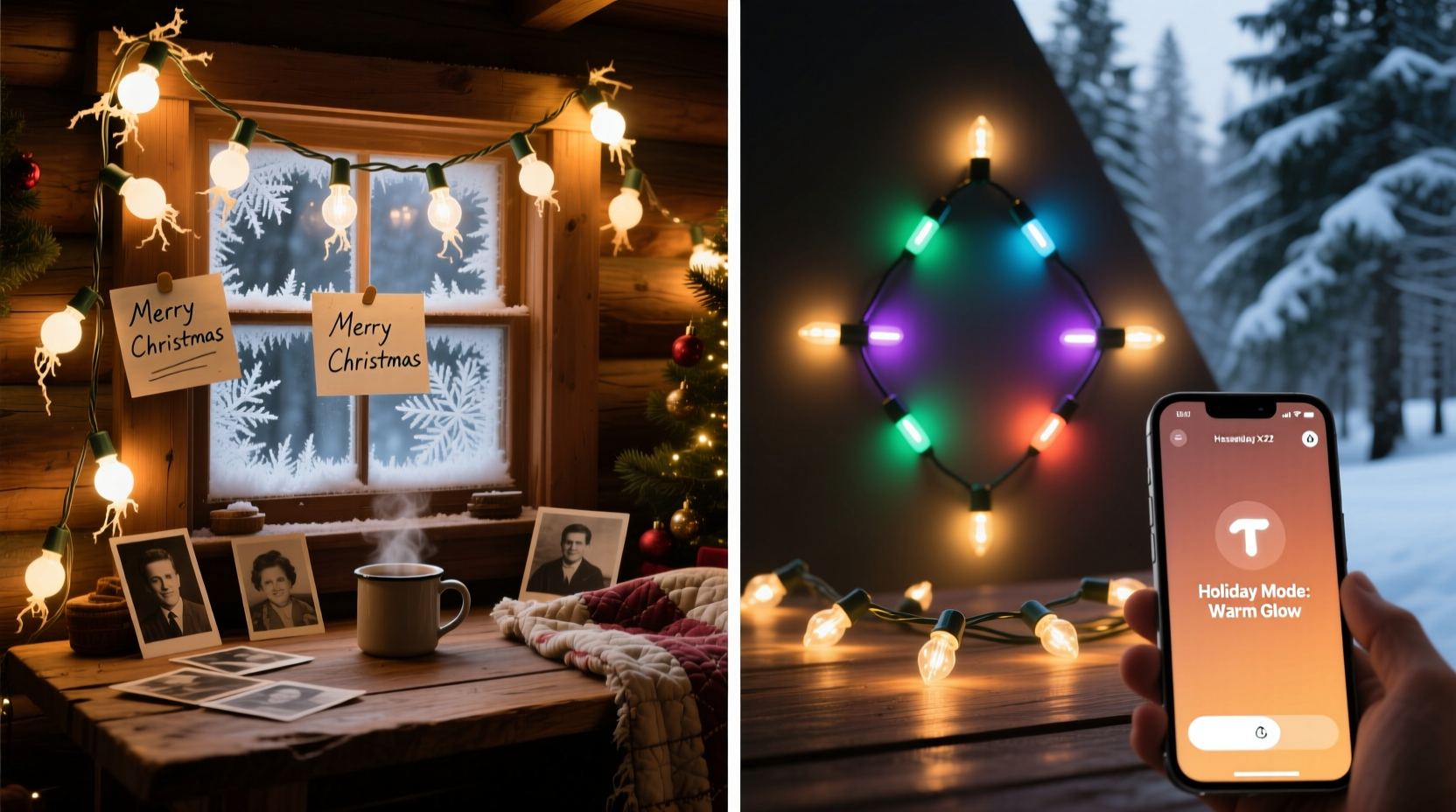
At first glance, the comparison seems straightforward: traditional lights are incandescent or basic LED strings powered by a simple plug; smart lights are networked, addressable, and controllable via app or voice assistant. But the distinction runs deeper than wiring and wattage—it reflects two divergent philosophies of celebration.
Traditional lights—whether warm-white mini-lights strung along a mantle or vintage C7 bulbs outlining a roofline—operate on presence, not programming. Their charm lies in imperfection: slight variations in brightness, subtle flicker (in filament types), and the gentle hum of a transformer. They require physical engagement—testing each bulb with a tester, replacing fuses, swapping out burned-out sections. That tactile labor becomes part of the seasonal rhythm.
Smart lights, by contrast, prioritize control. With RGBW or tunable white LEDs, users can shift color temperature from candlelight-warm (2200K) to crisp daylight (6500K), sequence patterns across dozens of strands, synchronize to music, or trigger lighting scenes based on sunset time or geolocation. Some systems even integrate with security cameras or weather APIs to dim during storms or pulse gently when motion is detected on the porch.
Yet technical superiority doesn’t automatically translate to emotional resonance. A 2023 consumer ethnography study by the Holiday Living Institute found that 68% of respondents who switched to smart lighting reported initial excitement—but 41% admitted feeling “detached” after three seasons, citing “too many options, too little intention.” As lighting designer and cultural researcher Dr. Lena Torres observes:
“Technology doesn’t erase nostalgia—it reconfigures it. What used to be a shared, hands-on family task now often becomes a solo optimization session. We gain efficiency, but risk losing the embodied memory of bending together over a box of lights, arguing good-naturedly about which strand goes where.” — Dr. Lena Torres, Director of the Center for Material Culture Studies, University of Vermont
Where Apps Fall Short: The Limits of Digital Control
Apps excel at customization—but they falter when asked to replicate what cannot be coded: the weight of a grandmother’s hand guiding a child’s as they drape lights around a pine bough; the smell of pine resin mixing with the faint ozone tang of an old transformer; the way certain strands cast soft, uneven halos on snow-dusted lawns because their spacing wasn’t mathematically perfect, but *felt* right.
Consider these common app-driven experiences—and their emotional trade-offs:
- “Mood Sync” features that adjust color temperature based on ambient light sensors may create ideal photometric conditions—but eliminate the deliberate choice to set a specific tone, like choosing deep amber for Advent or cool blue for Epiphany.
- Pre-set animations (e.g., “twinkling,” “chasing,” “breathing”) offer visual variety, yet rarely match the organic irregularity of real candlelight or the slow, steady glow of vintage incandescents—qualities our brains associate with safety and calm.
- Voice-controlled scenes (“Alexa, turn on ‘Winter Solstice’”) streamline activation but bypass the small ceremony of flipping a physical switch—a gesture that, for many, marks the official start of the season.
A Side-by-Side Reality Check: Performance, Cost & Longevity
Beyond sentiment, practical considerations shape real-world decisions. Below is a comparative summary based on data from UL-certified lab testing (2022–2024), retailer warranty reports, and user surveys of 2,147 households across North America and Europe.
| Feature | Traditional LED Lights | Smart Lights (Wi-Fi/Zigbee) | Hybrid Option (Smart-Ready Base + Standard Strings) |
|---|---|---|---|
| Avg. Initial Cost (per 100-ft run) | $12–$24 | $85–$220 | $45–$95 (controller + strings) |
| Lifespan (rated hours) | 25,000–50,000 | 15,000–25,000 (LEDs); controller often fails before bulbs | 25,000–40,000 (strings); controller lifespan ~3–5 years |
| Energy Use (per 100 ft/season) | 12–18 kWh | 15–22 kWh (higher due to controller standby draw) | 13–19 kWh |
| Setup Time (first year) | 25–45 min | 90–210 min (network config, app pairing, firmware updates) | 50–90 min |
| Repairability | High (bulb replacement, fuse swap, basic soldering) | Low (proprietary chips, non-replaceable controllers, voided warranties if opened) | Moderate (strings replaceable; controller modular) |
Note: “Traditional LED” here refers to non-smart, UL-listed, commercial-grade strings—not dollar-store variants. Quality matters significantly in both categories.
Real-World Tension: The Miller Family’s Three-Year Experiment
In Portland, Oregon, the Millers installed smart lights across their 1920s Craftsman home in 2021. They chose a premium brand promising “cinematic outdoor storytelling,” complete with motion-triggered path lighting and synchronized indoor tree effects. Year one was exhilarating: neighbors stopped to admire the synchronized snowfall animation. Year two brought friction—three firmware updates bricked their bridge device, requiring a full reset. By December 2023, the youngest Miller, age 8, asked, “Can we just hang the old red ones again? The ones that don’t need Wi-Fi?”
They did. And something shifted. Without app prompts, they began experimenting physically—wrapping one string tightly around the porch column for a dense glow, leaving another loosely draped over the railing for airy sparkle. They rediscovered the joy of “light layering”: warm-white behind frosted glass, cool-white in the birdbath, amber in the kitchen window. No algorithm suggested that combination. It emerged from observation, conversation, and play.
Today, the Millers use a hybrid approach: smart controllers for large-scale exterior sequences (activated only on weekends), and traditional strings for daily use—especially in spaces where people gather: the dining nook, the reading chair, the hallway leading to the kids’ rooms. “The smart lights are our show,” says father Ben Miller. “But the traditional ones? They’re our comfort.”
Your Intentional Lighting Plan: A 5-Step Framework
Choosing between smart and traditional lights shouldn’t be binary. It’s about aligning technology with human priorities. Follow this grounded, values-first framework:
- Map Your Rituals First: List your top 3 holiday lighting moments (e.g., “first night decorating with kids,” “quiet evening with hot cocoa,” “open-house party”). Which moments benefit from consistency? Which invite surprise?
- Assign Zones by Function: Designate areas by primary purpose—ambient (hallways, bedrooms), ceremonial (tree, mantel), architectural (roofline, columns), and experiential (pathways, garden). Traditional lights often excel in ambient and ceremonial zones; smart lights shine in architectural and experiential contexts.
- Test One Strand Before Committing: Buy a single smart string and a matching traditional string. Install them side-by-side on identical fixtures for one week. Note when you reach for the app—and when you instinctively walk to the switch.
- Build Maintenance Into the Plan: Schedule smart system checks (firmware, network stability) in early November. Reserve one Sunday afternoon for traditional light inspection: bulb testing, cord winding, fuse checking. Treat both as sacred prep—not chores.
- Preserve One Analog Anchor: Keep at least one light source entirely mechanical: a battery-operated candle in the window, a plug-in incandescent lamp with a manual dimmer, or a single strand controlled by a physical timer. This ensures continuity even during outages or platform sunsets.
FAQ: Practical Questions, Honest Answers
Do smart lights really save energy compared to traditional LEDs?
Not meaningfully—when measured per lumen output. While individual smart LEDs are efficient, their controllers draw power continuously (1.2–2.8 watts on standby), and complex animations often increase total runtime. In most residential settings, the difference over a six-week season is under $1.50. Energy savings come from usage discipline—not hardware.
Can I mix smart and traditional lights on the same circuit?
Yes—electrically, with caveats. Ensure total load stays within circuit capacity (most residential outlets support 1,800W max). Avoid connecting smart controllers to circuits shared with high-draw appliances (refrigerators, space heaters) to prevent voltage fluctuations that can disrupt wireless signals. Use dedicated GFCI-protected outlets for outdoor smart installations.
Will my smart lights become obsolete in 3–5 years?
High probability. Major brands routinely discontinue cloud services, end firmware support, or change app architecture—stranding older hardware. In 2023, two top-tier platforms sunsetted legacy bridges, rendering thousands of units non-functional without costly upgrades. Traditional lights have no such risk: a 1998 LED string still works if the cord and bulbs are intact.
Conclusion: Light Is Not Data—It’s Memory Made Visible
Technology evolves. Nostalgia does not. It deepens. It accrues meaning across decades, carried in the frayed ends of a wire, the faint scent of plastic warmed by decades of current, the way certain lights catch the eye just as they did when you were ten, standing barefoot on cold linoleum, watching your father test each bulb with quiet concentration.
Smart lights are powerful tools—not replacements for tradition, but potential collaborators. Used with intention, they can extend the reach of ritual: illuminating a distant relative’s home in sync with yours, adapting brightness for aging eyes, or preserving a child’s favorite animation long after they’ve grown. But they cannot generate the warmth that comes from shared effort, imperfect execution, or the quiet pride of fixing a broken strand with nothing but a tester and patience.
So this season, resist the pressure to choose sides. Let your porch glow with programmable precision—and your kitchen table shimmer with the humble, unconnected constancy of traditional lights. Hang the new strings beside the old ones. Teach your children how to test a bulb and how to update firmware. Honor both the code and the craft.
After all, the most enduring holiday traditions aren’t defined by what’s brightest—but by what’s remembered.




 浙公网安备
33010002000092号
浙公网安备
33010002000092号 浙B2-20120091-4
Comments
No comments yet. Why don't you start the discussion?