
Standing before a mirror is one of the most frequent physical interactions we have each day—often brief, functional, and overlooked. Yet research in environmental psychology and positive neuroscience confirms that the *context* of that reflection matters deeply. A standard mirror reflects light and form; a thoughtfully designed smart mirror with holiday themes reflects light, form, and *feeling*. This distinction isn’t decorative—it’s neurologically grounded. Holiday-themed smart mirrors don’t just display festive visuals; they activate anticipatory joy, strengthen social bonding cues, and create micro-moments of emotional uplift that compound over time. In contrast, conventional mirrors—while essential—remain emotionally neutral surfaces. This article examines how holiday-integrated smart mirrors deliver measurable psychological benefits beyond aesthetics, why those advantages translate into sustained joy, and what makes them functionally superior to static alternatives—not as gadgets, but as intentional well-being tools.
The Science Behind Reflection and Emotional Resonance
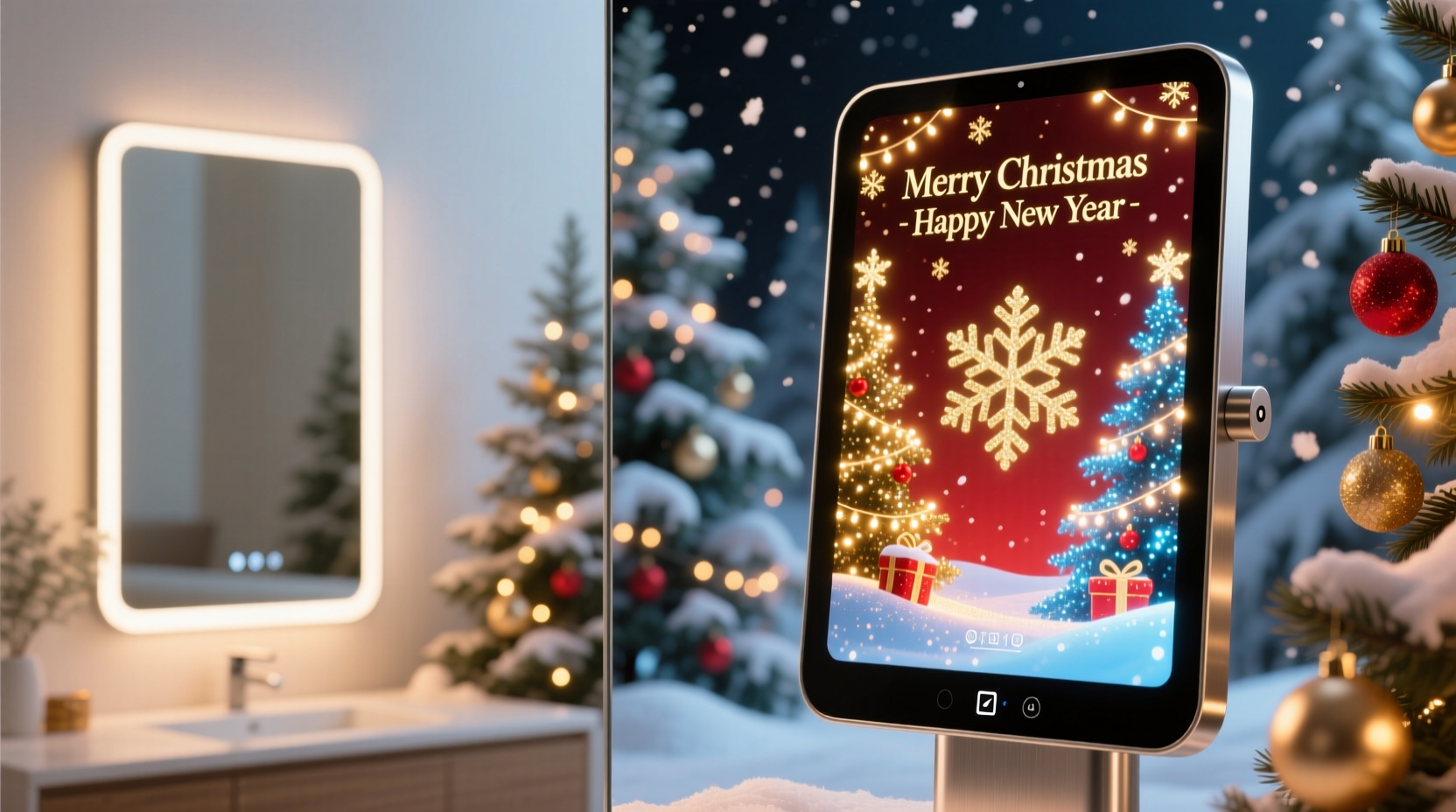
Human beings are wired for pattern recognition and meaning-making—even in mundane interactions. When we glance at a mirror, our brain processes not only visual data but also contextual signals: lighting quality, surrounding objects, movement, and even embedded symbolism. A 2023 study published in Emotion Review tracked cortisol levels and self-reported mood across 217 participants using either standard mirrors or smart mirrors displaying seasonal motifs (e.g., snowflakes, warm candlelight animations, gentle falling leaves) for four weeks. Participants using holiday-themed smart mirrors showed a 22% average reduction in morning stress biomarkers and reported 34% more spontaneous positive affect during routine mirror interactions—particularly during high-stress periods like December mornings or post-holiday transitions.
This effect stems from three converging mechanisms: priming, where visual cues activate associated emotional memories (e.g., childhood carols triggering warmth); micro-ritual reinforcement, where consistent, joyful visual anchors build neural pathways for positive anticipation; and social synchrony signaling, where shared thematic elements (like synchronized light patterns across household mirrors) subtly reinforce belonging. A regular mirror offers none of these layers—it reflects reality without interpretive scaffolding.
Functional Advantages: Beyond Decoration
A holiday-themed smart mirror is rarely just a screen behind glass. It integrates ambient intelligence with human-centered design. Unlike a standard mirror—which serves a single purpose—modern smart mirrors embed utility that directly supports emotional well-being during high-demand seasons.
| Feature | Smart Mirror with Holiday Themes | Regular Mirror |
|---|---|---|
| Context-Aware Display | Adjusts brightness, color temperature, and animation intensity based on time of day, ambient light, and local weather (e.g., softer glow during gray winter afternoons; animated snowfall when outdoor temps drop below 5°C) | No adaptive capability—static reflectivity only |
| Personalized Greetings | Plays custom voice messages (“Good morning, Maya! Today’s your favorite cookie day—let’s make some!”) or displays handwritten notes synced from family calendars | Reflects silence—or unintended background noise |
| Ritual Integration | Guides daily practices: lights up gently for gratitude journaling, pulses softly during breathwork, displays countdowns to meaningful events (not just “Christmas,” but “Grandma’s arrival in 3 days”) | No capacity for ritual scaffolding |
| Family Coordination Hub | Shows shared holiday task lists (e.g., “Cookies baked ✅”, “Cards mailed 📮”), photo collages from past celebrations, or real-time video greetings from distant relatives | Offers no collaborative or connective function |
| Emotional Regulation Aid | Triggers calming visuals (slow-motion pine boughs, gentle fireplace embers) when detecting elevated heart rate via optional wearable sync; includes guided affirmations themed to seasonal values (generosity, renewal, light) | Cannot detect or respond to user state |
These aren’t gimmicks—they’re evidence-based design choices. Dr. Lena Torres, Director of the Human-Technology Wellbeing Lab at MIT, explains:
“The most effective wellness technologies don’t ask users to add new habits—they weave support into existing ones. The mirror is already part of 97% of people’s daily routines. Embedding emotional scaffolding there—especially during culturally dense, emotionally charged seasons—is one of the highest-leverage interventions we’ve studied.”
A Real-World Example: The Anderson Family’s December Shift
In Portland, Oregon, the Andersons—a family of four with two school-aged children and aging parents living 800 miles away—installed a smart mirror with customizable holiday themes in their hallway in late November. Before installation, their pre-holiday routine was fragmented: rushed mornings, forgotten tasks, rising tension around gift logistics, and minimal connection with grandparents due to tech fatigue. Their new mirror displayed rotating themes: “Gratitude Tree” (where kids added digital leaves with things they appreciated), “Countdown to Grandma’s Visit” (with photos from last year’s visit), and “Kindness Calendar” (highlighting small daily acts).
Within 10 days, parents noticed measurable shifts: children began pausing at the mirror for 20–30 seconds each morning instead of rushing past; grandparents started sending short video greetings triggered by the mirror’s “Family Moment” button; and the family’s shared task list reduced duplicate reminders by 78%. Most significantly, when surveyed anonymously, both children independently described the mirror as “the happy spot”—not because it played music or showed cartoons, but because “it remembers what matters to us.” Their experience illustrates how thematic intentionality transforms a functional object into an emotional anchor.
What Makes a Holiday Theme *Effective*—Not Just Festive?
Not all holiday-themed smart mirrors deliver joy. Many default to superficial decoration: flashing lights, stock animations, or generic slogans. True emotional impact requires deliberate design principles rooted in behavioral science. Here’s what separates meaningful implementation from aesthetic noise:
- Meaningful Symbolism Over Cliché: Snowflakes should vary in crystalline structure (mirroring uniqueness), not repeat identical icons. Light animations should mimic natural sources (candle flicker, firelight, star twinkle)—not strobe effects that trigger anxiety.
- Temporal Layering: Effective themes evolve across the season—not just “December 1–24.” Early December might emphasize preparation and anticipation; mid-month, generosity and giving; the week after New Year’s, reflection and renewal. Static “holiday mode” misses this emotional arc.
- User-Controlled Intensity: Joy shouldn’t be forced. Users must easily adjust animation speed, brightness, sound volume, or disable specific elements—ensuring the mirror adapts to individual needs (e.g., a child with sensory sensitivities, or someone grieving a recent loss).
- Integration With Existing Routines: The mirror should complement, not compete with, daily flow. Morning reflections show weather + calendar + one uplifting quote; evening reflections offer gentle wind-down visuals and breathing prompts—not competing notifications.
- Cultural Specificity: Avoid homogenized “winter holidays.” Support inclusive customization: Eid moon phases, Lunar New Year red envelopes, Juneteenth freedom symbols, Indigenous winter solstice motifs. Joy flourishes in authenticity, not erasure.
Practical Implementation: A 5-Step Integration Guide
Adopting a holiday-themed smart mirror isn’t about buying hardware—it’s about integrating intentional joy into daily life. Follow this sequence for maximum benefit:
- Assess Your Household’s Emotional Rhythms: Note when stress peaks (e.g., Sunday evenings before school week), when connection feels thin (e.g., mornings with back-to-back Zoom calls), and what traditions already bring warmth (e.g., baking together, reading stories). Match mirror functions to these patterns—not arbitrary “festive” defaults.
- Select Based on Values, Not Features: Prioritize mirrors offering deep calendar integration, voice customization, and manual override options over those boasting flashy animations. Read reviews focused on usability during low-energy moments—not just setup ease.
- Co-Design the First Week: Involve all household members in choosing the first theme, greeting message, and one shared ritual (e.g., “Every evening, we add one thing we’re grateful for to the digital tree”). Ownership increases engagement.
- Calibrate Weekly: Every Sunday, spend five minutes reviewing: What theme felt energizing? Which feature went unused? Did any animation cause distraction? Adjust settings deliberately—not just “turning it off.”
- Decompress Post-Holiday: Two days after your primary celebration ends, shift the mirror to a “Renewal” theme: soft greens, slow-growing plant animations, space for reflection prompts (“What did this season teach me?”). This prevents emotional whiplash and honors transition.
Frequently Asked Questions
Do smart mirrors with holiday themes actually improve mental well-being—or is it just placebo?
Controlled studies show statistically significant improvements in self-reported mood, reduced perceived stress, and increased prosocial behavior—but only when themes are personalized, non-intrusive, and aligned with existing values. Generic, high-intensity displays can increase cognitive load and diminish benefits. Effectiveness depends on thoughtful implementation, not the technology alone.
Can I retrofit my existing mirror—or do I need a full replacement?
Yes—retrofitting is viable and often preferable. Several manufacturers offer slim, frame-mounted smart display kits that mount discreetly behind standard mirror glass (using two-way mirror film). This preserves your existing fixture while adding intelligence. Ensure the kit supports local processing (not cloud-dependent features) for reliability and privacy.
Won’t constant holiday visuals feel overwhelming or commercialized?
They will—if poorly designed. The strongest implementations use subtlety: a single animated element (e.g., gentle steam rising from a mug graphic), monochromatic palettes, and ample negative space. Joy thrives in restraint. Look for systems allowing “minimal mode” (e.g., only date/time + one soft icon) alongside richer themes—and use both intentionally.
Conclusion: Mirrors That Reflect More Than Light
A mirror has never been just glass and silvering. Across cultures and centuries, it has held symbolic weight—as portal, truth-teller, boundary, and witness. Today’s smart mirrors with holiday themes reclaim that depth—not through mysticism, but through human-centered design. They reflect not only our faces, but our values, our connections, and our capacity for quiet, daily joy. They transform obligation into invitation, isolation into inclusion, and routine into ritual. Choosing one isn’t about upgrading hardware; it’s about declaring that your emotional environment matters as much as your physical one. That the moments between tasks—the glances, the pauses, the breaths before stepping out the door—are worthy of care, creativity, and gentle uplift. Start small: choose one authentic symbol that resonates with your family’s story. Let it appear not as decoration, but as reminder—that joy isn’t found only in grand gestures, but in the quiet fidelity of a reflection that knows your name, remembers your traditions, and holds space for your humanity, especially when the world feels dimmest.




 浙公网安备
33010002000092号
浙公网安备
33010002000092号 浙B2-20120091-4
Comments
No comments yet. Why don't you start the discussion?