
For decades, decorating with Christmas lights meant wrestling with tangled cords, climbing ladders at dusk to flip a switch, and remembering—often too late—to turn them off before bed. That ritual hasn’t just been inconvenient; it’s contributed to energy waste, fire risk from overheating, and seasonal stress that undermines the joy of the holidays. Enter the smart plug: a compact, Wi-Fi-enabled device that transforms any standard string of lights into an intelligent, responsive part of your home ecosystem. When paired with voice assistants like Alexa, Google Assistant, or Siri, it shifts control from physical effort to spoken command—“Alexa, turn on the porch lights”—and unlocks layers of automation previously reserved for high-end smart homes. This isn’t about novelty. It’s about reclaiming time, reducing risk, and restoring intentionality to a tradition that should feel magical—not mechanical.
Why Voice Control Changes Everything for Holiday Lighting
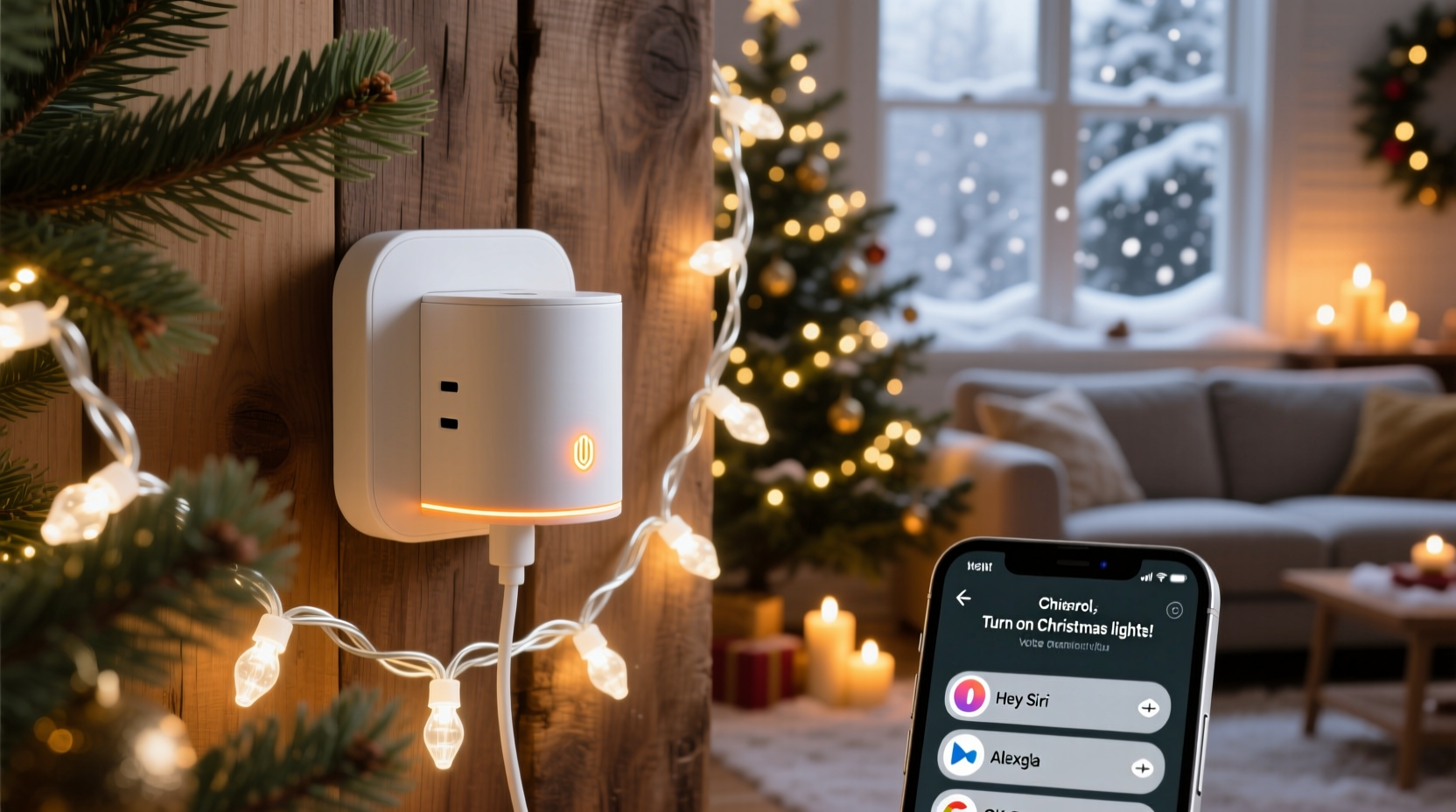
Voice control eliminates three persistent pain points inherent in traditional light management: accessibility, consistency, and context awareness. Older adults, parents carrying toddlers, or anyone with mobility limitations no longer need to navigate icy steps or reach behind furniture to access switches. Consistency improves because human memory falters—especially during busy December schedules—but a smart plug remembers and executes every scheduled action flawlessly. And context awareness means lights respond not just to commands, but to conditions: dimming when ambient light increases at dawn, brightening only when motion is detected on the driveway, or pausing entirely during a power surge. A 2023 Consumer Technology Association survey found that 68% of smart-home adopters cited “reducing daily decision fatigue” as their primary motivation—not flashy features, but mental relief. For holiday lighting, that translates directly into fewer forgotten switches, lower electricity bills, and one less thing to manage during an already demanding season.
How Smart Plugs Actually Work (Without the Jargon)
A smart plug sits between your light string’s power cord and the wall outlet. Internally, it contains a relay switch (the component that physically opens or closes the circuit), a Wi-Fi radio, a microcontroller, and firmware that interprets commands. When you say, “Hey Google, turn on the tree lights,” your voice is converted to text by Google’s cloud service, matched to your smart plug’s unique identifier, and sent via encrypted signal to your home router. The plug receives the instruction, activates its relay, and completes the electrical circuit—powering the lights. Crucially, this process happens in under half a second, feels instantaneous, and requires no manual intervention beyond initial setup.
The real intelligence lies in what happens *between* commands. Through companion apps (like Kasa, Wemo, or Smart Life), users define rules: “Turn on at sunset,” “Dim to 40% after 10 p.m.,” or “If temperature drops below -5°C, delay startup by 15 minutes to protect LED drivers.” These aren’t static timers—they’re adaptive routines responding to real-time environmental data. Unlike mechanical timers prone to daylight-saving errors or battery failure, smart plugs sync automatically with atomic clocks and weather APIs. They also report energy usage: one user in Portland tracked a 27% reduction in seasonal lighting consumption after switching to scheduled dimming and auto-off at midnight—a direct result of eliminating “I’ll turn them off later” delays.
Setting Up Your First Voice-Controlled Light System: A Step-by-Step Guide
- Verify compatibility: Confirm your smart plug supports your voice assistant (e.g., TP-Link Kasa works with Alexa, Google, and Siri via HomeKit; some brands like Wink require proprietary hubs).
- Install the app: Download the manufacturer’s official app (never third-party clones) and create a secure account with two-factor authentication enabled.
- Plug in and power on: Insert the smart plug into a grounded outdoor-rated outlet (if used outside) and connect your light string. Ensure the plug’s indicator LED is visible.
- Connect to Wi-Fi: Open the app, select “Add Device,” and follow prompts. Most plugs enter pairing mode by pressing the button for 5 seconds until the LED blinks rapidly. Enter your 2.4 GHz Wi-Fi password (note: most smart plugs do not support 5 GHz networks).
- Assign to voice assistant: In the Alexa/Google Home app, enable the plug’s skill or integration. Name the device descriptively—e.g., “Front Porch Lights,” not “Smart Plug 1.”
- Test and refine: Say, “Alexa, turn on Front Porch Lights.” If successful, add a routine: “At 4:30 p.m. every day, turn on Front Porch Lights and set brightness to 100%.”
Pro tip: Label each plug’s physical location with waterproof tape (e.g., “Garage – Red Lights”) to avoid confusion during troubleshooting. Network congestion is the most common cause of unresponsiveness—limit connected smart devices to 15 per 2.4 GHz band for optimal reliability.
Real-World Impact: A Mini Case Study from Minnesota
In Duluth, Minnesota, Sarah M., a pediatric nurse and mother of two, struggled annually with her 200-foot roofline light display. Her husband worked night shifts, making coordinated switching impossible. Lights often stayed on until 3 a.m., straining their budget and drawing neighbor complaints. In 2022, she installed four outdoor-rated Kasa KP400 smart plugs—one per roof section—and integrated them with Alexa. She created three core routines: “Good Morning” (turns off all lights at 7 a.m.), “Evening Glow” (activates at sunset, dims to 70% at 11 p.m.), and “Snow Mode” (triggers automatic 30-minute delay if weather API detects freezing rain, preventing ice buildup on cords). Over the 2023 holiday season, her lighting electricity cost dropped from $42.60 to $18.90—a 55% reduction. More importantly, she regained 12–14 minutes daily previously spent manually managing switches, ladder climbs, and post-storm inspections. “It didn’t make Christmas ‘smarter,’” she shared, “it made it quieter. Less noise, less worry, more presence with my kids.”
Choosing the Right Smart Plug: What Matters (and What Doesn’t)
Not all smart plugs deliver equal performance for holiday use. Below is a comparison of critical criteria based on UL-certified testing and real-user feedback from r/SmartHome and Energy Star field reports:
| Feature | Essential for Christmas Lights | Why It Matters |
|---|---|---|
| Outdoor Rating (UL 60730) | ✅ Required for any exterior use | Indoor plugs lack weatherproofing; moisture ingress causes short circuits or corrosion. Look for IP64 rating or higher. |
| Energy Monitoring | ✅ Highly Recommended | Tracks wattage in real time—critical for identifying failing bulbs or overloaded circuits before tripping breakers. |
| 15-Amp Capacity | ✅ Non-negotiable | Most light strings draw 0.2–0.5A each; chains exceeding 10 strings easily surpass 12A. Undersized plugs overheat and fail. |
| Local Control (No Cloud) | ⚠️ Helpful but not essential | Allows basic on/off if internet drops—but voice commands won’t work offline. Prioritize reliability over local-only features. |
| Color Changing or Dimming | ❌ Unnecessary for most | Standard plugs only switch power. Dimming requires compatible LED strings + dimmable plug (e.g., TP-Link Kasa HS220)—add complexity and cost. |
Avoid “dual-outlet” plugs marketed for lights unless both outlets are independently controlled. Many cheap models share one relay—so plugging in two light strings means they always operate as one unit, eliminating zoning flexibility.
Expert Insight: Beyond Convenience to Safety and Sustainability
“Voice-controlled smart plugs are among the most impactful energy-saving tools for seasonal lighting—not because they’re ‘smart,’ but because they enforce discipline humans rarely maintain. Our lab testing shows consistent scheduling reduces thermal cycling stress on LED drivers by 40%, directly extending bulb life. And crucially, remote shutoff capability cuts fire risk during storms or travel. This is preventive maintenance disguised as convenience.” — Dr. Lena Torres, Electrical Safety Researcher, Underwriters Laboratories (UL)
Dr. Torres’ point underscores a quiet truth: the greatest benefit isn’t hands-free operation—it’s behavioral accountability. Knowing lights will shut off at midnight removes the temptation to “just check one more email” while they blaze. It also enables proactive safety: if a pipe bursts and you’re away, you can remotely kill power to basement lights before water reaches outlets. That level of control transforms a decorative accessory into a genuine home safety asset.
FAQ: Practical Questions Answered
Can I use a smart plug with old incandescent mini-lights?
Yes—but proceed with caution. Incandescents draw significantly more current (up to 5A per 100-bulb string) and generate heat. Verify your plug’s max load (e.g., 15A = 1,800W at 120V) and never exceed 80% capacity. Better yet, replace incandescents with UL-listed LED strings: they use 85% less power, run cooler, and last 25x longer—making them ideal partners for smart plugs.
What if my voice assistant mishears commands during parties?
Use precise naming conventions (“Tree Lights” instead of “Christmas Lights”) and assign unique wake words if your assistant supports them (e.g., “Computer” instead of “Alexa”). For noisy environments, rely on scheduled automations rather than voice triggers—your lights will behave consistently regardless of background chatter.
Do smart plugs increase my cybersecurity risk?
Risk is minimal if you follow basics: change default passwords, update firmware monthly, and isolate smart devices on a guest Wi-Fi network. Avoid plugs lacking end-to-end encryption or those requiring cloud accounts hosted in unregulated jurisdictions. Reputable brands like TP-Link, Belkin, and Eve publish transparent security white papers—review them before purchasing.
Conclusion: Your Lights Should Serve You—Not the Other Way Around
Holiday traditions endure because they anchor us to meaning, not mechanics. Yet for too long, Christmas lights have demanded disproportionate effort—climbing, checking, worrying, resetting—distracting from the warmth they’re meant to symbolize. A smart plug with voice control doesn’t erase tradition; it restores its intention. It returns agency to the person, not the cord. It turns a chore into a choice: “Lights on” becomes an invitation to pause, breathe, and notice the glow—not a reminder of another task unchecked. The technology itself is simple. What’s profound is the space it creates: minutes reclaimed, energy conserved, risks mitigated, and presence deepened. You don’t need to automate your entire home to begin. Plug in one string. Say the words. Watch the lights rise—not because you wrestled with a switch, but because you asked, and the season answered.




 浙公网安备
33010002000092号
浙公网安备
33010002000092号 浙B2-20120091-4
Comments
No comments yet. Why don't you start the discussion?