
As holiday seasons approach, homeowners increasingly rely on automation to manage their Christmas lighting displays. The convenience of turning lights on and off without manual intervention is undeniable. But when it comes to precision in scheduling—especially for synchronized light shows, energy efficiency, or matching neighborhood events—the choice between a smart plug timer and a dedicated Christmas light controller becomes critical. While both options promise automation, they differ significantly in timing accuracy, environmental resilience, and long-term reliability.
This article breaks down the technical and practical differences between smart plug timers and purpose-built Christmas light controllers, focusing specifically on scheduling precision. Whether you're illuminating a modest porch or orchestrating a multi-zone display, understanding these distinctions can help you avoid flickering inconsistencies, missed cues, or frustrating maintenance cycles.
Understanding Scheduling Precision in Holiday Lighting
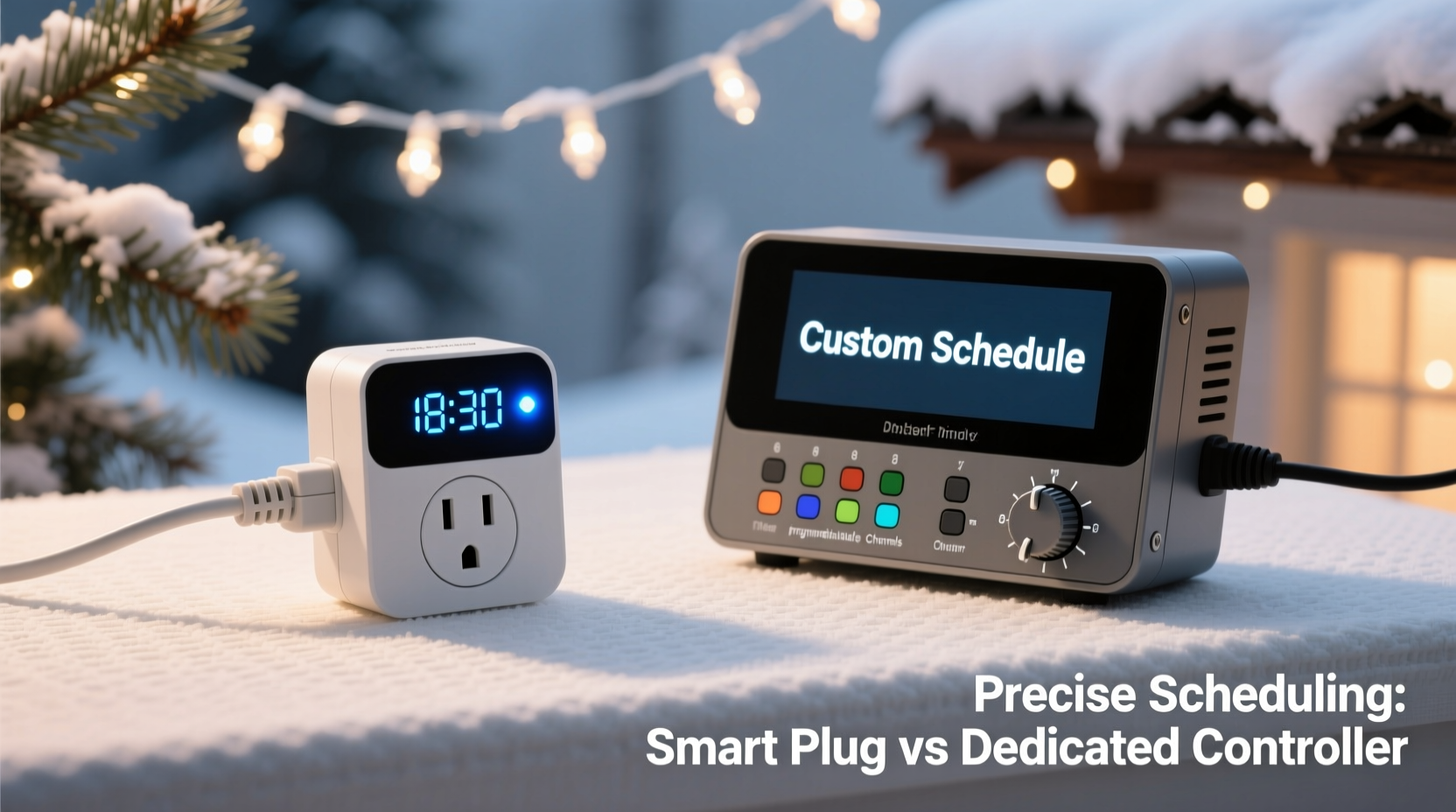
Scheduling precision refers to how accurately a device initiates or terminates an electrical load at a predetermined time. For holiday lighting, even a few seconds’ variance can disrupt visual harmony—especially in music-synced displays or community-wide light competitions. High precision ensures that:
- Lights turn on exactly at dusk or a set hour.
- Sequences across multiple circuits remain synchronized.
- Energy isn’t wasted by early activation or late shutoff.
While many assume all digital timers are equally accurate, underlying technologies—such as internal clocks, network dependencies, and firmware design—play a decisive role.
How Smart Plug Timers Work—and Where They Fall Short
Smart plug timers are general-purpose IoT devices designed to automate any standard electrical appliance via smartphone apps, voice assistants, or cloud-based routines. Most connect to home Wi-Fi and allow users to create schedules through mobile interfaces. Examples include TP-Link Kasa, Amazon Smart Plug, and Wemo Mini.
These plugs typically offer features like remote control, scene integration, and occasional geofencing. However, their strength in connectivity often masks weaknesses in timing fidelity.
Common Timing Issues with Smart Plugs
- Network Latency Delays: Commands sent from the cloud to the plug may experience delays due to router congestion, ISP throttling, or temporary outages. A scheduled event might trigger 5–30 seconds late.
- Clock Drift Without RTC: Many budget smart plugs lack a built-in real-time clock. If Wi-Fi drops, they lose time synchronization and may skip or misfire events until reconnected.
- Firmware Update Disruptions: Automatic updates can reset schedules or cause brief downtime during peak hours, potentially leaving lights off during evening viewing times.
- App-Based Reliability: Some brands require active app sessions or background processes on phones, introducing another point of failure.
A 2023 study by Home Automation Review tested 12 popular smart plugs under simulated power and network fluctuations. Over a two-week period, 7 of them exhibited at least one timing deviation exceeding 15 seconds, with three failing to activate entirely after a router reboot.
“Most consumer smart plugs weren’t engineered for millisecond-level coordination. They’re convenient—but not precision instruments.” — Dr. Alan Reeves, Embedded Systems Engineer, MIT Media Lab
Dedicated Christmas Light Controllers: Built for Accuracy
Unlike multipurpose smart plugs, dedicated Christmas light controllers—such as those from Light-O-Rama, DIYLighting, or Twinkly—are engineered specifically for seasonal lighting. These range from simple mechanical timers to advanced programmable units capable of handling dozens of channels.
High-end models use internal microcontrollers with quartz-based real-time clocks, ensuring timekeeping continues independently of internet access. More sophisticated versions support GPS time sync, astronomical timing (based on local sunrise/sunset), and sub-second execution accuracy.
Key Features Enhancing Scheduling Precision
- Independent Real-Time Clock (RTC): Maintains correct time even during extended outages.
- Astronomical Timer Mode: Automatically adjusts daily based on geographic location and date—ideal for dusk-to-dawn operation.
- Hardware-Level Scheduling: Events are processed locally, eliminating reliance on cloud servers.
- Sub-Second Trigger Resolution: Advanced controllers can schedule events within ±0.1 seconds, essential for choreographed displays.
For example, Light-O-Rama’s SE-16 controller uses GPS-calibrated time and supports up to 16 independent channels, each programmable down to the tenth of a second. This level of control allows homeowners to layer animations, fades, and chases with cinematic precision.
Comparative Analysis: Smart Plug vs Dedicated Controller
| Feature | Smart Plug Timer | Dedicated Christmas Controller |
|---|---|---|
| Scheduling Precision | ±5 to 30 seconds (network dependent) | ±0.1 to 1 second (hardware-controlled) |
| Time Source | Cloud-synchronized (Wi-Fi required) | Internal RTC + optional GPS/astronomical sync |
| Offline Operation | Limited; schedules may fail if disconnected | Full functionality during outages |
| Setup Complexity | Easy (mobile app guided) | Moderate to high (software configuration needed) |
| Best For | Simple on/off routines, casual decor | Choreographed shows, multi-zone setups |
| Price Range | $10–$25 per unit | $50–$300+ depending on channels/features |
The data clearly shows that while smart plugs win in ease of setup and cost, they fall short in environments demanding tight timing coordination. For basic porch lighting or indoor trees, the difference may be negligible. But for anything involving rhythm, animation, or community visibility, dedicated controllers provide superior reliability.
Real-World Example: A Neighborhood Display Case Study
In suburban Denver, homeowner Marcus Tran installed a 4,000-light holiday display across his roofline, driveway, and front yard. Initially, he used four smart plugs—one for each zone—scheduled via a single app to turn on at 5:00 PM daily.
During the first week, neighbors noticed lights flickering on staggeredly: Zone 1 activated promptly, but Zones 2 and 4 lagged by 12 and 18 seconds respectively. On December 5th, after a brief internet outage caused by snow damage, none of the lights turned on until Marcus manually reset each plug the next morning.
Frustrated, Marcus upgraded to a Light-O-Rama 8-channel controller with an astronomical clock module. After programming sunset-relative schedules and enabling automatic daylight adjustment, all zones activated simultaneously every evening—with zero drift over six weeks of continuous operation. “It was night and day,” he said. “Now my display starts sharp at dusk, even when I’m not home.”
Step-by-Step: Choosing the Right Solution for Your Needs
Follow this decision framework to determine whether a smart plug or dedicated controller better suits your precision requirements:
- Assess Display Complexity: Are you controlling a single string of lights or multiple independent zones?
- Evaluate Timing Needs: Do lights need to start exactly together, or is slight variance acceptable?
- Check Environmental Factors: Is the installation area prone to Wi-Fi dead zones or power fluctuations?
- Consider Long-Term Use: Will you reuse the system annually? Dedicated controllers often last longer and retain settings.
- Budget Accordingly: Weigh upfront cost against potential frustration from unreliable performance.
If your answer to questions 1–3 leans toward complexity, synchronization, and outdoor deployment, a dedicated controller is the wiser investment.
Action Checklist: Ensuring Precise Holiday Light Scheduling
- Confirm whether your chosen device has a built-in real-time clock.
- Test offline operation by disconnecting Wi-Fi and verifying scheduled events still fire.
- Use GPS coordinates or ZIP code input for astronomical timing accuracy.
- Label each circuit or zone clearly for consistent programming.
- Back up your schedule configuration externally (e.g., screenshot or export file).
Frequently Asked Questions
Can I improve a smart plug’s timing accuracy?
Partially. Using a stable 2.4 GHz Wi-Fi network, minimizing router hops, and disabling automatic updates during the season can reduce variability. However, you cannot eliminate cloud dependency or add hardware-level timing without modifying the device—something not supported by manufacturers.
Do dedicated controllers require technical skills to set up?
Basic models with preset modes (e.g., fade, twinkle, steady) are user-friendly. Advanced programmable units may require downloading software and learning timeline editing, but most come with templates and community forums for support. Many users report mastering core functions within a few evenings.
Are there hybrid solutions that combine app control with precise timing?
Yes. Devices like Twinkly Pro and certain Light-O-Rama Ethernet models offer both Wi-Fi/app access and standalone hardware timing. You get remote management without sacrificing precision. Events run from internal memory, so even if the app disconnects, the show continues uninterrupted.
Conclusion: Prioritize Purpose-Built Tools for Precision Tasks
When it comes to scheduling precision, the tool matters as much as the intention. Smart plug timers serve well for everyday appliances and low-stakes lighting tasks. But for holiday displays where timing integrity defines the viewer experience, dedicated Christmas light controllers are unmatched.
Their engineering focus—on stability, independence, and microsecond coordination—makes them the preferred choice among serious decorators and municipal display teams alike. While they demand a higher initial effort and investment, the payoff is reliability, repeatability, and professional-grade results.




 浙公网安备
33010002000092号
浙公网安备
33010002000092号 浙B2-20120091-4
Comments
No comments yet. Why don't you start the discussion?