
Choosing how to control your Christmas lights remotely isn’t just about convenience—it’s about safety, light quality, long-term reliability, and whether your setup will survive December’s cold, rain, and the inevitable holiday chaos. Many homeowners assume “smart plug = done,” only to discover flickering LEDs, unresponsive scheduling, or tripped breakers when they string 300 feet of lights across gutters and trees. Others invest in a hardwired dimmer expecting theater-grade ambiance—only to find it incompatible with their LED mini-lights or unable to handle multiple circuits. The right choice depends less on marketing buzzwords and more on your specific lights, wiring infrastructure, aesthetic goals, and tolerance for DIY complexity.
How Each System Actually Works (and Where They Break Down)
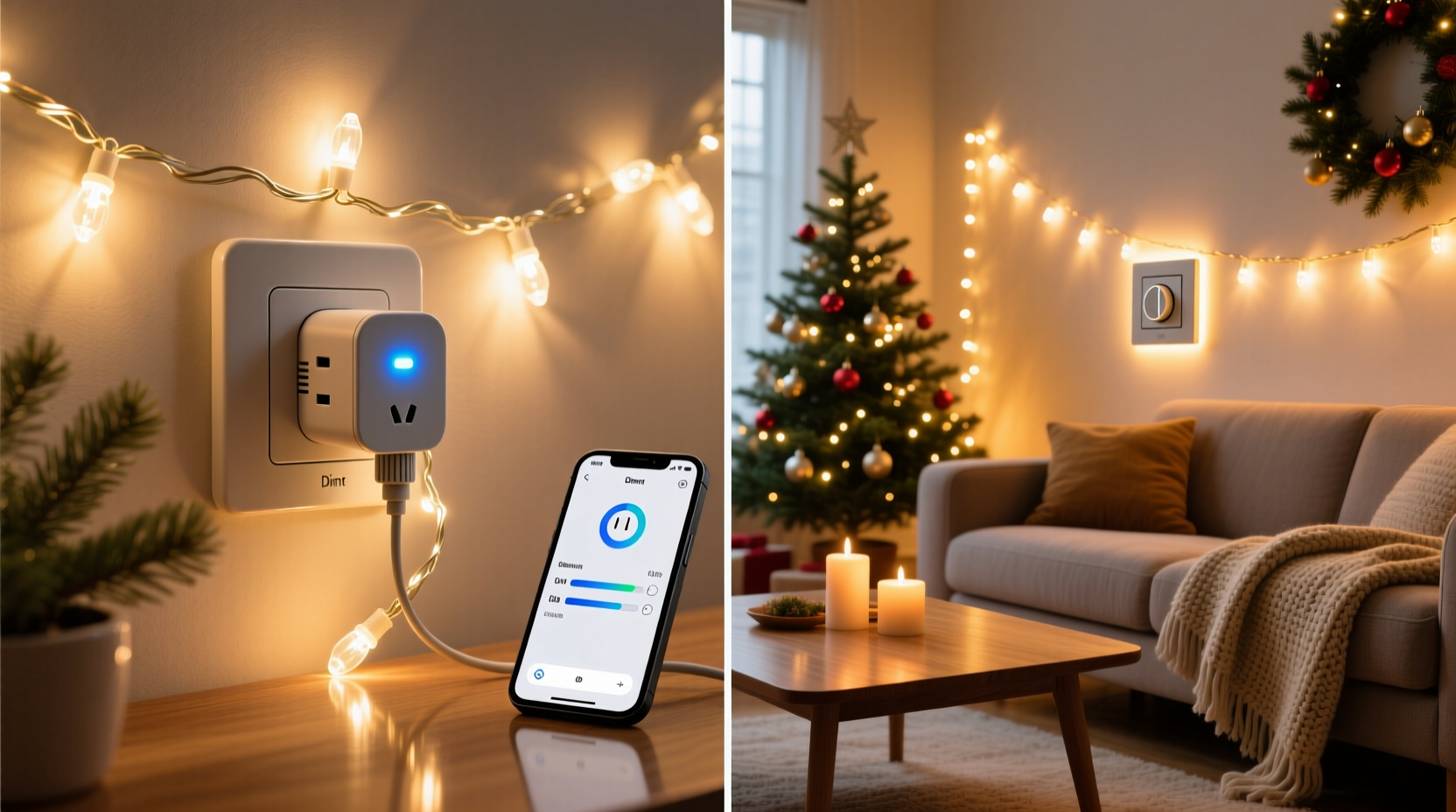
A smart plug is an outlet-level controller: you plug your light strand (or power strip feeding multiple strands) into the device, then control it via app, voice, or automation. It switches power on/off—and, in higher-end models—offers basic dimming by rapidly cycling power (pulse-width modulation). A built-in dimmer replaces your wall switch and connects directly to your home’s electrical circuit. It modulates voltage or current to smoothly reduce light output, typically using leading-edge (for incandescent/halogen) or trailing-edge (for most modern LEDs) technology.
The critical distinction lies in how they dim. Smart plugs that claim “dimming” almost always use on/off pulsing—not true analog dimming. This works acceptably for simple warm-white strings but often causes visible strobing, audible buzzing, or inconsistent brightness with sensitive LED drivers. Built-in dimmers deliver continuous voltage reduction, enabling smooth, silent, flicker-free dimming—but only if matched precisely to your light type and load profile.
One overlooked reality: many “dimmable” LED Christmas lights aren’t truly compatible with standard residential dimmers. Their internal drivers expect stable 120V input. When fed a chopped waveform from a mismatched dimmer, they may flicker, drop out entirely, emit high-pitched whine, or fail prematurely. Always verify compatibility with both the dimmer manufacturer’s LED load chart and your light strand’s technical specs—not just the box label.
Real-World Performance Comparison: What the Spec Sheets Don’t Tell You
| Feature | Smart Plug (Dimming-Capable) | Built-In Dimmer |
|---|---|---|
| Installation Effort | Zero tools needed. Plug-and-play in under 60 seconds. No electrical knowledge required. | Requires turning off circuit breaker, removing old switch, wiring line/load/neutral/ground correctly. Minimum 30–90 minutes for confident DIYers; licensed electrician recommended for most homeowners. |
| True Dimming Quality | Limited range (often 10–90% brightness). Noticeable step changes. Flicker common below 30%. No fade-in/fade-out transitions. | Smoother 0–100% range. Silent operation with compatible LEDs. Supports programmable fade curves (e.g., 5-second ramp up at dusk). |
| Circuit Capacity | Typical max load: 1,800W (15A). One plug powers one circuit—or multiple low-wattage strands via heavy-duty power strip. | Rated per device (e.g., 600W for LED-only, 1,000W for mixed loads). Can control entire outdoor lighting circuit—including multiple outlets, porch lights, and landscape lighting simultaneously. |
| Weather & Safety | Most are indoor-rated only. Outdoor use requires UL-listed weatherproof enclosure (adds bulk/cost) and GFCI protection. Not rated for direct exposure to snow or hose-down conditions. | Hardwired units designed for damp locations (UL 943 Class A). Mounts safely inside weatherproof outdoor boxes. Integrated GFCI options available for added protection. |
| Smart Ecosystem Integration | Native support for Alexa, Google, HomeKit, Matter. Enables complex automations (e.g., “When front door opens after sunset, dim lights to 40% for 2 minutes”). | Varies widely. High-end models (Lutron Caséta, Leviton Decora) offer full smart integration. Budget dimmers often require separate hub or lack automation entirely. |
Case Study: The Anderson Family’s Two-Story Victorian
The Andersons installed 800 feet of premium warm-white LED mini-lights across eaves, columns, and a 20-foot spruce. Initially, they used four $25 smart plugs—one per outlet—plugged into GFCI-protected exterior receptacles. For the first two years, it worked. Then came December 2023: temperatures dropped to 12°F overnight. Three plugs failed to respond to voice commands. One emitted a faint burning odor. Investigation revealed moisture ingress into non-weatherproof enclosures and thermal stress on cheap relay components. They replaced all plugs with industrial-grade, UL-listed outdoor smart switches—but still faced inconsistent dimming across strands.
In spring 2024, they hired an electrician to install a Lutron Caséta PD-6WCL dimmer on their dedicated 20-amp outdoor circuit, rewiring lights to feed through a single, properly sized junction box. Result? Zero failures. Smooth, silent dimming from 5% to 100%. Lights now warm up gradually at sunset and fade gently to off at midnight—no more abrupt blackouts startling guests. Total cost: $320 (dimmer + labor). Payback? Three fewer plug replacements and dramatically improved guest experience.
Step-by-Step: Choosing & Installing the Right Solution
- Inventory your lights: Note total wattage (add all labels), bulb type (incandescent? C7/C9? LED filament? Addressable RGB?), and whether they’re labeled “dimmable.” If unsure, test one strand with a known-compatible dimmer before committing.
- Map your circuit: Identify which outdoor outlets share a breaker. Use a circuit breaker finder or turn off breakers one-by-one while testing outlets. Most homes have 1–2 dedicated outdoor circuits (15A or 20A).
- Evaluate your dimming needs: Do you want subtle ambient glow (requires true 5–20% dimming)? Dynamic scenes (requires smart scheduling)? Or just on/off with occasional brightness tweaks? True dimming demands hardware compatibility—not just app sliders.
- Assess your DIY confidence: If you’ve never removed a wall plate or used a voltage tester, skip the dimmer. Smart plugs are safer, reversible, and effective for basic needs. If you’re comfortable with wire nuts and torque specs, a dimmer delivers superior performance.
- Select and verify: For smart plugs, choose UL-listed, outdoor-rated models (e.g., TP-Link Kasa KP400, Wemo Mini Outdoor). For dimmers, match type to load: trailing-edge (ELV) for most LED strings; universal dimmers (like Lutron Diva DVCL-153P) for mixed or uncertain loads. Cross-check minimum load requirements—many LEDs draw <10W, below the 25W minimum of older dimmers.
Expert Insight: What Electrical Contractors See Year After Year
“Ninety percent of ‘dimmer doesn’t work with my lights’ calls stem from one issue: the homeowner bought the cheapest dimmer online without checking the LED compatibility chart. Modern LED drivers need precise waveform control—not brute-force voltage reduction. And smart plugs outdoors? We see melted casings every January from people skipping weatherproof enclosures. If you want reliability, treat outdoor lighting like outdoor plumbing: seal it, ground it, and over-spec the components.” — Marcus Chen, Master Electrician & NEC Code Trainer, 22 years field experience
Key Considerations You’ll Face in Practice
Voltage Drop Over Long Runs: Smart plugs don’t solve this. If your outlet is 100 feet from your tree, voltage at the far end drops—causing dimmer ends and color shift in RGB strings. A built-in dimmer placed closer to the load (e.g., in a junction box near the tree) mitigates this significantly.
Neutral Wire Requirement: Most smart dimmers require a neutral wire in the switch box for consistent power. Homes built before 1985 often lack neutrals in switch boxes—requiring either running new cable (costly) or choosing a neutral-free dimmer (fewer options, lower reliability).
LED Driver Sensitivity: Cheap LED strings use basic capacitive dropper drivers highly susceptible to dimmer noise. Premium strands (e.g., BriteStar, Twinkly Pro) include active constant-current drivers that tolerate wider dimming ranges and reject electrical noise.
Future-Proofing: Smart plugs integrate easily with Matter 1.3 and Thread networks. Hardwired dimmers lag here—though Lutron and Leviton now offer Matter-certified models. If you’re building a whole-home smart system, prioritize Matter compatibility regardless of path.
FAQ
Can I use a smart plug to control a built-in dimmer?
No—and it’s unsafe. Plugging a dimmer into a smart plug creates a hazardous double-switching scenario. The dimmer expects constant line voltage. Interrupting its power causes erratic behavior, relay damage, and potential fire risk. Control dimmers directly via their app or smart hub—not through another switching device.
Why do my LED lights buzz when dimmed with a built-in dimmer?
Buzzing indicates waveform incompatibility. Leading-edge dimmers (designed for incandescent) chop the front of the AC wave, creating electrical noise that vibrates LED driver components. Switch to a trailing-edge (ELV) dimmer, ensure minimum load is met, and verify your lights are certified dimmable—not just “compatible.”
Do I need a GFCI outlet if I use a smart plug outdoors?
Yes—absolutely. The National Electrical Code (NEC) requires all outdoor 125-volt, 15- and 20-amp receptacles to be GFCI-protected. A smart plug does not replace this requirement. Either plug into an existing GFCI outlet, use a GFCI-protected power strip, or install a GFCI breaker. Skipping GFCI protection risks electrocution in wet conditions.
Conclusion: Prioritize Function Over Features
Remote control of Christmas lights shouldn’t mean choosing between fragility and frustration. A smart plug delivers simplicity, speed, and broad compatibility—if your goal is reliable on/off control and basic brightness adjustment for modest setups. A built-in dimmer delivers precision, durability, and professional-grade light quality—if you value smooth dimming, whole-circuit control, and long-term peace of mind. Neither is universally “better.” The right solution emerges from honestly assessing your lights’ technical needs, your home’s electrical reality, and your willingness to invest time or money upfront. Don’t let holiday pressure rush this decision. Test one strand with your chosen method before decorating the whole house. Measure voltage at the farthest light. Verify GFCI protection. Read the fine print on dimmable claims. Because the most beautiful display isn’t the brightest—it’s the one that works flawlessly, night after night, until New Year’s Day.




 浙公网安备
33010002000092号
浙公网安备
33010002000092号 浙B2-20120091-4
Comments
No comments yet. Why don't you start the discussion?