
As the holiday season approaches, more homeowners are turning to smart technology to create dazzling, automated light displays with minimal effort. Two of the most popular options—smart plugs and built-in smart lights—offer distinct advantages and trade-offs when it comes to controlling festive decorations. While both can bring convenience and flair to your holiday routine, choosing between them depends on your priorities: budget, scalability, control precision, or long-term use.
This guide dives deep into the real-world performance of each option, helping you decide which solution delivers superior holiday automation based on installation, functionality, customization, and overall value.
Understanding the Core Differences
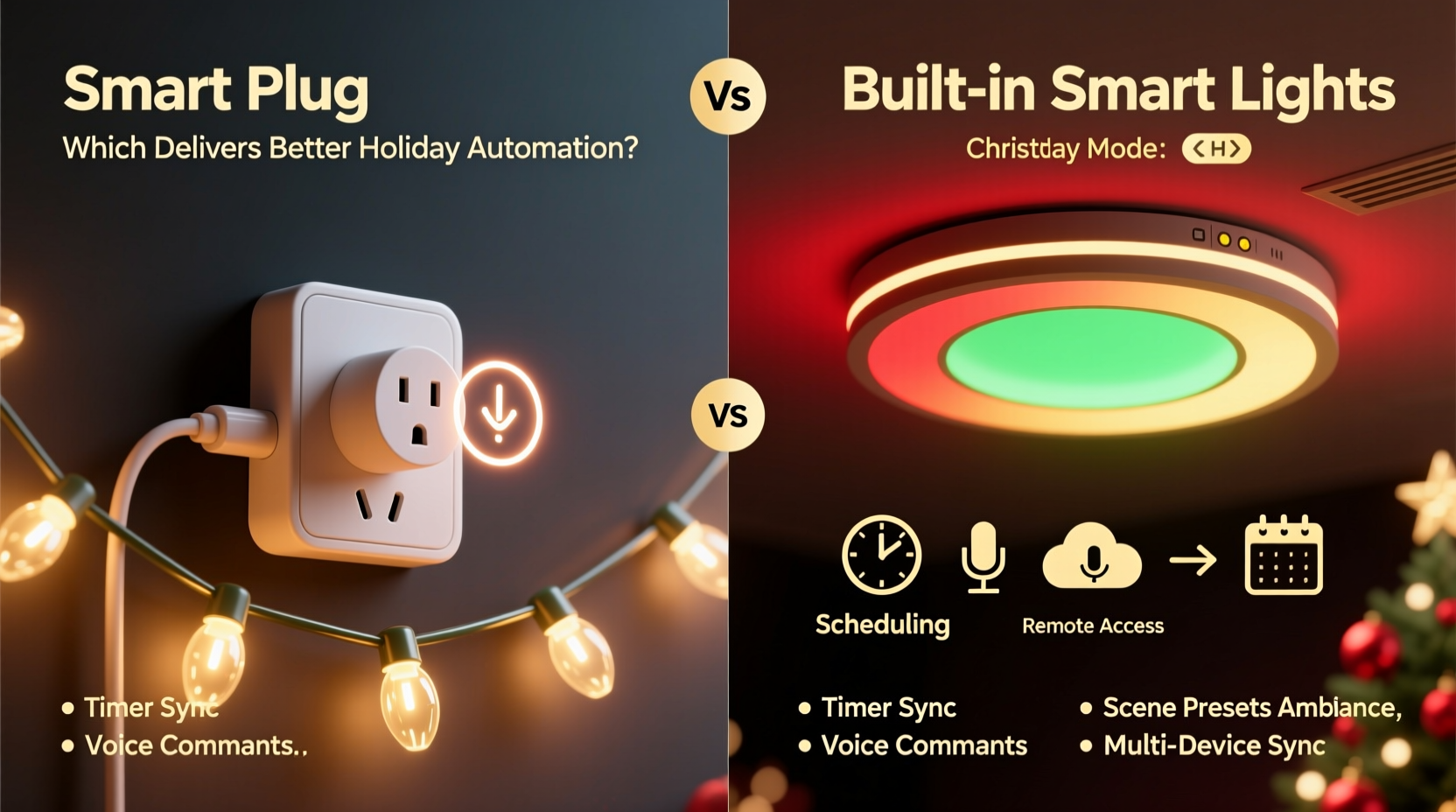
A smart plug is a physical device that connects to a standard wall outlet and allows you to control any lamp or string of traditional holiday lights via an app or voice assistant. It essentially turns “dumb” lights into smart ones by managing power delivery. In contrast, built-in smart lights come with embedded Wi-Fi or Bluetooth chips, enabling direct connectivity to your home network. These include LED strings, bulbs, or integrated fixtures designed from the ground up for intelligent control.
The fundamental distinction lies in integration. Smart plugs offer external control over existing hardware, while built-in smart lights provide native intelligence within the lighting system itself. This difference affects everything from setup complexity to feature availability during the holidays.
Setup and Installation: Speed vs Long-Term Simplicity
For many users, ease of setup is a deciding factor—especially when preparing for time-sensitive holiday events. Smart plugs typically win in this category due to their plug-and-play nature. Most models require only three steps: plug the device into an outlet, connect your lights to the plug, and pair it with your smartphone using a companion app. Within minutes, you can schedule on/off times or activate lights remotely.
Built-in smart lights, however, often involve more initial configuration. Each set must be connected directly to your home’s Wi-Fi network, which can take longer depending on signal strength and the number of devices. Some brands require individual pairing, meaning ten separate light strings could mean ten separate setup sessions. However, once configured, these lights rarely need re-pairing year after year.
Additionally, outdoor placement introduces another layer of complexity. Smart plugs used outdoors must be protected with weatherproof enclosures, adding bulk and requiring GFCI outlets for safety. Built-in smart lights designed for exterior use usually come with higher IP ratings (like IP65), making them inherently more durable in wet or cold conditions.
“Smart plugs are excellent for quick wins, but if you're serious about annual holiday automation, investing in permanent smart lighting infrastructure pays off in reliability.” — Jordan Lee, Home Automation Consultant at BrightPath Systems
Feature Comparison: Control, Customization, and Effects
When it comes to creative expression during the holidays, not all smart solutions are created equal. Built-in smart lights dramatically outperform smart plugs in terms of dynamic effects and granular control. Because they contain programmable LEDs, many smart light systems allow users to change colors, adjust brightness per bulb, create flowing animations (like twinkling snow or falling stars), and synchronize patterns to music—all through an app.
Smart plugs, by comparison, can only toggle power on and off. You cannot dim standard incandescent strings plugged into a basic smart plug, nor can you shift colors unless the original lights have manual color-switching buttons. Even advanced features like sunrise/sunset scheduling or geofencing work similarly across both platforms, but the lack of intermediate states limits what smart plugs can achieve.
Consider a scenario where you want red and green lights to alternate slowly along a rooftop edge. With built-in smart lights, this is achievable with a few taps in the app. With a smart plug, you’d need multiple circuits and additional controllers just to approximate the effect—adding cost and complexity.
Key Features Breakdown
| Feature | Smart Plug | Built-In Smart Lights |
|---|---|---|
| On/Off Control | Yes | Yes |
| Dimming | Limited (requires compatible lights) | Yes (per bulb or zone) |
| Color Changing | No | Yes (millions of colors) |
| Animation Effects | No | Yes (pulse, fade, chase, etc.) |
| Music Sync | No | Yes (with some brands) |
| Scheduling & Automation | Yes | Yes (often more advanced) |
| Multi-Zone Grouping | Only by circuit | Yes (fine-grained grouping) |
If your goal is simple illumination—turning porch lights on at dusk and off at midnight—a smart plug suffices. But for immersive, animated holiday scenes, built-in smart lights are unmatched.
Total Cost and Long-Term Value Analysis
Upfront cost is where smart plugs shine. A reliable Wi-Fi smart plug averages $15–$25, whereas a single strand of high-quality smart LED lights can range from $30 to $80 depending on length and features. For someone decorating with five light strings, that’s a potential savings of $100 or more by sticking with conventional lights and using smart plugs.
However, long-term ownership shifts the equation. Traditional incandescent holiday lights consume significantly more energy than modern smart LEDs. Over a typical six-week holiday season, running ten strands of old-style mini-lights might cost $15–$20 in electricity alone. Smart LED equivalents, especially those with efficient drivers and low-wattage designs, often use 70–80% less power, reducing operational costs and heat output.
Moreover, durability favors built-in smart lights. Many are engineered for repeated seasonal use, featuring UV-resistant coatings, reinforced connectors, and tangle-free wiring. Incandescent strings degrade faster, with bulbs burning out annually and wires becoming brittle. Replacing failed sections adds hidden costs over time.
Real-World Example: The Thompson Family Holiday Display
The Thompsons live in a suburban neighborhood known for competitive holiday decorating. For years, they relied on dozens of incandescent strings controlled by timers and basic smart plugs. Their display turned on at 5 PM and off at 11 PM—consistent but static.
Last year, they invested in a hybrid approach: retaining smart plugs for large outline lights (roofline and trees) while upgrading key focal points—such as their front yard nativity scene and driveway arch—to addressable smart LEDs. Using a single app, they programmed synchronized color waves, gentle flickers mimicking candlelight, and even scheduled daily theme changes (e.g., “Winter Wonderland” on Mondays, “Retro Red & Green” on Fridays).
The result? A 40% reduction in total energy use compared to the previous year, increased neighborhood engagement (including social media shares), and far greater enjoyment from their own family. They now reuse the same smart strands every year with minimal troubleshooting. According to Mr. Thompson, “The initial cost felt steep, but we’ve already saved on replacements and electric bills. Plus, the kids love designing new shows.”
Step-by-Step Guide to Choosing Your Holiday Automation Strategy
- Evaluate your current inventory: Take stock of existing holiday lights. Are they functional, energy-efficient, and in good condition?
- Determine your desired effects: Do you want simple on/off control or dynamic color and motion effects?
- Assess outdoor access and outlets: Identify available GFCI outlets and proximity to router signal. Poor Wi-Fi may limit smart light performance.
- Calculate short- and long-term costs: Compare price per foot of smart LEDs versus cost of smart plugs plus legacy light maintenance.
- Plan for scalability: Consider whether you’ll expand your display next year. Built-in smart lights integrate better into larger ecosystems like Google Home, Apple HomeKit, or Alexa Routines.
- Test one setup before committing: Start with one smart plug or one strand of smart lights to evaluate usability, app stability, and aesthetic impact.
- Implement automation schedules: Set sunrise/sunset triggers, vacation modes, or special event scenes (e.g., Christmas Eve all-night glow).
Checklist: Smart Holiday Lighting Readiness
- ☐ All outdoor outlets are GFCI-protected and accessible
- ☐ Wi-Fi extends reliably to decoration zones
- ☐ Smart devices are on the same network and updated
- ☐ Backup power strips or surge protectors are in place
- ☐ Schedules tested at least one week before debut
- ☐ Physical mounting hardware secured (clips, stakes, extension cords rated for outdoor use)
- ☐ Voice assistant routines configured (e.g., “Alexa, turn on holiday magic”)
Frequently Asked Questions
Can I use a smart plug with LED holiday lights?
Yes, absolutely. Smart plugs work seamlessly with LED strings, which draw less power and generate less heat—making them safer for prolonged use. Just ensure the total wattage of connected lights stays below the plug’s maximum load rating (usually 1800W).
Do built-in smart lights work during power outages?
No—if the power goes out, both smart plugs and built-in smart lights will stop functioning unless backed by a UPS (uninterruptible power supply). However, most smart systems retain their settings and automatically resume schedules once power returns.
Are there security concerns with smart holiday lights?
Potentially. Any internet-connected device poses a minor risk. Use strong Wi-Fi passwords, avoid public sharing of device names (e.g., don’t name your plug “Front Yard Santa Cam”), and keep firmware updated. Choose reputable brands with regular security patches.
Final Recommendation: Match the Tool to the Goal
There is no universal winner between smart plugs and built-in smart lights—it depends on your goals. For casual decorators who want reliable, low-cost automation of existing lights, smart plugs deliver excellent value with minimal learning curve. They’re ideal for turning on porch lanterns or illuminating window silhouettes without fuss.
For enthusiasts seeking vibrant, customizable, and repeatable holiday experiences, built-in smart lights are the superior choice. Their ability to produce complex lighting effects, integrate with home ecosystems, and reduce long-term energy and maintenance costs makes them a worthwhile investment.
The smartest strategy may lie in combining both. Use smart plugs for non-dimmable accent lights and heavy-duty outdoor outlines, while reserving built-in smart LEDs for areas where visual impact matters most—entryways, trees, and centerpiece displays. This hybrid model balances budget, performance, and creativity.




 浙公网安备
33010002000092号
浙公网安备
33010002000092号 浙B2-20120091-4
Comments
No comments yet. Why don't you start the discussion?