
Home automation is no longer a luxury reserved for tech enthusiasts—it’s becoming a standard part of modern living. As people look to streamline daily routines, reduce energy consumption, and enhance convenience, two devices often rise to the top: smart plugs and smart speakers. While both integrate with voice assistants and smart home ecosystems, they serve fundamentally different purposes. The real question isn’t whether one is better overall, but which offers more meaningful control over your environment.
Understanding the distinction between these tools is essential. A smart plug enables physical devices to become “smart,” while a smart speaker acts as a command center. When evaluating which provides greater control, the answer depends on how you define control—direct device manipulation or centralized voice interaction. Let’s break down their capabilities, limitations, and ideal use cases.
Understanding Smart Plugs: Turning Dumb Devices Smart
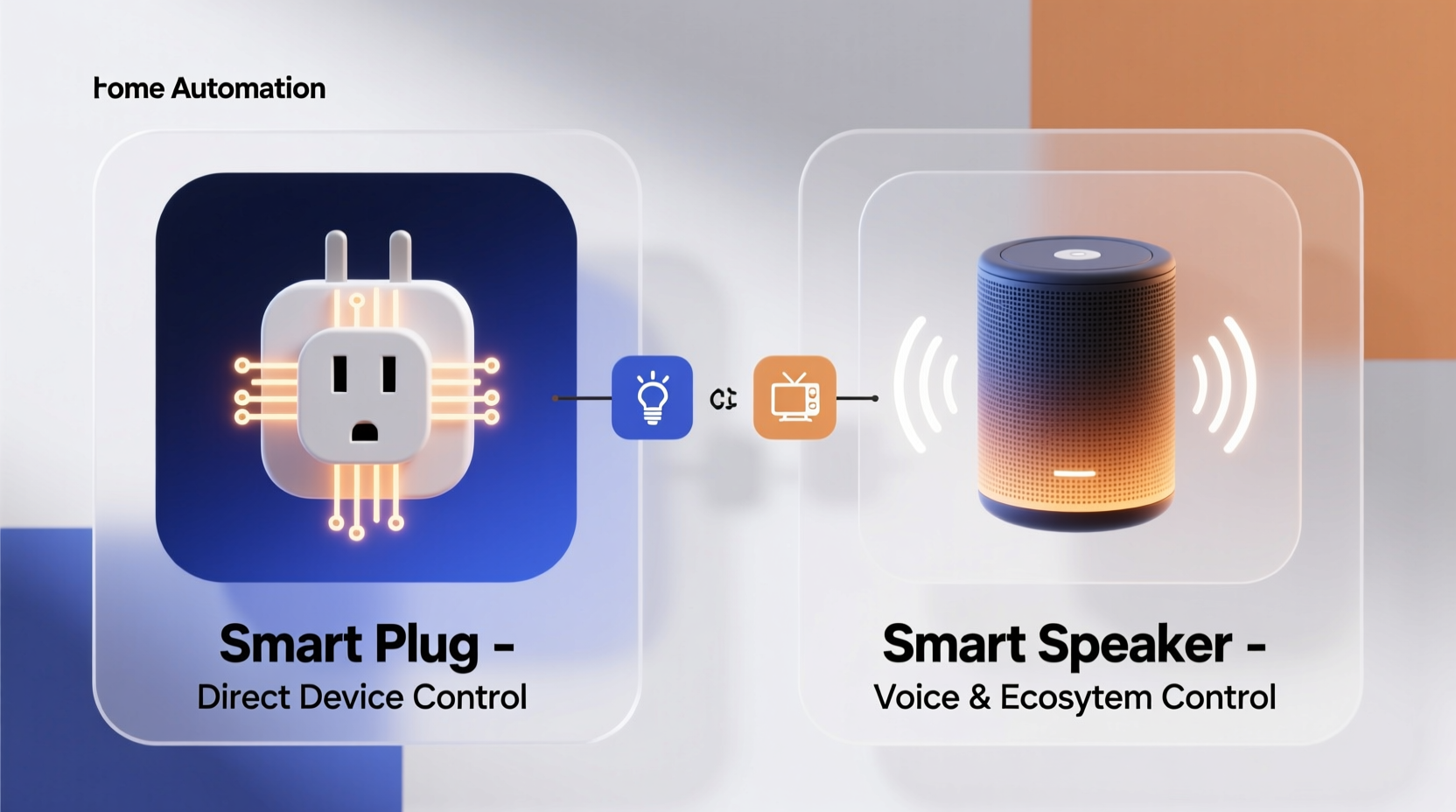
A smart plug is a simple device that fits into a standard wall outlet. Once connected, any appliance plugged into it—such as a lamp, fan, coffee maker, or space heater—gains remote and automated functionality. Through a companion app or voice assistant, users can turn the device on or off from anywhere, schedule operations, and monitor energy usage in some models.
What makes smart plugs powerful is their ability to retrofit existing appliances without requiring replacements. This democratizes access to smart home technology, especially for those who don’t want to invest in full smart versions of every household item.
Control via smart plugs is direct and granular. You're not just issuing commands—you're modifying the state of a physical device. For example, turning off a forgotten iron becomes a one-tap action in an app, regardless of your location. Some advanced models even offer power monitoring, letting you see how much electricity a device consumes over time—a feature particularly useful for identifying energy hogs.
The Role of Smart Speakers: Your Voice-Controlled Hub
Smart speakers like Amazon Echo (Alexa), Google Nest Audio, and Apple HomePod Mini do far more than play music. They act as central hubs for voice-controlled automation, allowing users to issue spoken commands to control lights, thermostats, cameras, and other smart devices. Their strength lies in accessibility and integration—they bring hands-free convenience to everyday tasks.
For instance, saying “Alexa, turn off the living room lights” feels faster and more natural than unlocking your phone and tapping through an app. Over time, this seamless interaction encourages deeper engagement with smart home systems. Many smart speakers also support routines—automated sequences triggered by voice, time, or sensor data.
“Voice interfaces lower the barrier to entry for smart homes, making automation accessible to non-tech-savvy users.” — Dr. Linda Park, Human-Computer Interaction Researcher at MIT Media Lab
However, smart speakers don’t directly control most devices. Instead, they rely on other smart hardware—like smart bulbs, switches, or yes, smart plugs—to execute commands. This means their control is indirect and dependent on what’s already connected and compatible within your ecosystem.
Comparing Control: Direct vs. Indirect Influence
To determine which device gives more control, we must distinguish between types of control:
- Direct control: Physically altering a device’s state (on/off, scheduling).
- Indirect control: Issuing instructions through an intermediary (voice command relayed to another device).
- Systemic control: Orchestrating multiple devices through automation.
Smart plugs provide direct control over individual appliances. If you have three smart plugs managing lamps, fans, and a humidifier, each can be managed independently with precision. You can set timers, create schedules, or toggle them remotely—all without needing another device to mediate.
Smart speakers, on the other hand, excel at systemic control. They allow you to coordinate actions across multiple devices using voice. For example: “Hey Google, good morning” could trigger lights to turn on, blinds to open, and a coffee maker (plugged into a smart plug) to start—all with one phrase. Here, the speaker doesn’t control anything directly but orchestrates the system.
Key Differences in Control Capabilities
| Feature | Smart Plug | Smart Speaker |
|---|---|---|
| Direct Device Control | Yes – powers on/off connected devices | No – relies on other smart devices |
| Voice Command Interface | Limited – requires integration | Yes – primary function |
| Remote Access via App | Yes – full control | Limited – mostly status and voice |
| Energy Monitoring | Available in mid-to-high-end models | No |
| Automation & Scheduling | Yes – per device | Yes – system-wide routines |
| Hands-Free Operation | No | Yes – core advantage |
| Works Without Internet | Limited – local control possible with some brands | No – cloud-dependent |
This comparison shows that smart plugs offer more precise, device-level control, while smart speakers enable broader, user-friendly orchestration. Neither replaces the other; they complement each other.
Real-World Example: Automating a Morning Routine
Consider Sarah, a working professional who wants a smoother morning. She uses both a smart plug and a smart speaker to automate her routine:
- Her bedside lamp is plugged into a smart plug programmed to turn on at 6:45 AM.
- Her coffee maker is also on a smart plug, scheduled to start brewing at 7:00 AM.
- She has a Google Nest speaker on her nightstand.
- When she says, “Hey Google, start my day,” the speaker triggers a routine that turns on the overhead light (a smart bulb), reads the weather, and starts the news briefing.
- Later, she checks the smart plug app and sees the coffee maker used 0.8 kWh that morning—useful for tracking energy costs.
In this scenario, the smart plug provides tangible, measurable control over appliances. The smart speaker enhances convenience through voice. But if Sarah wanted to disable the coffee maker remotely while at work, only the smart plug would allow that—not the speaker alone.
Choosing Based on Your Needs: A Practical Checklist
Deciding between a smart plug and a smart speaker isn’t about picking a winner—it’s about matching tools to your goals. Use this checklist to guide your decision:
- ✅ Do you have non-smart appliances you’d like to automate? → Start with smart plugs.
- ✅ Do you want hands-free control for lighting, music, or information? → Choose a smart speaker.
- ✅ Are you concerned about energy usage? → Prioritize smart plugs with power monitoring.
- ✅ Do you live with others who aren’t tech-inclined? → A smart speaker improves accessibility.
- ✅ Do you travel frequently and want remote access? → Smart plugs offer better remote management.
- ✅ Are you building a whole-home automation system? → Use both together.
If you’re just starting out, consider beginning with a single smart plug to test automation with a lamp or fan. It’s low-cost, easy to install, and delivers immediate value. Once you’ve experienced device-level control, adding a smart speaker can elevate the experience with voice commands and routines.
Integration and Compatibility: The Hidden Factor
Control is only as strong as the ecosystem supporting it. Both smart plugs and smart speakers must work within platforms like Amazon Alexa, Google Assistant, or Apple HomeKit. Not all devices are universally compatible.
For example, a smart plug labeled “Works with Alexa” may not support Apple Home unless explicitly stated. Similarly, some smart speakers cannot control third-party devices without additional setup or subscriptions. Always verify compatibility before purchasing.
Newer standards like Matter aim to solve this fragmentation. Devices certified under Matter can communicate across ecosystems, meaning a smart plug bought for Alexa will also work seamlessly with a HomePod. As Matter adoption grows, interoperability will improve, giving users more control regardless of brand.
Frequently Asked Questions
Can a smart speaker turn on any appliance?
No. A smart speaker can only control appliances that are already connected to a controllable device—like a smart plug, smart switch, or smart outlet. The speaker sends the command, but the smart plug executes it.
Do smart plugs need a smart speaker to work?
No. Smart plugs function perfectly through mobile apps and Wi-Fi. A smart speaker is optional and adds voice control, but it’s not required for basic operation.
Which is safer: a smart plug or smart speaker?
Both are generally safe when purchased from reputable brands. However, smart plugs handle electrical loads, so ensure they’re rated for the appliance’s wattage. Overloading can pose fire risks. Smart speakers pose minimal physical risk but raise privacy concerns due to always-on microphones.
Final Verdict: Where True Control Lies
When comparing smart plugs and smart speakers in terms of control, the smart plug wins in directness and precision. It grants you authority over individual devices, enables remote management, supports energy tracking, and works independently. It’s the tool that actually changes the physical world.
The smart speaker, while impressive in its reach and ease of use, functions more as a messenger than a controller. It enhances usability and encourages broader adoption of automation but depends entirely on other smart devices to take action.
Ultimately, the most empowered smart homes use both. The smart plug provides the muscle—the ability to switch, schedule, and monitor. The smart speaker provides the voice—the intuitive, accessible interface. Together, they create a balanced system where control is both powerful and effortless.




 浙公网安备
33010002000092号
浙公网安备
33010002000092号 浙B2-20120091-4
Comments
No comments yet. Why don't you start the discussion?